
Rust Glancer: Rust LSP using 100x less RAM
Rust Glancer is an alternative Rust language server built over four months to reduce memory use and preserve workspace indexes across editor restarts. It targets less than 100 MB of RAM for reasonable projects by storing analysis results on the filesystem and loading data only when a query needs it. Its VS Code extension is available now, although the server remains incomplete and has known bugs. Rust Glancer performs full workspace indexing with type inference and the Chalk trait solver, and supports common Rust syntax and LSP functions including go-to-definition, hover information, inlay hints, and completions. On a MacBook Pro M4 Max with 36 GB RAM, its reported base and full indexing times were five and eight seconds, versus six and 13 seconds for rust-analyzer. On a 2020 M1 MacBook Pro with 8 GB RAM, the reported times were six and nine seconds, versus seven and 14 seconds for rust-analyzer. Unlike rust-analyzer’s incremental in-memory model, Rust Glancer invalidates frozen analysis on save. It uses shallow analysis while typing and reuses the previous complete index, so new imports, structs, and traits are not fully indexed until a document is saved. The developer expects rust-analyzer to remain preferable for feature completeness and per-keystroke accuracy, while Rust Glancer targets lower-memory machines and workflows with many external code changes.
rust-glancer.github.io
6 min
8/21/2026

Zero-Mem: Zero-Token Memory Operations for LLM Agents
Zero-Mem introduces zero-token memory operations for large language model (LLM) agents, allowing them to maintain consistency in long interactions without incurring additional token and time costs from multiple LLM calls. This method aims to improve memory management by reducing the complexity and potential loss of detail in memory retrieval processes.
arxiv.org
2 min
8/5/2026
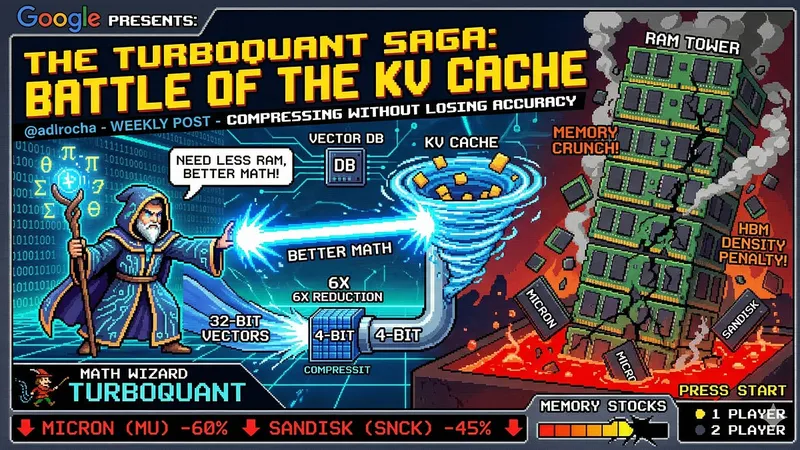
What if AI doesn't need more RAM but better math?
TurboQuant compresses the KV cache in AI applications, improving efficiency without sacrificing accuracy. This innovation addresses the challenges of HBM density penalties and DRAM price pressures in the AI memory landscape.
adlrocha.substack.com
10 min
3/29/2026

David Patterson: Challenges and Research Directions for LLM Inference Hardware
Large Language Model (LLM) inference faces significant challenges primarily related to memory and interconnect issues rather than compute power. The autoregressive Decode phase of Transformer models distinguishes LLM inference from training, complicating the process.
arxiv.org
2 min
1/25/2026
Rust Glancer: Rust LSP using 100x less RAM
Rust Glancer is an alternative Rust language server built over four months to reduce memory use and preserve workspace indexes across editor restarts. It targets less than 100 MB of RAM for reasonable projects by storing analysis results on the filesystem and loading data only when a query needs it. Its VS Code extension is available now, although the server remains incomplete and has known bugs. Rust Glancer performs full workspace indexing with type inference and the Chalk trait solver, and supports common Rust syntax and LSP functions including go-to-definition, hover information, inlay hints, and completions. On a MacBook Pro M4 Max with 36 GB RAM, its reported base and full indexing times were five and eight seconds, versus six and 13 seconds for rust-analyzer. On a 2020 M1 MacBook Pro with 8 GB RAM, the reported times were six and nine seconds, versus seven and 14 seconds for rust-analyzer. Unlike rust-analyzer’s incremental in-memory model, Rust Glancer invalidates frozen analysis on save. It uses shallow analysis while typing and reuses the previous complete index, so new imports, structs, and traits are not fully indexed until a document is saved. The developer expects rust-analyzer to remain preferable for feature completeness and per-keystroke accuracy, while Rust Glancer targets lower-memory machines and workflows with many external code changes.
rust-glancer.github.io
6 min
8/21/2026
What if AI doesn't need more RAM but better math?
TurboQuant compresses the KV cache in AI applications, improving efficiency without sacrificing accuracy. This innovation addresses the challenges of HBM density penalties and DRAM price pressures in the AI memory landscape.
adlrocha.substack.com
10 min
3/29/2026
Zero-Mem: Zero-Token Memory Operations for LLM Agents
Zero-Mem introduces zero-token memory operations for large language model (LLM) agents, allowing them to maintain consistency in long interactions without incurring additional token and time costs from multiple LLM calls. This method aims to improve memory management by reducing the complexity and potential loss of detail in memory retrieval processes.
arxiv.org
2 min
8/5/2026
David Patterson: Challenges and Research Directions for LLM Inference Hardware
Large Language Model (LLM) inference faces significant challenges primarily related to memory and interconnect issues rather than compute power. The autoregressive Decode phase of Transformer models distinguishes LLM inference from training, complicating the process.
arxiv.org
2 min
1/25/2026
Rust Glancer: Rust LSP using 100x less RAM
Rust Glancer is an alternative Rust language server built over four months to reduce memory use and preserve workspace indexes across editor restarts. It targets less than 100 MB of RAM for reasonable projects by storing analysis results on the filesystem and loading data only when a query needs it. Its VS Code extension is available now, although the server remains incomplete and has known bugs. Rust Glancer performs full workspace indexing with type inference and the Chalk trait solver, and supports common Rust syntax and LSP functions including go-to-definition, hover information, inlay hints, and completions. On a MacBook Pro M4 Max with 36 GB RAM, its reported base and full indexing times were five and eight seconds, versus six and 13 seconds for rust-analyzer. On a 2020 M1 MacBook Pro with 8 GB RAM, the reported times were six and nine seconds, versus seven and 14 seconds for rust-analyzer. Unlike rust-analyzer’s incremental in-memory model, Rust Glancer invalidates frozen analysis on save. It uses shallow analysis while typing and reuses the previous complete index, so new imports, structs, and traits are not fully indexed until a document is saved. The developer expects rust-analyzer to remain preferable for feature completeness and per-keystroke accuracy, while Rust Glancer targets lower-memory machines and workflows with many external code changes.
rust-glancer.github.io
6 min
8/21/2026
David Patterson: Challenges and Research Directions for LLM Inference Hardware
Large Language Model (LLM) inference faces significant challenges primarily related to memory and interconnect issues rather than compute power. The autoregressive Decode phase of Transformer models distinguishes LLM inference from training, complicating the process.
arxiv.org
2 min
1/25/2026
Zero-Mem: Zero-Token Memory Operations for LLM Agents
Zero-Mem introduces zero-token memory operations for large language model (LLM) agents, allowing them to maintain consistency in long interactions without incurring additional token and time costs from multiple LLM calls. This method aims to improve memory management by reducing the complexity and potential loss of detail in memory retrieval processes.
arxiv.org
2 min
8/5/2026
What if AI doesn't need more RAM but better math?
TurboQuant compresses the KV cache in AI applications, improving efficiency without sacrificing accuracy. This innovation addresses the challenges of HBM density penalties and DRAM price pressures in the AI memory landscape.
adlrocha.substack.com
10 min
3/29/2026
No more articles to load