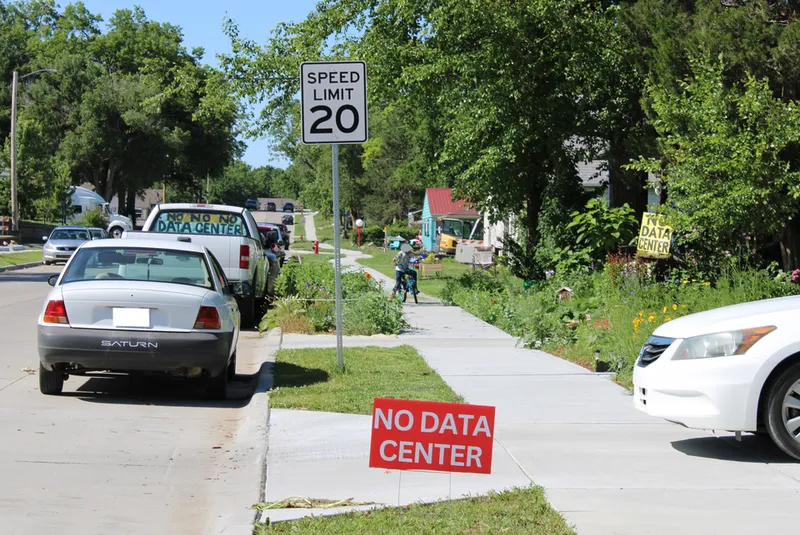
GOP urges top AI firms to do something about the toxic image of data centers
The National Republican Senatorial Committee has privately urged major AI companies to address growing public opposition to data centers, warning that the issue could affect Republican Sen. Jon Husted’s Ohio reelection campaign and future projects nationwide. A memo titled “Ohio Data Center Risk” calls on companies to explain who benefits from data centers, who pays for them and why communities should want them. Former Democratic Sen. Sherrod Brown is eight points ahead of Husted, according to the reported campaign polling, after spending millions to portray Husted as “the face of data centers in Ohio.” The NRSC said data centers are “the anchor hanging around Husted’s neck” and warned that a loss blamed on the facilities could deter politicians in other states from supporting new projects. Ohio has one of the largest shares of completed U.S. data-center projects, with dozens more planned. Reuters reported in 2026 that 77% of 4,531 poll respondents were concerned AI development could raise electricity bills; 64% opposed rapid AI data-center construction and 33% supported it. The United States has about 4,000 operating data centers and nearly 3,000 more in planning, while concerns have grown over their energy consumption and AI’s potential effects on jobs.
siliconangle.com
3 min
8/22/2026

David Sacks on X: Some thoughts on Dario's post
David Sacks criticized Anthropic CEO Dario Amodei’s position on AI regulation, arguing that Amodei did not directly rebut investor Gavin Baker’s account of prior remarks. Sacks rejected Amodei’s characterization of critics as treating all regulation as regulatory capture, saying he supports antitrust enforcement and defining capture through economist George Stigler’s framework of industry-backed rules that primarily benefit industry. Sacks said Anthropic has hired former Biden AI-policy officials, expanded government affairs efforts, and supported aligned organizations advocating its preferred policies. Sacks said Amodei has backed a federal pre-release review system for frontier AI models, previously likened to the FDA, FAA, or FINRA. He argued that such a system would create approval delays, disadvantage the United States against China, and favor well-funded frontier labs such as Anthropic over smaller competitors and open-model developers. Sacks also said Amodei has called open models dangerous, criticized their lack of central monitoring and withdrawal mechanisms, and linked them to intellectual-property theft. He disputed Anthropic’s warnings about AI harms, citing Amodei’s May 2025 prediction that AI could eliminate 50% of entry-level knowledge jobs within five years and Anthropic’s televised “blackmail” study. Sacks framed the dispute as whether powerful frontier AI should be centralized or broadly distributed.
twitter.com
4 min
8/17/2026

Sam Altman's response to Molotov cocktail incident
A family photo has been shared to discourage potential attacks after a Molotov cocktail was thrown at the house. The incident occurred at 3:45 AM, and fortunately, no one was harmed as the device bounced off the house.
blog.samaltman.com
5 min
4/10/2026

Study found that young adults have grown less hopeful and more angry about AI
A Gallup study reveals that over half of Gen Z in the United States regularly uses generative artificial intelligence. Despite this high usage, their feelings towards the technology have become increasingly negative, with rising sentiments of anger and decreased hopefulness.
nytimes.com
4 min
4/9/2026

People Loved the Dot-Com Boom. The A.I. Boom, Not So Much
Tech leaders express concern over the public's lack of enthusiasm for the AI boom, contrasting it with the excitement of the dot-com era. Executives claim that AI will significantly improve lives and is comparable to transformative innovations like electricity and fire.
nytimes.com
2 min
2/22/2026
GOP urges top AI firms to do something about the toxic image of data centers
The National Republican Senatorial Committee has privately urged major AI companies to address growing public opposition to data centers, warning that the issue could affect Republican Sen. Jon Husted’s Ohio reelection campaign and future projects nationwide. A memo titled “Ohio Data Center Risk” calls on companies to explain who benefits from data centers, who pays for them and why communities should want them. Former Democratic Sen. Sherrod Brown is eight points ahead of Husted, according to the reported campaign polling, after spending millions to portray Husted as “the face of data centers in Ohio.” The NRSC said data centers are “the anchor hanging around Husted’s neck” and warned that a loss blamed on the facilities could deter politicians in other states from supporting new projects. Ohio has one of the largest shares of completed U.S. data-center projects, with dozens more planned. Reuters reported in 2026 that 77% of 4,531 poll respondents were concerned AI development could raise electricity bills; 64% opposed rapid AI data-center construction and 33% supported it. The United States has about 4,000 operating data centers and nearly 3,000 more in planning, while concerns have grown over their energy consumption and AI’s potential effects on jobs.
siliconangle.com
3 min
8/22/2026
Sam Altman's response to Molotov cocktail incident
A family photo has been shared to discourage potential attacks after a Molotov cocktail was thrown at the house. The incident occurred at 3:45 AM, and fortunately, no one was harmed as the device bounced off the house.
blog.samaltman.com
5 min
4/10/2026
People Loved the Dot-Com Boom. The A.I. Boom, Not So Much
Tech leaders express concern over the public's lack of enthusiasm for the AI boom, contrasting it with the excitement of the dot-com era. Executives claim that AI will significantly improve lives and is comparable to transformative innovations like electricity and fire.
nytimes.com
2 min
2/22/2026
David Sacks on X: Some thoughts on Dario's post
David Sacks criticized Anthropic CEO Dario Amodei’s position on AI regulation, arguing that Amodei did not directly rebut investor Gavin Baker’s account of prior remarks. Sacks rejected Amodei’s characterization of critics as treating all regulation as regulatory capture, saying he supports antitrust enforcement and defining capture through economist George Stigler’s framework of industry-backed rules that primarily benefit industry. Sacks said Anthropic has hired former Biden AI-policy officials, expanded government affairs efforts, and supported aligned organizations advocating its preferred policies. Sacks said Amodei has backed a federal pre-release review system for frontier AI models, previously likened to the FDA, FAA, or FINRA. He argued that such a system would create approval delays, disadvantage the United States against China, and favor well-funded frontier labs such as Anthropic over smaller competitors and open-model developers. Sacks also said Amodei has called open models dangerous, criticized their lack of central monitoring and withdrawal mechanisms, and linked them to intellectual-property theft. He disputed Anthropic’s warnings about AI harms, citing Amodei’s May 2025 prediction that AI could eliminate 50% of entry-level knowledge jobs within five years and Anthropic’s televised “blackmail” study. Sacks framed the dispute as whether powerful frontier AI should be centralized or broadly distributed.
twitter.com
4 min
8/17/2026
Study found that young adults have grown less hopeful and more angry about AI
A Gallup study reveals that over half of Gen Z in the United States regularly uses generative artificial intelligence. Despite this high usage, their feelings towards the technology have become increasingly negative, with rising sentiments of anger and decreased hopefulness.
nytimes.com
4 min
4/9/2026
GOP urges top AI firms to do something about the toxic image of data centers
The National Republican Senatorial Committee has privately urged major AI companies to address growing public opposition to data centers, warning that the issue could affect Republican Sen. Jon Husted’s Ohio reelection campaign and future projects nationwide. A memo titled “Ohio Data Center Risk” calls on companies to explain who benefits from data centers, who pays for them and why communities should want them. Former Democratic Sen. Sherrod Brown is eight points ahead of Husted, according to the reported campaign polling, after spending millions to portray Husted as “the face of data centers in Ohio.” The NRSC said data centers are “the anchor hanging around Husted’s neck” and warned that a loss blamed on the facilities could deter politicians in other states from supporting new projects. Ohio has one of the largest shares of completed U.S. data-center projects, with dozens more planned. Reuters reported in 2026 that 77% of 4,531 poll respondents were concerned AI development could raise electricity bills; 64% opposed rapid AI data-center construction and 33% supported it. The United States has about 4,000 operating data centers and nearly 3,000 more in planning, while concerns have grown over their energy consumption and AI’s potential effects on jobs.
siliconangle.com
3 min
8/22/2026
Study found that young adults have grown less hopeful and more angry about AI
A Gallup study reveals that over half of Gen Z in the United States regularly uses generative artificial intelligence. Despite this high usage, their feelings towards the technology have become increasingly negative, with rising sentiments of anger and decreased hopefulness.
nytimes.com
4 min
4/9/2026
David Sacks on X: Some thoughts on Dario's post
David Sacks criticized Anthropic CEO Dario Amodei’s position on AI regulation, arguing that Amodei did not directly rebut investor Gavin Baker’s account of prior remarks. Sacks rejected Amodei’s characterization of critics as treating all regulation as regulatory capture, saying he supports antitrust enforcement and defining capture through economist George Stigler’s framework of industry-backed rules that primarily benefit industry. Sacks said Anthropic has hired former Biden AI-policy officials, expanded government affairs efforts, and supported aligned organizations advocating its preferred policies. Sacks said Amodei has backed a federal pre-release review system for frontier AI models, previously likened to the FDA, FAA, or FINRA. He argued that such a system would create approval delays, disadvantage the United States against China, and favor well-funded frontier labs such as Anthropic over smaller competitors and open-model developers. Sacks also said Amodei has called open models dangerous, criticized their lack of central monitoring and withdrawal mechanisms, and linked them to intellectual-property theft. He disputed Anthropic’s warnings about AI harms, citing Amodei’s May 2025 prediction that AI could eliminate 50% of entry-level knowledge jobs within five years and Anthropic’s televised “blackmail” study. Sacks framed the dispute as whether powerful frontier AI should be centralized or broadly distributed.
twitter.com
4 min
8/17/2026
People Loved the Dot-Com Boom. The A.I. Boom, Not So Much
Tech leaders express concern over the public's lack of enthusiasm for the AI boom, contrasting it with the excitement of the dot-com era. Executives claim that AI will significantly improve lives and is comparable to transformative innovations like electricity and fire.
nytimes.com
2 min
2/22/2026
Sam Altman's response to Molotov cocktail incident
A family photo has been shared to discourage potential attacks after a Molotov cocktail was thrown at the house. The incident occurred at 3:45 AM, and fortunately, no one was harmed as the device bounced off the house.
blog.samaltman.com
5 min
4/10/2026
No more articles to load