GOP urges top AI firms to do something about the toxic image of data centers
siliconangle.com
August 22, 2026
3 min read
38/100
Summary
The National Republican Senatorial Committee has privately urged major AI companies to address growing public opposition to data centers, warning that the issue could affect Republican Sen. Jon Husted’s Ohio reelection campaign and future projects nationwide. A memo titled “Ohio Data Center Risk” calls on companies to explain who benefits from data centers, who pays for them and why communities should want them. Former Democratic Sen. Sherrod Brown is eight points ahead of Husted, according to the reported campaign polling, after spending millions to portray Husted as “the face of data centers in Ohio.” The NRSC said data centers are “the anchor hanging around Husted’s neck” and warned that a loss blamed on the facilities could deter politicians in other states from supporting new projects. Ohio has one of the largest shares of completed U.S. data-center projects, with dozens more planned. Reuters reported in 2026 that 77% of 4,531 poll respondents were concerned AI development could raise electricity bills; 64% opposed rapid AI data-center construction and 33% supported it. The United States has about 4,000 operating data centers and nearly 3,000 more in planning, while concerns have grown over their energy consumption and AI’s potential effects on jobs.
Key Takeaways
- The NRSC warned AI companies that public hostility toward data centers in Ohio could create obstacles for similar projects across the United States.
- The NRSC’s “Ohio Data Center Risk” memo asks companies to clarify the benefits, costs and local rationale for hosting data centers.
- Reuters reported that 77% of 4,531 respondents were concerned AI development could increase electricity bills, while 64% opposed rapid AI data-center construction.
- Ohio is a major U.S. data-center market, with many completed facilities and dozens of additional projects in planning.
What the discussion said
The thread barely engages with partisan messaging and instead treats the requested image repair as an admission that AI data-center deployment is alienating the communities around it. Commenters repeatedly point to immediate physical harms: diesel or gas generators near homes, constant industrial noise, higher electricity bills, and the prospect of protests. Their core view is simple: public hostility is not a branding failure that a better campaign can erase; it follows from siting huge power-hungry facilities where residents bear the costs. Several readers mock the premise that companies should polish perception rather than alter construction and operating practices. The sharpest suggestions are to keep facilities away from housing, rely on adequate dedicated generation rather than straining local grids, and use zoning to prevent obviously incompatible projects. One minority response argues that on-site power can be preferable to pulling scarce capacity from the grid, provided it genuinely adds generation. But even that defense does not endorse business as usual. The prevailing mood is that AI’s infrastructure footprint has become a product and governance problem, not a communications problem, and that continued expansion without better siting will worsen the backlash.
Where opinion split
The central dispute is whether dedicated on-site generation helps or harms communities hosting AI data centers. Critics see gas-powered generation beside homes as noisy, polluting evidence of reckless siting; the opposing view is that self-supplied power may protect local customers from grid-driven price increases. Both sides imply that capacity must be added, but they sharply differ over whether these installations belong near residents at all.
Community Sentiment
Positives
- Dedicated power generation could spare surrounding grid customers from some AI-driven electricity-demand pressure, if it truly adds capacity rather than shifting costs.
- The discussion identifies practical routes to more acceptable AI infrastructure: enforce zoning, separate industrial-scale compute from homes, and build enough generation for demand.
Concerns
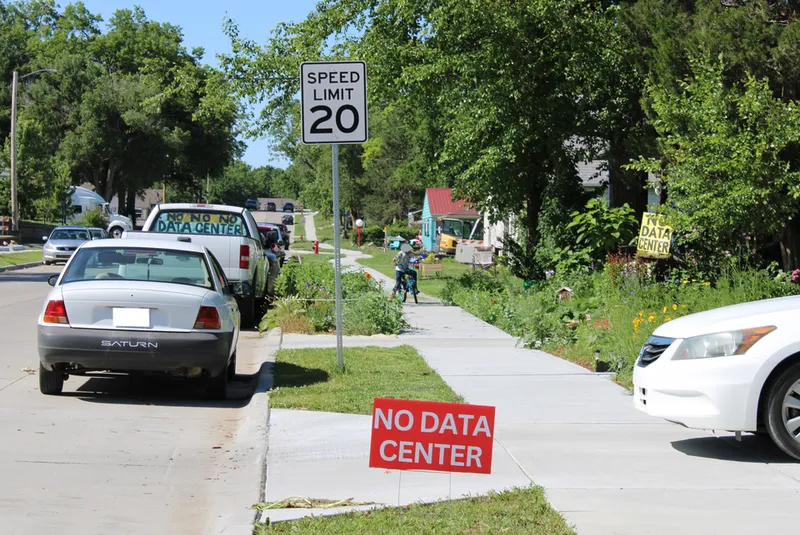
- AI data centers parked beside homes turn abstract compute demand into relentless noise and industrial intrusion, making public resentment entirely predictable.
- Gas generators and heavy AI electricity use risk raising local power costs, so residents see private model-serving capacity subsidized by their own utility bills.
- Commenters reject PR-first responses: polishing the reputation of AI infrastructure while leaving its noise, power burden, and siting untouched reads as cynical evasion.
- The backlash is framed as a deployment failure, not irrational anti-AI hysteria; expansion that ignores local impacts will make data centers politically harder to build.
Related Articles

The AI Industry Is Discovering That the Public Hates It
Apr 25, 2026
U.S. gov't moves to suppress pushback on data centers
Aug 26, 2026
Data centers trigger voter backlash
Jun 26, 2026
The AI Backlash Could Get Ugly
May 13, 2026
If AI data centers are so great, why are they being built in secret?
Jun 3, 2026