A new ceiling for Λ: the de Bruijn–Newman constant
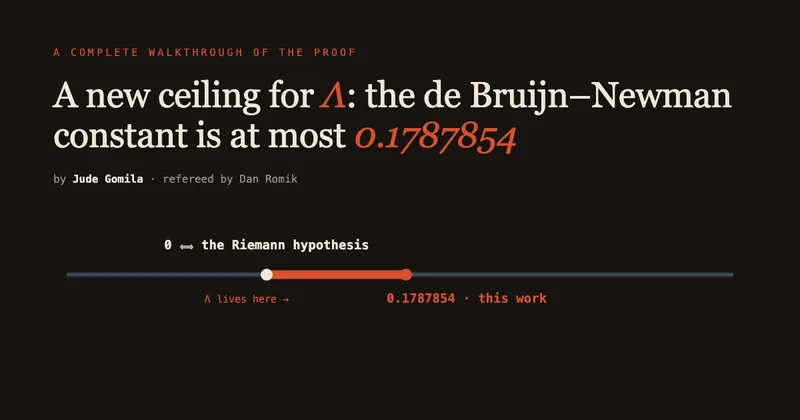
Jude Gomila reports a computer-assisted, unconditional upper bound of Λ ≤ 0.1787854 for the de Bruijn–Newman constant, improving the previous 0.2 ceiling obtained using the same general Polymath 15 framework and Platt–Trudgian’s verified Riemann-hypothesis height. The de Bruijn–Newman constant satisfies Λ ≤ 0 exactly when the Riemann hypothesis is true, while Rodgers and Tao proved in 2018 that Λ ≥ 0. The reported result therefore narrows the known interval for Λ to [0, 0.1787854] but does not prove the Riemann hypothesis. The bound instantiates Polymath 15’s criterion with exact rational parameters and relies on Platt and Trudgian’s 2020 verification that zeta zeros up to height 3,000,175,332,800 lie on the critical line. Gomila says the proof combines 3,149,013 interval-arithmetic certificates establishing final-time zero-free regions, a tail argument covering all remaining windows to infinity, and 883 time-sliced barrier certificates based on the argument principle. The audit package uses fail-closed checkers, SHA-256-pinned artifacts, replays with FLINT/Arb and Python interval implementations, and runs on two toolchains. Gomila says Dan Romik independently reviewed the analytic lemmas and that journal publication remains pending.
judegomila.com
23 min
8/25/2026
A new ceiling for Λ: the de Bruijn–Newman constant
Jude Gomila reports a computer-assisted, unconditional upper bound of Λ ≤ 0.1787854 for the de Bruijn–Newman constant, improving the previous 0.2 ceiling obtained using the same general Polymath 15 framework and Platt–Trudgian’s verified Riemann-hypothesis height. The de Bruijn–Newman constant satisfies Λ ≤ 0 exactly when the Riemann hypothesis is true, while Rodgers and Tao proved in 2018 that Λ ≥ 0. The reported result therefore narrows the known interval for Λ to [0, 0.1787854] but does not prove the Riemann hypothesis. The bound instantiates Polymath 15’s criterion with exact rational parameters and relies on Platt and Trudgian’s 2020 verification that zeta zeros up to height 3,000,175,332,800 lie on the critical line. Gomila says the proof combines 3,149,013 interval-arithmetic certificates establishing final-time zero-free regions, a tail argument covering all remaining windows to infinity, and 883 time-sliced barrier certificates based on the argument principle. The audit package uses fail-closed checkers, SHA-256-pinned artifacts, replays with FLINT/Arb and Python interval implementations, and runs on two toolchains. Gomila says Dan Romik independently reviewed the analytic lemmas and that journal publication remains pending.
judegomila.com
23 min
8/25/2026
A new ceiling for Λ: the de Bruijn–Newman constant
Jude Gomila reports a computer-assisted, unconditional upper bound of Λ ≤ 0.1787854 for the de Bruijn–Newman constant, improving the previous 0.2 ceiling obtained using the same general Polymath 15 framework and Platt–Trudgian’s verified Riemann-hypothesis height. The de Bruijn–Newman constant satisfies Λ ≤ 0 exactly when the Riemann hypothesis is true, while Rodgers and Tao proved in 2018 that Λ ≥ 0. The reported result therefore narrows the known interval for Λ to [0, 0.1787854] but does not prove the Riemann hypothesis. The bound instantiates Polymath 15’s criterion with exact rational parameters and relies on Platt and Trudgian’s 2020 verification that zeta zeros up to height 3,000,175,332,800 lie on the critical line. Gomila says the proof combines 3,149,013 interval-arithmetic certificates establishing final-time zero-free regions, a tail argument covering all remaining windows to infinity, and 883 time-sliced barrier certificates based on the argument principle. The audit package uses fail-closed checkers, SHA-256-pinned artifacts, replays with FLINT/Arb and Python interval implementations, and runs on two toolchains. Gomila says Dan Romik independently reviewed the analytic lemmas and that journal publication remains pending.
judegomila.com
23 min
8/25/2026
No more articles to load