A new ceiling for Λ: the de Bruijn–Newman constant
judegomila.com
August 25, 2026
23 min read
44/100
Summary
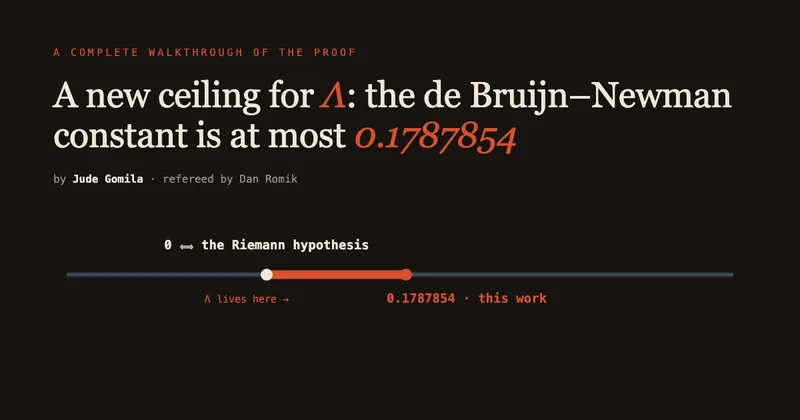
Jude Gomila reports a computer-assisted, unconditional upper bound of Λ ≤ 0.1787854 for the de Bruijn–Newman constant, improving the previous 0.2 ceiling obtained using the same general Polymath 15 framework and Platt–Trudgian’s verified Riemann-hypothesis height. The de Bruijn–Newman constant satisfies Λ ≤ 0 exactly when the Riemann hypothesis is true, while Rodgers and Tao proved in 2018 that Λ ≥ 0. The reported result therefore narrows the known interval for Λ to [0, 0.1787854] but does not prove the Riemann hypothesis. The bound instantiates Polymath 15’s criterion with exact rational parameters and relies on Platt and Trudgian’s 2020 verification that zeta zeros up to height 3,000,175,332,800 lie on the critical line. Gomila says the proof combines 3,149,013 interval-arithmetic certificates establishing final-time zero-free regions, a tail argument covering all remaining windows to infinity, and 883 time-sliced barrier certificates based on the argument principle. The audit package uses fail-closed checkers, SHA-256-pinned artifacts, replays with FLINT/Arb and Python interval implementations, and runs on two toolchains. Gomila says Dan Romik independently reviewed the analytic lemmas and that journal publication remains pending.
Key Takeaways
- Jude Gomila reports an upper bound of Λ ≤ 0.1787854 for the de Bruijn–Newman constant, replacing a previously cited ceiling of 0.2.
- The Riemann hypothesis is equivalent to Λ ≤ 0, and Rodgers and Tao’s 2018 result Λ ≥ 0 places the constant in the interval from 0 to the reported upper bound.
- The computation uses Platt and Trudgian’s verification that all nontrivial zeta zeros through height 3,000,175,332,800 lie on the critical line.
- Gomila says the certification includes 3,149,013 interval-arithmetic window checks, an infinite-tail theorem, and 883 barrier prisms that remain zero-free during the heat flow.
- The reported bound does not establish the Riemann hypothesis, and Gomila says the result has not yet completed journal publication.
What the discussion said
The thread spent less time on the new mathematical bound than on the uneasy question of what an AI-written research explainer is worth. Several readers found the post lucid and visually engaging, and one welcomed the chance to learn about the Polymath project through it. But the polished Claude-like cadence was so conspicuous that it undermined trust for others: they could not tell whether the named author understood the proof, selected and checked the argument, or merely prompted a model. Defenders pushed back that directing an AI, publishing the result, and standing behind the finished work can still be meaningful authorship; they argued that readability and correctness matter more than a tally of human versus machine prose. The more substantive AI-and-mathematics debate was about verification. Readers worried that generated proofs may create a flood of claims whose review burden exceeds their value, making apparent progress hard to distinguish from noise. A claimed Lean formalization was offered as a major counterweight, since machine checking can reduce proof validation to trusted definitions and a kernel rather than human scrutiny of every line. Others saw AI as making incremental, formerly laborious proof-tightening cheap: useful work, but no longer inherently spectacular. The emerging consensus was that AI may accelerate mathematical production, while rigorous formal verification and expert quality control become the real bottlenecks.
Where opinion split
The sharpest dispute is whether obvious AI authorship damages the value and accountability of a mathematical article. Skeptics say synthetic prose obscures who actually understands and can defend the result; defenders say guided AI use is legitimate work if the final explanation is accurate, useful, and accountable.
Community Sentiment
Positives
- A Lean-backed proof changes the game: formal checking can turn a sprawling generated argument into a mechanically auditable claim rather than a reviewer’s leap of faith.
- AI appears capable of making tedious incremental proof improvements cheap, potentially freeing mathematicians to pursue questions that previously stalled on labor alone.
- The model-assisted presentation made difficult material approachable, with readers praising its clarity and proof visualization rather than treating accessibility as a cosmetic extra.
Concerns
- The unmistakable Claude-style prose makes readers doubt whether the credited author can explain, verify, or take responsibility for the mathematics behind the polished narrative.
- AI-generated mathematics risks flooding the field with claims whose correctness and relevance cost experts more to assess than the results are worth.
- If models make routine proof tightening effortless, impressive-looking numerical advances can become low-hanging fruit rather than evidence of deep mathematical progress.
- Readers fear formulaic generated writing may normalize an exaggerated, repetitive explanatory style that erodes mathematical communication rather than improving it.
Related Articles
Solving 20 Erdős Problems with 20 Codex Accounts Running in Parallel
Jul 15, 2026
Human mathematicians are being outcounterexampled
Jul 20, 2026

A recent experience with ChatGPT 5.5 Pro
May 9, 2026
Lean proved this program correct; then I found a bug
Apr 14, 2026

Working with AI Feels More Like Leadership Than Coding
Aug 15, 2026