Turbovec – Google's TurboQuant for vector search in Rust
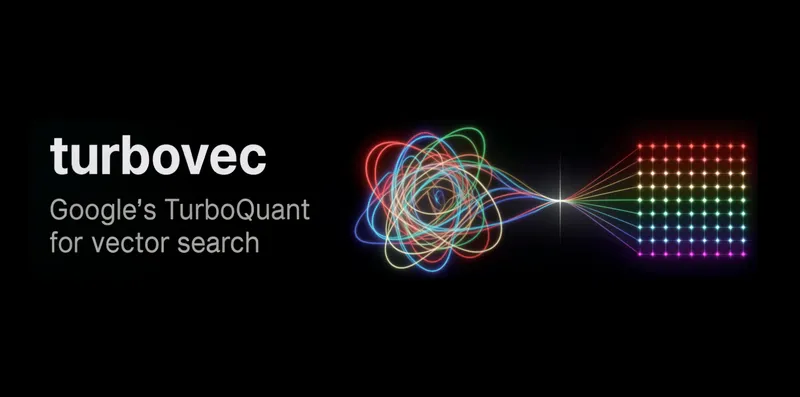
turbovec is a Rust vector index with Python bindings that implements Google Research’s TurboQuant quantization algorithm for approximate nearest-neighbor search. It accepts float32 vectors, supports online ingestion without a separate training phase, and provides full-file snapshots plus incremental, crash-safe sync operations. Its IdMapIndex variant supports stable uint64 external IDs and O(1) deletions. Search can apply ID allowlists or slot bitmasks inside SIMD kernels, returning up to k results only from permitted vectors. The project claims that a 10 million-document corpus requiring 31 GB as float32 fits in 4 GB with turbovec. On 100,000-vector benchmarks using OpenAI 1,536- and 3,072-dimensional embeddings and GloVe 200-dimensional vectors, its maintainers report TurboQuant search outperformed FAISS IndexPQFastScan in every measured ARM and x86 configuration: averages were 3.4–3.5 times faster at 4-bit quantization and 20–26% faster at 2-bit. The reported recall results varied by embedding dimension and bit width, with calibrated TQ+ generally matching or exceeding FAISS at recall@1 in tested OpenAI configurations. TurboQuant normalizes vectors, applies a shared random rotation, quantizes coordinates into 2- or 4-bit codes, and scores compressed vectors directly using NEON, AVX-512, AVX2, or scalar kernels. Optional TQ+ calibration fits per-coordinate shifts and scales from a representative sample before ingestion.
github.com
12 min
8/19/2026
Turbovec – Google's TurboQuant for vector search in Rust
turbovec is a Rust vector index with Python bindings that implements Google Research’s TurboQuant quantization algorithm for approximate nearest-neighbor search. It accepts float32 vectors, supports online ingestion without a separate training phase, and provides full-file snapshots plus incremental, crash-safe sync operations. Its IdMapIndex variant supports stable uint64 external IDs and O(1) deletions. Search can apply ID allowlists or slot bitmasks inside SIMD kernels, returning up to k results only from permitted vectors. The project claims that a 10 million-document corpus requiring 31 GB as float32 fits in 4 GB with turbovec. On 100,000-vector benchmarks using OpenAI 1,536- and 3,072-dimensional embeddings and GloVe 200-dimensional vectors, its maintainers report TurboQuant search outperformed FAISS IndexPQFastScan in every measured ARM and x86 configuration: averages were 3.4–3.5 times faster at 4-bit quantization and 20–26% faster at 2-bit. The reported recall results varied by embedding dimension and bit width, with calibrated TQ+ generally matching or exceeding FAISS at recall@1 in tested OpenAI configurations. TurboQuant normalizes vectors, applies a shared random rotation, quantizes coordinates into 2- or 4-bit codes, and scores compressed vectors directly using NEON, AVX-512, AVX2, or scalar kernels. Optional TQ+ calibration fits per-coordinate shifts and scales from a representative sample before ingestion.
github.com
12 min
8/19/2026
Turbovec – Google's TurboQuant for vector search in Rust
turbovec is a Rust vector index with Python bindings that implements Google Research’s TurboQuant quantization algorithm for approximate nearest-neighbor search. It accepts float32 vectors, supports online ingestion without a separate training phase, and provides full-file snapshots plus incremental, crash-safe sync operations. Its IdMapIndex variant supports stable uint64 external IDs and O(1) deletions. Search can apply ID allowlists or slot bitmasks inside SIMD kernels, returning up to k results only from permitted vectors. The project claims that a 10 million-document corpus requiring 31 GB as float32 fits in 4 GB with turbovec. On 100,000-vector benchmarks using OpenAI 1,536- and 3,072-dimensional embeddings and GloVe 200-dimensional vectors, its maintainers report TurboQuant search outperformed FAISS IndexPQFastScan in every measured ARM and x86 configuration: averages were 3.4–3.5 times faster at 4-bit quantization and 20–26% faster at 2-bit. The reported recall results varied by embedding dimension and bit width, with calibrated TQ+ generally matching or exceeding FAISS at recall@1 in tested OpenAI configurations. TurboQuant normalizes vectors, applies a shared random rotation, quantizes coordinates into 2- or 4-bit codes, and scores compressed vectors directly using NEON, AVX-512, AVX2, or scalar kernels. Optional TQ+ calibration fits per-coordinate shifts and scales from a representative sample before ingestion.
github.com
12 min
8/19/2026
No more articles to load