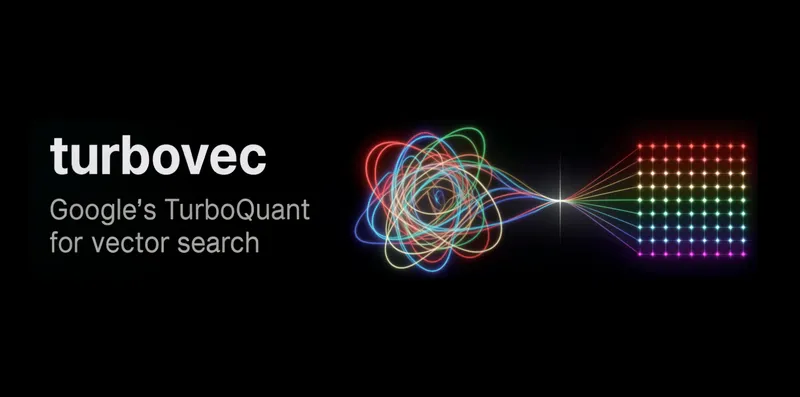
Turbovec – Google's TurboQuant for vector search in Rust
github.com
August 18, 2026
12 min read
62/100
Summary
turbovec is a Rust vector index with Python bindings that implements Google Research’s TurboQuant quantization algorithm for approximate nearest-neighbor search. It accepts float32 vectors, supports online ingestion without a separate training phase, and provides full-file snapshots plus incremental, crash-safe sync operations. Its IdMapIndex variant supports stable uint64 external IDs and O(1) deletions. Search can apply ID allowlists or slot bitmasks inside SIMD kernels, returning up to k results only from permitted vectors. The project claims that a 10 million-document corpus requiring 31 GB as float32 fits in 4 GB with turbovec. On 100,000-vector benchmarks using OpenAI 1,536- and 3,072-dimensional embeddings and GloVe 200-dimensional vectors, its maintainers report TurboQuant search outperformed FAISS IndexPQFastScan in every measured ARM and x86 configuration: averages were 3.4–3.5 times faster at 4-bit quantization and 20–26% faster at 2-bit. The reported recall results varied by embedding dimension and bit width, with calibrated TQ+ generally matching or exceeding FAISS at recall@1 in tested OpenAI configurations. TurboQuant normalizes vectors, applies a shared random rotation, quantizes coordinates into 2- or 4-bit codes, and scores compressed vectors directly using NEON, AVX-512, AVX2, or scalar kernels. Optional TQ+ calibration fits per-coordinate shifts and scales from a representative sample before ingestion.
Key Takeaways
- turbovec is a local Rust vector index with Python bindings that uses TurboQuant compression and requires no separate training phase for standard ingestion.
- The project claims 10 million float32 document vectors can be reduced from 31 GB to 4 GB of RAM with turbovec.
- turbovec supports incremental crash-safe persistence, stable external IDs with O(1) deletion, and allowlist filtering performed within its SIMD search kernels.
- Maintainers report that turbovec outperformed FAISS IndexPQFastScan in their ARM and x86 benchmarks, averaging roughly 3.4–3.5× faster at 4-bit quantization.
- TQ+ calibration can be run once on a representative sample before adding vectors to fit per-coordinate quantization adjustments.
What the discussion said
The thread treated Turbovec less as a Rust release than as a practical lever for making embedding retrieval cheap enough to run everywhere. The loudest enthusiasm centered on its reported density: fitting ten million document vectors into roughly four gigabytes could make local indexes, debugging datasets, and repeated performance tests far less cumbersome. Several readers immediately connected that footprint to privacy-preserving browser or on-device search, and asked whether a WebAssembly build could preserve the CPU acceleration needed to make that vision useful. Others saw it as a natural fit for agent retrieval over personal notes, documentation, wikis, and codebases. The discussion was not convinced that compression alone establishes a new retrieval leader. Readers stressed that TurboQuant is principally a size-versus-accuracy tradeoff, not necessarily a replacement for the fastest approximate-nearest-neighbor systems. They pointed to benchmark suites, an allegedly stronger quantization technique already adopted in other libraries, and the possibility that equally compact Matryoshka embeddings may retrieve better. Still, practical integration reports were encouraging: one vector database has added TurboQuant support and can now avoid retaining full-precision vectors when applications do not need them. Interest also extended to pairing small fine-tuned embedding models with quantization, potentially stacking model-level and index-level savings.
Where opinion split
The core dispute is whether TurboQuant is genuinely the best way to spend a constrained bit budget for vector retrieval. Supporters argue that its compelling accuracy at drastically lower storage is the relevant win, especially when it removes the need to keep FP32 vectors. Skeptics argue that stronger alternatives and compact Matryoshka embeddings may deliver better recall at the same storage cost, so compression figures alone do not prove retrieval superiority.
Community Sentiment
Positives
- A roughly four-gigabyte index for ten million documents has readers seeing local semantic search and iterative retrieval testing become materially cheaper and faster.
- Its compact footprint could push private embedding search into browser extensions or other on-device workflows, avoiding a remote vector service for personal data.
- Existing vector-database integration suggests users can drop full-precision vector storage when their retrieval requirements do not justify the cost.
- Fine-tuned low-dimensional embedding models combined with aggressive quantization could compound savings, turning vector-database spend from a bottleneck into a minor concern.
Concerns
- Benchmark-minded readers warn that TurboQuant's storage win should not be mistaken for state-of-the-art nearest-neighbor speed or recall against modern ANN indexes.
- Critics question whether the same number of bits allocated to Matryoshka embeddings would yield better retrieval, challenging the method's claimed practical edge.
- Open-review discussion and competing libraries were cited as evidence that a potentially stronger quantization approach may already be more broadly implemented.
- Browser deployment remains an open performance question because WebAssembly support for advanced vector instructions could determine whether local search is actually fast enough.
Related Articles

TurboQuant: A first-principles walkthrough
Apr 27, 2026

TurboQuant: Redefining AI efficiency with extreme compression
Mar 25, 2026
TurboQuant KV Compression and SSD Expert Streaming for M5 Pro and IOS
Apr 1, 2026
Run Kimi K3 using 29 GB of RAM at 0.50 tok/s
Jul 31, 2026
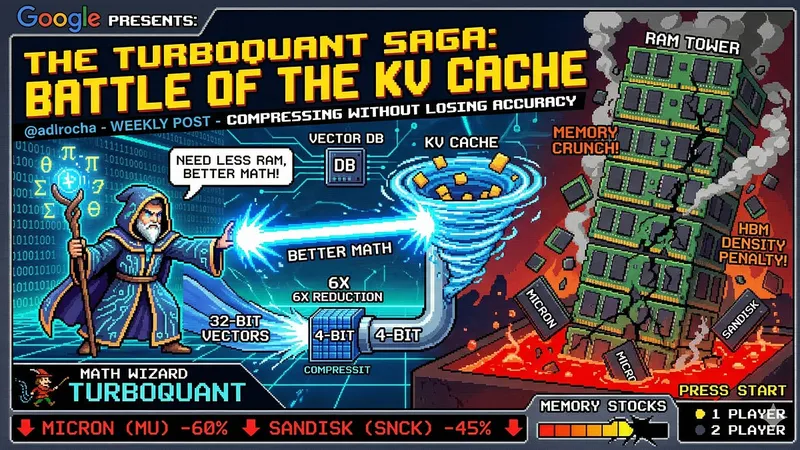
What if AI doesn't need more RAM but better math?
Mar 29, 2026