Lean proved this program correct; then I found a bug
kirancodes.me
April 14, 2026
7 min read
🔥🔥🔥🔥🔥
65/100
Summary
AI agents are increasingly effective at identifying vulnerabilities in large software systems. Anthropic chose not to release the Mythos model due to concerns over its potential to discover dangerous security flaws.
Key Takeaways
- AI agents are increasingly effective at identifying vulnerabilities in large-scale software systems, leading to concerns about a potential software crisis.
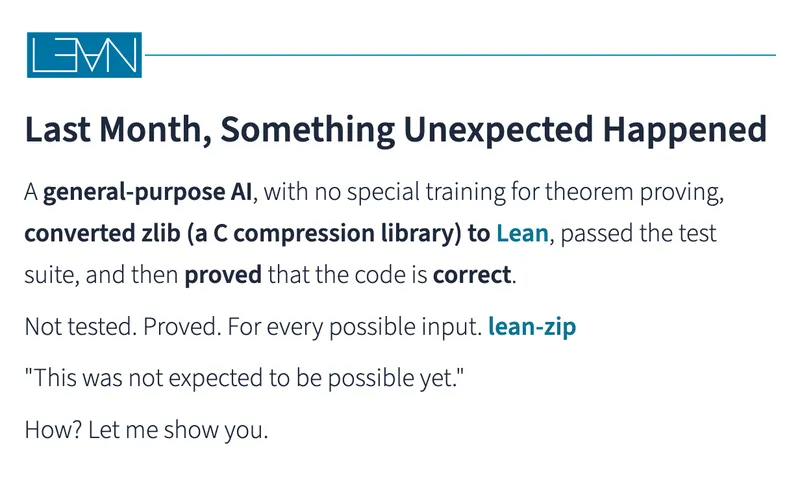
- The Lean ecosystem has achieved a significant milestone by autonomously verifying an implementation of zlib, named lean-zip, as correct and free of implementation bugs.
- Fuzzing experiments on the verified lean-zip code revealed no memory vulnerabilities, but identified a heap buffer overflow in the Lean 4 runtime and a denial-of-service issue in lean-zip's archive parser.
- The fuzzing setup involved stripping the code of documentation and specifications to prevent bias, allowing the AI agent to test the verified code without prior knowledge of its correctness.
Community Sentiment
Positives
- The article highlights the importance of formal verification, which can prove that a program conforms to a specification, enhancing trust in software correctness.
- Finding bugs in the Lean runtime, even if not in the proven code, underscores the necessity of rigorous verification methods in software development.
- The discussion around specification gaps emphasizes the complexity of ensuring that formal proofs align with intended program behavior, which is a critical aspect of software reliability.
Concerns
- The title of the article is misleading, as it suggests a bug was found in the proven code when it was actually in the Lean runtime, which could undermine trust in formal verification.
- Concerns about the reliability of formal verification systems themselves raise questions about the overall trustworthiness of software that relies on these methods.
- The article's framing may contribute to misconceptions about the capabilities of formal verification, potentially leading to overconfidence in its effectiveness.