Agent Lightning v1.0
github.com
August 24, 2026
1 min read
44/100
Summary
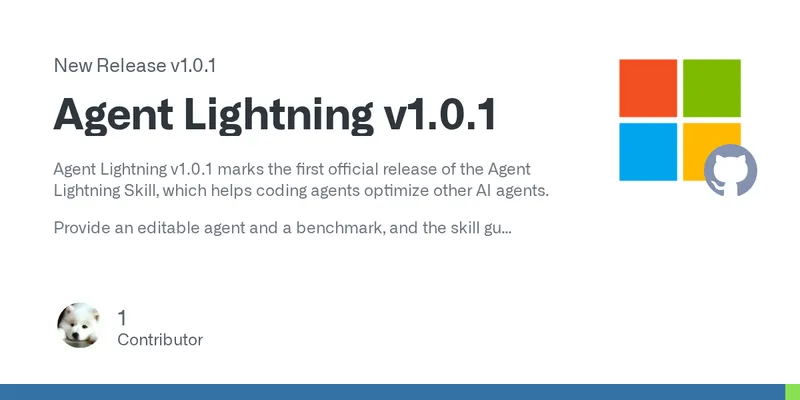
Microsoft released Agent Lightning v1.0.1, the first official release of the Agent Lightning Skill for coding agents. The skill is designed to help coding agents optimize other AI agents by working from an editable agent and a benchmark. Agent Lightning guides measured, systematic iteration across prompts, tools, workflows, models, and reasoning settings. It balances accuracy, cost, latency, and reliability during those improvements. The skill can be installed for Claude Code, Codex, or GitHub Copilot with the command `gh skill install microsoft/agent-lightning agent-lightning --agent <agent>`. Version 1.0.1 also strengthens continuous integration, packaging, release automation, documentation, and benchmark reporting.
What the discussion said
The thread barely gets to Agent Lightning’s technical merits because the project’s presentation blocks the starting line. Several commenters cannot tell whether it is an RL training framework, a general agent toolkit, or a coding-agent skill for improving other agents. One reader reconstructs the likely purpose as taking an LLM and further training or fine-tuning it against embodied or interactive tasks such as games or drawing. Another description frames it more concretely as a system for iterating on prompts, tools, workflows, model choice, and reasoning settings against a benchmark while trading off accuracy, cost, latency, and reliability. But that potentially useful idea is drowned out by disbelief at the README. The headline claim that a framework is lightweight because it has roughly 3,500 lines of code is treated as an empty and confusing selling point, not evidence that the agent-RL approach is simple or effective. Commenters also fault the release’s communication, especially given its corporate backing: it does not quickly establish what users can train, how the harnesses work, or whether the framework produces better agents. There is no real argument over results, benchmarks, or safety; the dominant conclusion is that the project may have a sensible agent-optimization goal but has failed to explain itself well enough to assess it.
Where opinion split
The sharpest issue is whether Agent Lightning’s compact-code framing signals a genuinely accessible agent-RL toolkit or merely obscures an undefined product. The charitable reading is that it offers measured optimization of agent components against real task harnesses; the skeptical reading is that line count says nothing about capabilities, and the documentation never makes the core use case legible.
Community Sentiment
Positives
- The apparent focus on training or fine-tuning LLM agents through real interactive tasks could make reinforcement learning practical beyond toy text-only evaluations.
- Its proposed loop of benchmarking prompts, tools, workflows, models, and reasoning settings targets the real deployment trade-offs among accuracy, cost, latency, and reliability.
Concerns
- The README’s emphasis on a roughly 3,500-line implementation is seen as a hollow simplicity claim, because code length does not explain agent capabilities or training value.
- Readers struggle to identify what the project actually is, leaving its RL workflow, target agents, and expected gains too vague to evaluate.
- The release presentation is criticized as surprisingly poor for a major company, since it fails to communicate the AI product’s purpose before pitching it.