Ox Alpha
openrouter.ai
August 20, 2026
3 min read
60/100
Summary
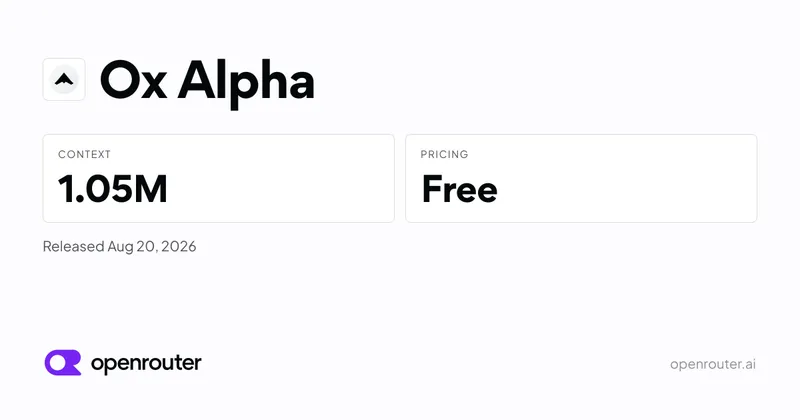
Ox Alpha is a free stealth reasoning model on OpenRouter for coding, sustained agentic work, production workloads, long-horizon software engineering, and complex reasoning. It accepts text, images, and video as input and returns text, supporting workflows that combine written and visual context. The model was released on August 20, 2026. An anonymous third-party provider develops and operates Ox Alpha during its preview period. OpenRouter routes requests directly to the model but is not its developer, owner, or provider. The provider retains prompts and completions, although it does not use them for training; other handling is governed by OpenRouter’s Stealth Model Terms. Ox Alpha is hosted by one provider, so OpenRouter has no alternative provider routing choices for requests. The model has a 1,048,576-token context window and can generate up to 131,072 completion tokens. It supports function calling through tools and tool_choice, plus JSON output through response_format without JSON Schema enforcement. OpenRouter lists prompt and completion token pricing at zero. Its reported median latency is 2.02 seconds and median throughput is 50 tokens per second. OpenRouter reports 99.99% uptime and 96.79% availability over the measured period.
Key Takeaways
- Ox Alpha is an anonymously operated third-party reasoning model offered through OpenRouter at zero listed token cost.
- Ox Alpha supports text, image, and video inputs, produces text outputs, and includes function calling and JSON-output capabilities.
- The model provides a 1,048,576-token context window and supports completion outputs of up to 131,072 tokens.
- Ox Alpha’s provider retains prompts and completions but says they are not used for training.
What the discussion said
The thread treated Ox Alpha less as a model launch than as an opaque public beta: a free, anonymous endpoint whose real value may be the prompts and behavior it collects. Commenters broadly agreed that OpenRouter likely knows the provider while users do not, and that the arrangement gives a lab large-scale real-world testing without attaching early failures to its brand. Some saw that as a practical exchange for experimenting with an unreleased system; others argued that hidden provenance and unverifiable retention promises make it impossible to assess privacy, safety practices, or political constraints. Performance impressions were scattered but notable. One tester found its loose, creative reasoning unusually strong, even surpassing a respected competing model on tasks that had recently impressed them, while visual reasoning lagged. Others inferred a Chinese or GLM-family origin from its speed, terse output accounting, lengthy deliberation traces, and safety behavior, but those guesses remained speculative. Reports of refusals sharply conflicted: one person saw political censorship paired with permissiveness around harmful technical requests, while another encountered the reverse. Several readers stressed that external inference is perfectly defensible for public, low-stakes material, but the dominant mood warned against sending confidential work data to an unidentified provider. The thread also questioned why a provider would offer free access while retaining conversations if not to extract product intelligence.
Where opinion split
The central fight was whether an anonymous free model is an acceptable testing tool or an unacceptable data-risk black box. Defenders said public-data tasks carry little privacy exposure and real-world trials help providers harden models before release. Critics answered that users cannot verify retention, internal training, safety controls, or even the provider’s identity, so free access is a poor trade for anything sensitive.
Community Sentiment
Positives
- Several testers found the model exceptionally capable on open-ended and creative work, reportedly edging out a strong rival where nuanced generation matters most.
- Free access gives developers a low-friction way to probe an unreleased model, especially for public-data workflows such as transcript tagging and semantic chaptering.
- Real-world anonymous trials can expose brittle behavior before a provider ties its brand to a release, potentially preventing highly visible rollbacks.
Concerns
- A free unidentified inference endpoint invites confidential prompts into a provider whose data handling, jurisdiction, and internal reuse cannot be independently verified.
- Retaining prompts and completions remains commercially valuable even without declared training use, supplying behavioral analytics and product-tuning signals at users’ expense.
- Stealth releases deny users the model card and provenance needed to judge safety tradeoffs, censorship behavior, and whether the system suits their risk profile.
- Conflicting reports about political restrictions and assistance for malicious technical activity make its guardrails look opaque and difficult to trust.