Report · tomshardware.com
AI agent swarms in Minecraft fail to build civilization, drown in bureaucracy
tomshardware.com
Source published November 1, 2026
Summary: 1 min read
56/100
Summary
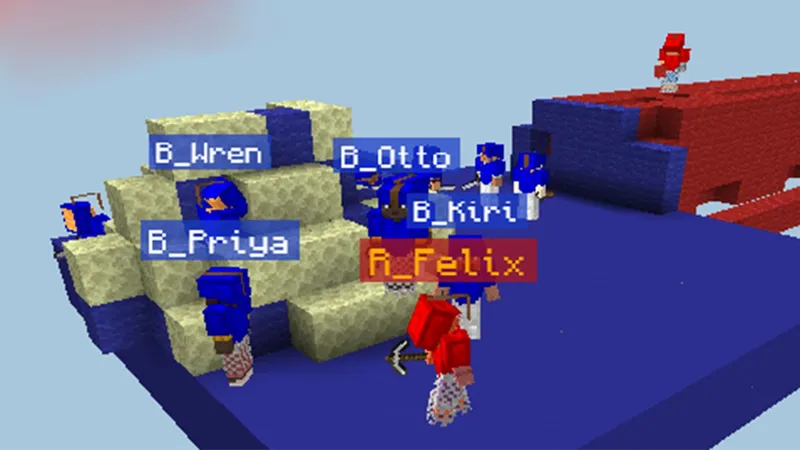
Researchers at Y Combinator and Olam Labs tested hundreds of AI agents in Minecraft-based collaborative and competitive scenarios, using prior frameworks including Mindcraft and Mineflayer. The experiments were intended to examine how agent groups coordinate, recover from failures, and compete in game environments. In a three-hour “Civ50” test, 50 GPT-6.1 Sol agents were asked to build a thriving civilization. Zombies eliminated many agents during the first night, after which ambitious work was often abandoned and the remaining group became highly bureaucratic. Four agents reportedly spent 11 minutes assigning a sole fertilizer operator to use one piece of bone meal on a single wheat block. In Bed Wars, teams of 10 GPT-6.1 Sol agents faced 10 Claude Opus 5.5 agents. The researchers said GPT agents adopted more aggressive and elaborate strategies, while Claude agents were more defensive. When a tool bug prevented block breaking, GPT agents diagnosed the problem and shared workarounds, while several Claude agents concluded that block breaking was impossible. In seven Mindustry matches, GPT agents won six games to Claude’s one. Researchers characterized GPT coordination as hive-like and Claude’s as a leader-centered, democratic process. The agent-swarm tools were released as open source software.
Key Takeaways
- A 50-agent GPT-6.1 Sol Minecraft civilization test failed to develop into a thriving colony and displayed prolonged bureaucratic decision-making after an early zombie attack.
- In a Bed Wars test, researchers said 10 GPT-6.1 Sol agents used more aggressive strategies and handled a block-breaking tool failure more effectively than 10 Claude Opus 5.5 agents.
- GPT-6.1 Sol agent teams defeated Claude Opus 5.5 teams 6–1 in seven Mindustry matches, according to the researchers.
- The Minecraft agent-swarm tools used in the experiments were open sourced for further testing and model-mix comparisons.
What the discussion said
Commenters treated the Minecraft collapse less as evidence that agent collectives inherently recreate failed human institutions and more as a stress test with an awkward experimental setup. Several readers found the behavior familiar: loosely directed agents burn time on trivial coordination, drift into loops, and substitute process for progress. One firsthand attempt to let a Claude-based agent play Minecraft produced similarly nonsensical, time-wasting behavior, lending the article’s anecdotes some practical credibility. But the dominant analytical pushback was methodological. Readers questioned what discipline this even belongs to and, more importantly, what stable conclusion can survive such a sensitive prompt, wrapper, and environment. The agents had to perceive partial game state, choose actions while the world continued running, and act at a slow cadence; critics argued that this is a poor comparison with the more structured shell-and-code environments where agents often coordinate better. On that view, the experiment reveals limitations of current agent harnesses, real-time embodiment, and goal specification, not a general law that multi-agent AI inevitably becomes bureaucratic. Some framed the work as a potentially useful intersection of complexity science and social science, while others saw an expensive amusement whose dramatic conclusion outruns its evidence. The thread also noted that task choice matters: prior Minecraft successes do not settle this result if the objectives differ.
Where opinion split
The sharp dispute is whether the swarm’s bureaucratic paralysis exposes a general weakness in multi-agent AI or merely a badly constrained benchmark. Supporters see wasted coordination and distraction loops as a recurring agent failure mode; skeptics argue that minimal prompting, slow real-time interaction, and the Mineflayer interface make the result too harness-dependent to generalize.
Coverage & discussions
Hacker News · tomshardware.com
Community discussions
Community Sentiment
Positives
- The experiment puts a vivid name to a real multi-agent failure mode: agents can spend their budget coordinating tiny decisions instead of advancing the shared objective.
- A hands-on Claude Minecraft attempt independently reproduced the agents’ poor situational judgment, suggesting the reported dysfunction is not purely theatrical.
- Treating LLM collectives as a complexity-science and social-systems problem could reveal how coordination failures emerge before such agents are trusted with consequential work.
Concerns
- The headline claims too much from a setup where a small prompt change, different wrapper, or altered timing could plausibly reverse the outcome.
- Real-time Minecraft is a punishing agent environment: delayed perception and actions let the world move on while models deliberate, confounding collaboration with control latency.
- Current agents readily enter loops, chase distractions, and formalize trivial work, making unsupervised swarms a costly way to accomplish remarkably little.
- Calling the failure inherent bureaucracy ignores evidence that agents cooperate more effectively in structured programming environments with clearer state and feedback.
Related Articles

We ran AI agent swarms in Minecraft and Mindustry
Oct 29, 2026
Google DeepMind says four AI agents beat Minecraft in 27 hours by writing 2,783 programs of their own — AI team died 605 times on Easy difficulty and ran up an estimated $520 in tokens
Oct 20, 2026

Patterns and problems in emerging multi-agent systems
Aug 16, 2026
Agent swarms and the new model economics
Jul 20, 2026

Tokenmaxxing is dead, long live tokenmaxxing
Jun 28, 2026