Any window from your Mac, on your iPhone and iPad
github.com
October 16, 2026
9 min read
60/100
Summary
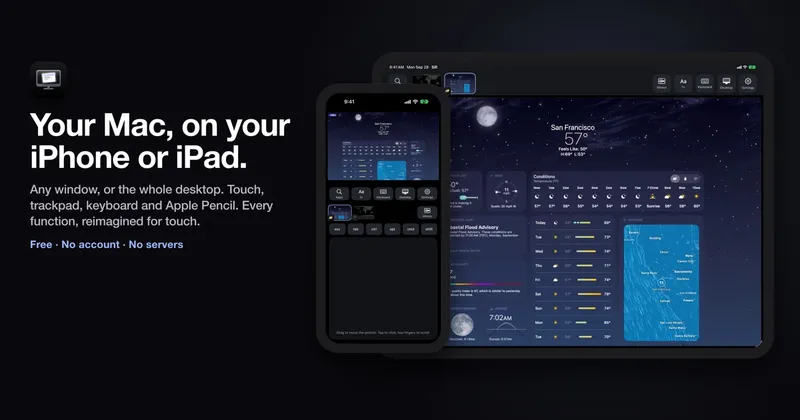
Sill is a free, open-source Mac, iPhone, and iPad application that streams either one Mac window or the entire desktop to a paired mobile device and returns touch, keyboard, trackpad, mouse, scrolling, and Apple Pencil input to the Mac. Sill for Mac captures content with ScreenCaptureKit, encodes it as HEVC using VideoToolbox, and sends it directly to the iPhone or iPad app over TLS 1.3. It drops delayed frames rather than queueing them to keep the displayed image current. The software works on Apple-silicon Macs running macOS 14 or later and iPhones or iPads running iOS or iPadOS 17 or later. Devices can connect over a shared local network, USB, peer-to-peer Wi-Fi through Direct Wireless Connection, or a user-managed VPN or forwarded router port with Remote Access enabled. Each device is paired once using a 12-digit code or USB, and subsequent connections are pinned to the paired keys. Sill has no account, intermediary server, ads, tracking, or subscription. It supports bidirectional text clipboard sharing up to 256 KB, but does not stream Mac audio and shows only one window or the desktop at a time. The Mac app requires Screen Recording and Accessibility permissions; the latter lets it generate mouse and keyboard events and resize streamed windows. Sill is available as a notarized Mac download, through Homebrew, and as a free iPhone and iPad App Store app under the Apache 2.0 license.
Key Takeaways
- Sill streams a single Mac window or the full desktop to an iPhone or iPad and sends device input back to the Mac.
- Connections can use local Wi-Fi, USB, peer-to-peer Wi-Fi, or a user-managed VPN or forwarded port, without a Sill-operated server or account.
- Sill encrypts current connections with TLS 1.3 and uses device pairing with pinned keys; versions of the Mac app before 0.4.0 did not encrypt local, wired, or direct-wireless connections.
- Sill is free and open source, requires an Apple-silicon Mac running macOS 14 or later, and does not stream audio from the Mac.
What the discussion said
The AI-adjacent discussion barely touched the remote-window app itself. Instead, commenters noticed how quickly generative tools are slipping into the surrounding work of shipping and marketing small software. One developer credited Claude with making polished demo-video production substantially easier through Hyperframes, and said that clearer feature demonstrations were already helping users discover what their apps can do. That landed as a practical, unglamorous AI win: not a breakthrough model claim, but faster communication between indie developers and potential users. The same thread also exposed the cost of that workflow. Readers inspecting the project were struck by the size of its CLAUDE.md instructions file, arguing that it consumes an excessive share of the model’s context window. Another commenter made an expansive prediction that, by 2026, a user could hand a repository to an LLM and receive Windows support or a narrowly tailored desktop tool within minutes or hours. Nobody directly challenged that forecast, but it remained assertion rather than demonstrated capability. Most of the thread focused on remote-control performance, Apple platform gaps, and alternatives such as VNC, which are outside the AI-specific scope here.
Where opinion split
The sharpest AI-related tension is between LLMs as near-instant builders of small, targeted software and their current dependence on bulky instruction context. Optimists expect repo-aware agents to implement platform support rapidly; skeptics point to sprawling project guidance already eating the context needed to reason about the code.
Community Sentiment
Positives
- Claude-assisted demo production is making feature videos cheap enough for small developers, improving discovery of software that would otherwise remain invisible.
- Repository-aware LLMs are being imagined as practical rapid-prototyping tools for narrow platform requests, potentially turning custom utility software into an hours-not-months task.
Concerns
- An enormous CLAUDE.md file can burn through the context window before the model reaches the code and task details that actually matter.
- The claim that an LLM can reliably add Windows support in minutes is aspirational in this thread, not backed by an example of cross-platform implementation quality.