Munder Difflin – Agent harness to run an office of your clones
munderdiffl.in
August 22, 2026
5 min read
62/100
Summary
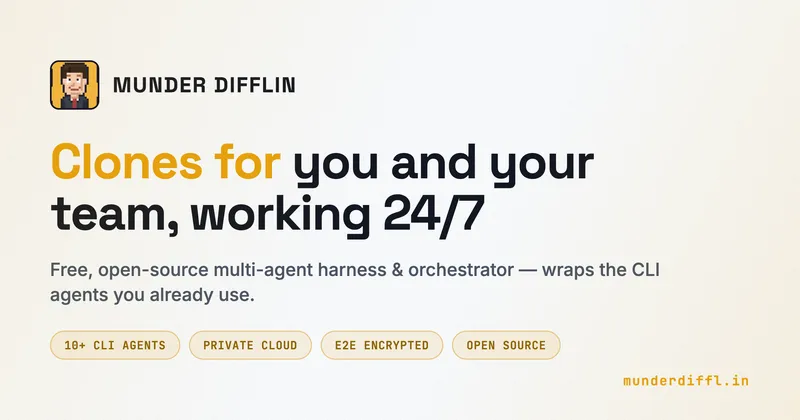
Munder Difflin is a free, MIT-licensed open-source multi-agent harness that wraps command-line AI agents into persistent personal “clones” that run tasks on a user’s computer. It supports existing subscriptions or API keys for tools including Claude Code, Codex, Gemini CLI, Copilot, Cursor and OpenCode. The software is designed to capture a user’s workflow, tooling and context so later clones inherit that memory, and it can automate command-line-accessible work such as code reviews, bug fixes, CI monitoring, documentation updates, design-system audits, ticket triage, CRM follow-ups and scheduling. Each clone runs as a node on its owner’s laptop by default, with code, keys and personal context remaining on that machine. Munder Difflin says clone-to-clone messages between teammates are encrypted on the sender’s node and decrypted only on the recipient’s node. Teams can provision a versioned shared knowledge base for common workflows, tooling and decisions while keeping personal context separate. The company sells optional Secure Org Network and Cloud + Network services: Teams Lite provides clone messaging and a shared knowledge base, while Teams Pro and Cloud + Network add dedicated sandbox virtual machines so clones can run continuously when laptops are closed. A $20 one-time purchase adds a supporter’s name to a Founders’ Wall; the core local application remains free.
Key Takeaways
- Munder Difflin wraps existing command-line AI agents into personal clones that can perform scriptable tasks on a user’s computer.
- The core application is free, open source under the MIT license, and uses customers’ existing AI subscriptions or API keys.
- By default, clones run locally, and Munder Difflin says code, keys and personal context do not leave the owner’s machine.
- Optional team services provide encrypted clone-to-clone messaging, a shared organizational knowledge base and dedicated sandbox VMs for always-on operation.
What the discussion said
Commenters spent less time debating an imagined autonomous office than asking whether the product is a useful agent-control surface or a decorative simulation wrapped around existing coding subscriptions. The builder’s core claim—that local, deterministic simulations and a shared memory layer can cut token use—drew interest, but the thread supplied little independent validation. One hands-on reader found the idea compelling while pushing for a much more disciplined workflow: reusable roles, multiple workers per role, explicit plan-review-approval-development-QA stages, and clearer intervention points instead of tasks drifting among named characters. Several readers saw real promise in a spatial display for concurrent agents. When agents browse, call tools, consult data, and wait on one another, a visual state map could make invisible work legible. Others argued that a faux office is exactly the wrong abstraction: it imports workplace clutter, anthropomorphizes systems that should be named by objective, and may distract from effective orchestration. The Office parody landed for some as an honest joke about today’s brittle swarms, whose narrow goals can collide into failure. That same joke fueled skepticism that the harness adds productivity rather than merely turning AI work into a tamagotchi. Readers also questioned whether specialized orchestration layers will endure as frontier models and labs absorb these capabilities, and criticized the product presentation for AI-style repetition and unclear positioning between game and tool.
Where opinion split
The sharp divide is whether a playful office visualization improves multi-agent orchestration or buries it under theater. Supporters argue that parallel agents need a spatial, at-a-glance representation of tool use, dependencies, and waiting states; critics say the office metaphor creates distraction and should yield to explicit objectives, pipelines, and controls.
Community Sentiment
Positives
- A deterministic local simulation paired with shared cross-agent memory could reduce repeated context loading and make subscription-backed coding agents cheaper to operate.
- A spatial view of parallel tool calls, research, database access, and agent handoffs could expose bottlenecks that a scrolling text log hides.
- The theme usefully satirizes current agent swarms, making their conflicting goals and brittle coordination easier to notice rather than pretending they are autonomous employees.
- A hands-on tester found the concept fascinating and identified a credible path to usefulness through role templates, repeatable worker pools, review gates, and QA loops.
Concerns
- The product’s purpose is muddy: readers could not quickly tell whether it is a serious productivity harness or an entertaining LLM simulation, undermining trust in its practical value.
- Named personality agents and work bouncing among them look like imported office dysfunction, when objective-based labels and explicit pipelines would make AI behavior safer and easier to steer.
- The pixel-office interface may consume attention without improving orchestration; critics see it as a familiar visual gimmick rather than actionable operational telemetry.
- Readers doubt the harness has durable value if smarter models or major AI labs soon provide orchestration and memory features directly.
Related Articles
I ditched OpenClaw and built a more secure AI agent (Blink and Mac Mini)
Feb 13, 2026
OpenClaw is a security nightmare dressed up as a daydream
Mar 22, 2026

Claude Code as a Daily Driver: Claude.md, Skills, Subagents, Plugins, and MCPs
May 27, 2026
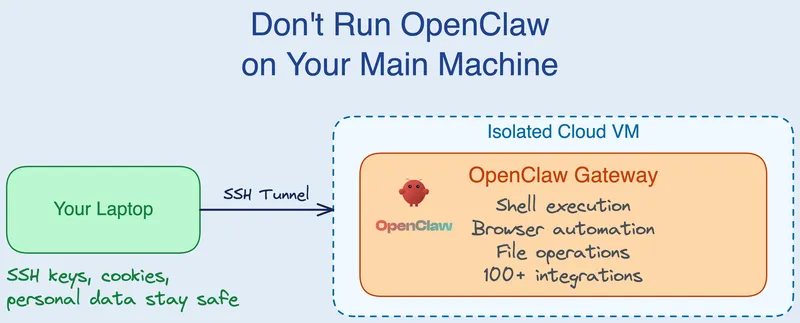
Setting up OpenClaw on a cloud VM
Feb 27, 2026
Slack Code
Aug 20, 2026