Report · jamesyu.org
Award-winning AI literature
jamesyu.org
Source published October 22, 2026
Summary: 2 min read
46/100
Summary
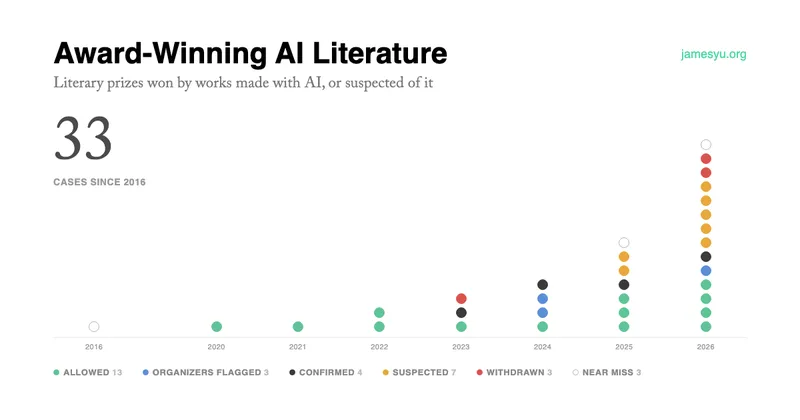
Literary prizes in multiple countries have recognized works made with generative AI, while other awards have revoked, reviewed, or disputed entries over alleged AI use. Japan’s Nikkei Hoshi Shinichi Literary Award explicitly permitted AI use and gave prizes to AI-assisted stories from 2022 through 2026. Its 2026 competition received 2,107 entries, counted 491 as partly AI-created, and said three of four general-division winners used AI somewhere in their process. Rie Kudan’s Akutagawa Prize-winning novel Sympathy Tower Tokyo used ChatGPT for roughly one page of its 143 pages, according to Kudan. Awards have also honored AI-centered poetry, fiction, and book projects when disclosure was permitted. Zuzana Husárová and Ľubomír Panák trained GPT-2 on 2,108 Slovak works for the 2021 Zlatá vlna-winning poetry collection Výsledky vzniku, while Sasha Stiles’s 2025 Lumen Prize-winning WORDS BEYOND WORDS generates a new poem whenever it is refreshed. Some allegations remain unresolved or were rejected after review. The Commonwealth Foundation retained 2026 prizes for Jamir Nazir, John Edward DeMicoli, and Sharon Aruparayil after reviewing evidence supporting their denials of AI use. In contrast, publishers and contest organizers have withdrawn or changed results in several cases, including the removal of Thélyson Orélien’s novel from the Goncourt longlist and Poetry.com’s reassignment of two 2024 monthly first prizes.
Key Takeaways
- The Nikkei Hoshi Shinichi Literary Award allowed AI use from the outset and reported that 491 of its 2,107 entries in 2026 were partly AI-created.
- Rie Kudan said ChatGPT contributed about one page to her 143-page Akutagawa Prize-winning novel Sympathy Tower Tokyo, primarily for dialogue written by an AI character.
- The Commonwealth Foundation retained several 2026 short-story prizes after examining drafts, timestamps, notes, and testimony from writers accused by AI detectors.
- The Slovak poetry collection Výsledky vzniku won the 2021 Zlatá vlna after its creators trained GPT-2 on 2,108 Slovak literary works and curated its output.
- Some award organizers have removed, recalled, or reassigned honors after AI-use allegations, although detector-based allegations have also been disputed or overturned.
What the discussion said
Commenters spent less time celebrating a supposed rise in award-winning AI literature than interrogating what the label even covers. Several argued that AI involvement spans a huge range: brainstorming plots, inventing a name, grammar help, cover art, and wholesale prose generation are not morally or artistically equivalent. Treating every one of those cases as an AI-authored win makes the underlying tally look inflated, especially when it includes contests designed specifically for machine-assisted work or prizes where the disclosed contribution was trivial. The deeper split was over whether provenance matters once readers encounter the finished text. One camp argued that literature is judged by what it does on the page; if machine-written work becomes genuinely moving and indistinguishable in blind reading, human authorship is not a necessary ingredient of quality. They also noted that AI can help writers discover narrative possibilities they would otherwise miss, and that human-made work may become more valued as a scarce craft. The opposing camp saw AI generation as a warning about diluted authorial effort, unreliable quality signals, and an automated flood that makes readers' limited attention harder to spend well. Even an experimenter building automated books conceded that current output is not yet comparable to strong human writing, instead working best in constrained, formulaic formats.
Where opinion split
The sharpest dispute is whether authorship matters independently of the quality readers perceive in the finished work. One side says a story that succeeds emotionally and aesthetically deserves credit regardless of whether a human or model produced it; the other says readers reasonably use human effort and lived perspective as signals that a work is worth their scarce time, especially amid cheap mass generation.
Coverage & discussions
Hacker News · jamesyu.org
Community discussions
Community Sentiment
Positives
- AI can serve as a genuine creative aide for plotting and character development, surfacing narrative routes a writer might never have considered alone.
- Blind-reader evidence that language models can produce appealing poetry suggests preference-trained systems already clear a meaningful bar for surface-level literary enjoyment.
- As synthetic media becomes abundant, human-made literature may gain value as a scarce, deliberately crafted alternative rather than simply disappearing.
- Current automated publishing experiments appear most viable in tightly structured formats such as recipes and historical retellings, where models can avoid some fiction-writing failures.
Concerns
- A single AI-assisted category collapses trivial help like naming a fictional disease into full text generation, turning award tallies into misleading evidence of model capability.
- Including competitions explicitly built for machine-assisted writing makes claims of broad literary recognition look like promotional accounting rather than an independent quality signal.
- Readers see AI use as a practical warning that an author may have offloaded the hard work of composition, leaving them to sift through a larger volume of low-effort prose.
- Preference-optimized model writing can charm at first glance while flattening the lived experience, difficult themes, and distinctive intent many readers seek from literature.
- Even proponents of automated books concede that the systems remain below strong human writing and work best by steering around the uncanny weaknesses of open-ended fiction.