BeBox is a Haiku application that emulates Be Inc.'s BeBox
github.com
October 15, 2026
13 min read
48/100
Summary
BeBox is a Haiku application that emulates Be Inc.’s dual-processor BeBox systems and earlier Hobbit-based prototypes. It runs the 66 MHz dual-PowerPC 603 BeBox and the 133 MHz dual-PowerPC 603e model from original boot ROMs, supporting PowerPC BeOS releases from Developer Release 6 through R5.0.3. The emulator includes PowerPC processors, the MPC105 bridge, writable flash ROM, NVRAM, SCSI, IDE, floppy storage, video, sound, serial ports, game ports and NE2000-compatible Ethernet. It displays the BeBox’s two columns of front-panel LEDs and can run both emulated processors on separate host CPU cores. The Hobbit mode emulates two 25 MHz AT&T 92010 processors and hardware used in Be prototypes from 1993-94. Because no Hobbit boot ROM survives, BeBox directly loads the prototype system kernel from a floppy or SCSI disk image. Hobbit emulation includes SCSI, floppy DMA, serial ports, keyboard, mouse and Trident VGA graphics, but not its DSPs, sound, Ethernet, joystick or parallel hardware. BeBox supports raw and QCOW2 disk images, overlays, Haiku shared folders mounted by BeOS as BFS disks, NAT-based networking and port forwarding. Original BeBox ROMs, BeOS media and prototype disk images are required separately and are not included.
Key Takeaways
- BeBox emulates 66 MHz and 133 MHz dual-PowerPC BeBox models and runs PowerPC BeOS releases from Developer Release 6 through R5.0.3.
- The emulator also supports 1993-94 dual-AT&T Hobbit Be prototypes, loading their kernels directly because no boot ROM is known to survive.
- BeBox provides emulated SCSI, IDE, floppy, video, sound, serial, input and NE2000-compatible networking hardware, although several ports and Hobbit devices remain unimplemented.
- Haiku folders can be exposed to supported BeOS releases as writable BFS volumes, with changes copied back after a clean BeOS shutdown.
- BeBox requires users to supply BeBox ROMs and BeOS installation media because they are not distributed with the project.
What the discussion said
The thread was overwhelmingly a nostalgia exchange about BeOS, Haiku, QNX, and the unusually responsive desktop experience those systems delivered on modest hardware. That matters to the AI-adjacent discussion because one reader framed today’s local-model hardware as an ironic contrast: people can buy powerful machines for large language models, yet still encounter sluggish modern desktop behavior. The implication was not that LLMs cause the slowdown, but that abundant compute has not guaranteed a snappy everyday experience. The clearest AI optimism came from the old BeOS problem everyone remembered: too few applications. Several readers treated modern LLM-assisted programming as a plausible way for small or hobbyist operating systems to overcome that historic software drought. The hope is that lowering the effort required to build simple utilities could make ecosystems such as Haiku, AROS, and MenuetOS more viable. A separate remark pointed to neural-network-based code analysis as a possible route to speeding Linux subsystems, though it offered no evidence that such work has delivered practical gains. No one debated model quality, safety, training, or benchmarks; AI appeared mainly as a tool for revitalizing neglected platforms and as part of the broader compute-heavy present being compared with leaner systems of the past.
Community Sentiment
Positives
- LLM-assisted coding could finally give small operating-system communities enough leverage to fill the long-standing gap in everyday applications.
- Neural code analysis was raised as a potential way to tune Linux internals, suggesting AI may help recover some of the responsiveness older systems made memorable.
Related Articles
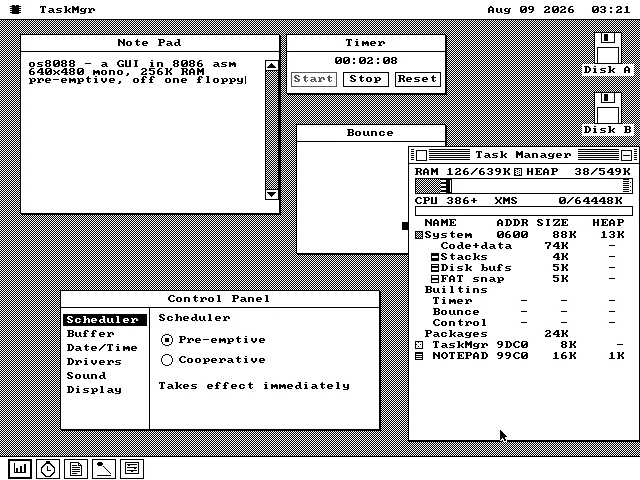
Os8088: A powerful Mac-like OS for the IBM XT, 286, 386
Aug 8, 2026
I need your clothes, your boots, and your motorcycle
Jun 18, 2026
How the Claude Code team does code review
Oct 16, 2026
Llama.cpp on a jailbroken PS5: run any GGUF model natively on the console
Oct 16, 2026

Apple ML Research: Muse Spark Open with MLX on Mac Studio
Oct 16, 2026