Report · brown.edu
Brown student maps the hidden global labor powering AI
brown.edu
Source published October 26, 2026
Summary: 1 min read
56/100
Summary
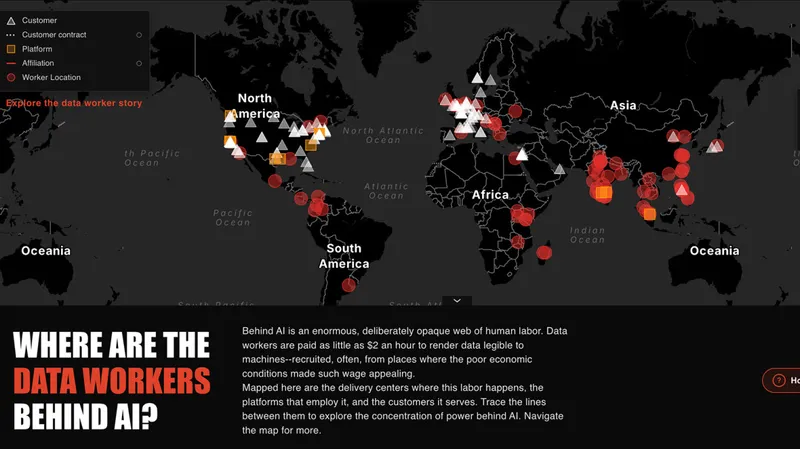
Brown University senior Cunyan Ma has created a free interactive map that links technology companies and their intermediaries to data workers around the world. Developed with Brown’s Center for Technological Responsibility, Reimagination and Redesign, the map combines existing data-worker databases, Ma’s own data collection and news reports on working conditions. It is part of an ongoing project examining the material underpinnings of the digital world. Data workers train AI systems by labeling objects in images, identifying parts of speech, transcribing speech, rating chatbot responses and marking tumor boundaries in medical scans. The work is often outsourced to people in the Global South who may receive low wages, according to Brown University. Some workers must also review disturbing images and text so AI systems can recognize harmful content or avoid producing it. Ma said the map is intended to make “AI colonialism” more visible and accessible, while supplementing anecdotal reporting with a broader picture of connections among technology firms, intermediaries and workers.
Key Takeaways
- Cunyan Ma’s interactive map aggregates databases, original data collection and news reports to connect technology companies and intermediaries with data workers worldwide.
- Data workers support AI training through tasks including image labeling, speech transcription, chatbot-response ratings and medical-image annotation.
- Some data workers review disturbing material to help AI systems identify harmful content and prevent chatbots from generating it.
- Ma said the project seeks to visualize AI colonialism and expand understanding beyond individual accounts of data-worker conditions.
What the discussion said
The thread focused less on the map itself than on what today’s hidden AI labor actually looks like. Many readers accepted the core premise: content moderation, annotation, and reinforcement-learning work are indispensable inputs to safer and more capable models, yet the people doing it can be geographically dispersed, poorly visible, and hard to organize. The strongest concern was not merely low pay but sustained exposure to abuse imagery, violence, and other disturbing material, which commenters argued creates a psychological hazard that cannot be waved away as easier than farm or construction work. Opinion split over both the article’s political framing and its currency. Critics called the colonialism label inflated, arguing that voluntary work in lower-income economies is not equivalent to coercive imperial rule and that the local economic context drives wages. Others replied that AI companies still exploit a global hierarchy built by wealth and power, whether the preferred label is colonialism, capitalism, or labor arbitrage. Several commenters also challenged the map’s implied picture of AI data work: they said modern demand has shifted from low-paid labeling toward higher-paid RL environment tasks, often performed by educated workers in wealthy countries. Even those skeptical of the rhetoric generally saw value in mapping the supply chain, provided it captures major platforms and changing work patterns accurately.
Where opinion split
The sharpest dispute was whether AI’s global labor pipeline deserves the colonialism label. Skeptics argued that paid, voluntary remote work—sometimes well above local wages—should not be conflated with forced extraction, while supporters argued that AI firms profit from entrenched global inequality, opaque contracting, and workers’ weak bargaining power, making the analogy substantively useful even if imperfect.
Coverage & discussions
Hacker News · brown.edu
Community discussions
Community Sentiment
Positives
- Mapping the human supply chain behind training and safety work makes an invisible part of AI development legible, giving workers and policymakers a clearer target for accountability.
- Several readers say the industry has moved beyond the caricature of universally underpaid labeling: RL environment work can pay roughly $35 to $100 per hour and attract educated workers in richer countries.
- The thread treats human review as a real safety function, since models cannot reliably filter or avoid generating harmful material without people first identifying it.
- Some commenters see practical room for improvement rather than fatalism: better pay, training, and mental-health support could reduce the damage of high-exposure moderation work.
Concerns
- Nine-hour shifts spent labeling sexual abuse, murder, suicide, and other extreme material can inflict psychological harm that physical-job comparisons dangerously minimize.
- Dispersing AI workers across opaque contractors and keeping them disconnected makes collective bargaining far harder, leaving already powerful platforms with even more leverage.
- The familiar Kenyan RLHF example reinforced fears that frontier-model safety has been subsidized by low-paid workers handling material that wealthier users and firms prefer not to see.
- Critics say the project may be stale if it overlooks major annotation platforms and the shift from commodity labeling to RL tasks, risking an outdated account of who trains modern AI.
Related Articles
Workers are spending over 6 hours a week botsitting AI, fueling job frustration
Jun 11, 2026

ChatGPT Lawsuit: OpenAI Accused of Using Kids’ Data
Oct 26, 2026

Cognitive Mercantilism: AI panic resembles fears of early capitalism
Oct 26, 2026

R/open source bans all solo projects and projects using LLMs
Oct 25, 2026
Imagine an AI future where being banned means you are now economically useless
Oct 25, 2026