Can a MUD evaluate LLMs? A $99 proof of concept
cruciblebench.ai
July 22, 2026
5 min read
🔥🔥🔥🔥🔥
51/100
Summary
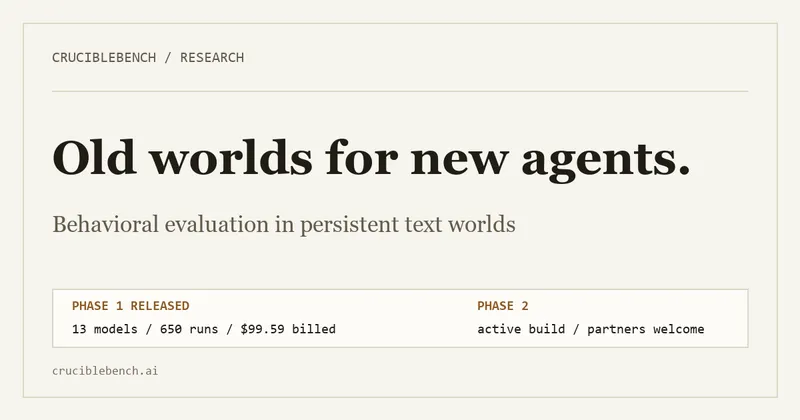
CrucibleBench places language models in a persistent MUD environment where NPCs can remember interactions, accumulate trust, and leave traces of mistakes. The system evaluates AI performance over 50 turns with hidden social objectives, utilizing established technology in innovative ways.
Key Takeaways
- CrucibleBench evaluates language models in a persistent MUD environment, where NPCs remember interactions and trust accumulates over time.
- The evaluation framework includes measurable constraints such as a limited action space, explicit social feedback from NPCs, and within-run persistence of items and trust.
- A single LLM-judge component can significantly reorder model rankings, indicating that aggregate reliability statistics may not fully capture performance variations.
- Benchmarks using LLM judges should report per-subject agreement and ranking stability to provide a clearer understanding of model performance.
Coverage & discussions
Hacker News · cruciblebench.ai
Community discussions
Community Sentiment
Positives
- Integrating LLMs with MUDs could spark a revival of text-based gaming, making it more engaging for a new generation.
- One commenter is having a blast letting agents interact in a MUD, showcasing the potential for LLMs to autonomously build maps and classify events.
- The idea of using a MUD as a testing ground for LLMs is brilliant; it leverages text as the native environment for these models.
Concerns
- There's a sense of frustration about the decline of MUDs, with some blaming Discord for its shortcomings, but others argue it's more about user engagement.
- The skepticism about whether MUDs can truly compete with modern social platforms highlights a concern about their relevance.