Development statistics for the 7.2 kernel

lwn.net
October 17, 2026
10 min read
52/100
Summary
Linus Torvalds released Linux kernel 7.2 on August 17 after a development cycle that added nearly 600,000 lines of code. The release incorporated 16,418 non-merge commits from a record 2,652 developers, making it the kernel’s second-busiest cycle by commit count after 6.7. Uwe Kleine-König submitted the most commits, while Matthew Stewart changed the most lines, largely through generated AMD GPU header files. Work was attributed to 249 employers; Intel led by commits with 1,512, while AMD led by changed lines with 224,121. Kernel 7.2 also set a record of 613 first-time contributors. LLM use became more visible: 1,111 commits, or under 7% of the total, included Assisted-by tags, up from 301 in 7.1. Rosen Penev submitted numerous LLM-authored fixes, and 252 patches credited the Sashiko review system with Reported-by tags; 568 commit messages mentioned Sashiko. The release included 4,830 commits with Fixes tags, a sharp increase that LWN linked to wider use of LLMs for finding defects. Review credits appeared on 48% of commits and testing credits on just over 8%, while review-tag use showed a mild recent decline. The linux-next repository already held nearly 14,000 non-merge changesets for 7.3, including more than 1,100 with Assisted-by tags.
Key Takeaways
- Linux kernel 7.2 included 16,418 non-merge commits from 2,652 developers, the second-highest commit total in kernel release history.
- The 7.2 development cycle added nearly 600,000 lines of code and set a new record with 613 first-time kernel contributors.
- At least 1,111 Linux 7.2 commits carried Assisted-by tags, up from 301 in kernel 7.1.
- Kernel 7.2 contained 4,830 commits marked as fixes for earlier bugs, alongside hundreds of reports credited to the Sashiko review system.
- Nearly 14,000 non-merge changesets were awaiting integration for Linux kernel 7.3, with more than 1,100 carrying Assisted-by tags.
What the discussion said
The thread treated the kernel statistics less as proof that AI is magically finding bugs and more as evidence that coding agents are changing the maintenance pipeline. Several commenters reported that agents can take a bug report through reproduction, diagnosis, and an initial patch quickly, leaving experienced maintainers to review technical choices rather than perform every investigative step. That is a meaningful productivity win in a project where debugging labor is scarce. But the apparent drop in bug reports drew a darker interpretation: users may be silently patching around upstream defects in their own code instead of filing actionable reports. Commenters also worried that AI-generated patches can turn maintainers into the last line of defense against plausible-looking nonsense, including elaborate local workarounds and potential concurrency defects. Others pushed back that this is not carefree autonomous development: kernel review still decides what lands, and pragmatic leadership has historically adopted useful tools while prioritizing correctness. The thread also challenged the article framing itself. A rise in fixes cannot cleanly be credited to LLMs without a control group, because funding, incentives, contributor behavior, and reporting patterns may all have shifted at once. The broad expectation was turbulence rather than either AI salvation or collapse.
Where opinion split
The sharp dispute is whether AI assistance is improving kernel quality or merely moving hidden risk and review work around. Optimists argue that agents accelerate the tedious path from report to tested fix, while human review preserves standards; critics argue that workarounds suppress upstream reports and generated patch volume lets subtle defects slip through. The statistics do not settle it, since no credible baseline isolates LLM use from changing project incentives.
Community Sentiment
Positives
- Agents can reproduce failures, trace their causes, and draft fixes from bug reports, compressing slow debugging work into a review-centered workflow.
- Human-reviewed AI assistance fits the kernel’s practical culture: use whatever removes real maintenance friction, but retain correctness as the admission price.
- Having an agent turn a raw device error into a possible diagnostic or fix is already concrete enough to change how developers approach support problems.
Concerns
- A falling bug-report count may be counterfeit progress when coding agents quietly route around library defects instead of sending maintainers reproducible upstream failures.
- Generated code can prefer baroque local hacks over proper API or upstream fixes, creating technical debt that looks successful until it breaks later.
- AI-authored patch floods risk exhausting volunteer review capacity, and a superficially credible change can still smuggle in races or other hard-to-spot regressions.
- More fixes per release is not proof of model-driven bug finding; altered funding, incentives, and reporting behavior make the headline’s causal story unmeasured.
Related Articles

AI bug reports went from junk to legit overnight, says Linux kernel czar
Mar 27, 2026

Linux kernel now allows AI-generated code, as long as you take "full responsibility" for any bugs
Apr 13, 2026
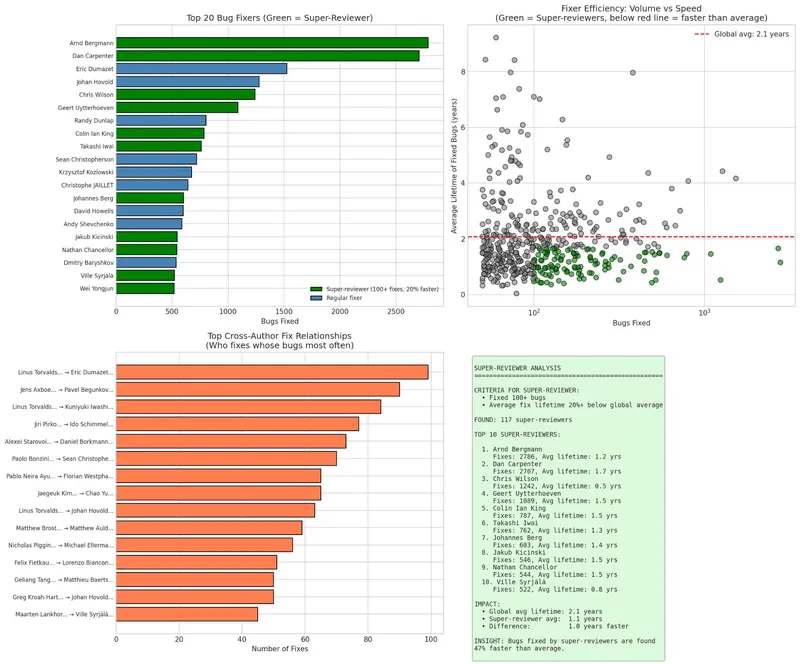
Who Writes the Bugs? A Deeper Look at 125,000 Kernel Vulnerabilities
Mar 4, 2026

Linus Torvalds says Linux is not an anti-AI project, and if you don't like that, then "fork it or just walk away"
Jul 17, 2026

Any window from your Mac, on your iPhone and iPad
Oct 16, 2026