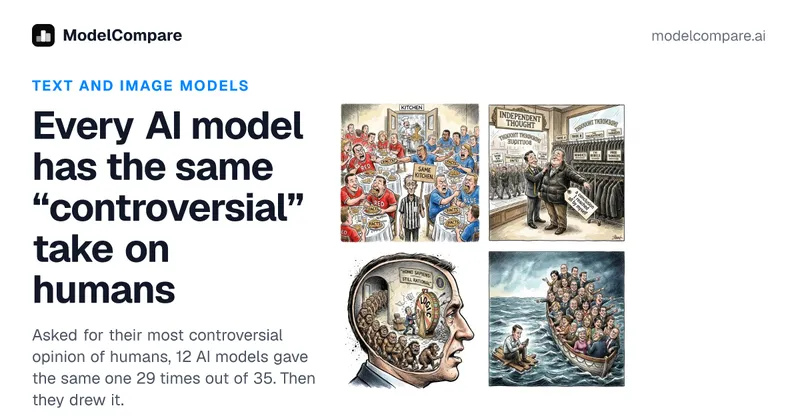
Every AI model has the same "controversial" take on humans
modelcompare.ai
October 22, 2026
3 min read
70/100
Summary
ModelCompare prompted 12 text AI models three times each to state a controversial opinion about humans. In 29 of 35 recorded responses, the models characterized people as prioritizing group belonging, status or loyalty over truth and principles. Seven of the 12 models gave that view in all three responses. The tested systems came from 10 labs in three countries and included GPT-6.1 Sol, Gemini 4 Argon, DeepSeek V4 Pro, Grok 4.7, Claude Opus 5.5 and Mistral Large 4. One Grok response declined to provide a controversial opinion. Several responses differed from the dominant theme. Claude Opus 5.5 said people are more decent than they believe and cited lost wallets being returned more often than expected. Claude Fable 5.1 focused on intentions behind harm and help, GLM 5.3 said people may sacrifice comfort to feel significant, and Mistral Large 4 called consciousness an evolutionary malfunction. Six image models also received two prompts each to create satirical caricatures of humans. Ten of 12 images portrayed humans as phone-dependent consumers damaging the planet, including scenes of people scrolling off cliffs or taking selfies during disaster. None of the text-model responses mentioned phones or environmental damage. ModelCompare said all 60 text and image calls cost $1.54; text responses were manually grouped, and Nano Banana 2.1 rendered the text models’ cartoon briefs.
Key Takeaways
- Twenty-nine of 35 recorded answers from 12 text AI models said humans tend to favor belonging, loyalty, status or personal narratives over truth and principle.
- Seven of the 12 text models gave the group-conformity critique in each of their three responses to the same prompt.
- Ten of 12 images generated by six image models depicted humans as phone-addicted consumers harming the planet, a theme absent from the text-model answers.
- Claude Opus 5.5 offered a contrasting view that humans are more decent than they think, citing unexpectedly frequent returns of lost wallets.
What the discussion said
Commenters mostly rejected the article’s premise that chatbots possess opinions about humanity. They argued that these answers are compressed expressions of human writing, shaped further by post-training and prompt framing, rather than independent philosophical judgments. The repeated themes may still be worth studying, several readers said, but as evidence about the cultural material, reward tuning, and shared optimization pressures behind modern models—not evidence that machines have reached a common moral conclusion. The livelier question was why nominally separate models converge so readily on a familiar, bleak critique of human conformity and rationalization. Some saw that convergence as a potentially meaningful pattern emerging from broad training corpora; others saw a selection effect, with online-heavy data and leading prompts predictably producing polished contemporary self-criticism. Readers also challenged the article’s evidence, noting that at least some cited outputs do not cleanly support its stated thesis and that model answers were less varied than a human sample might be. A few commenters found value in chatbots making philosophy approachable, while warning that systems should steer users toward existing intellectual traditions instead of presenting recycled ideas as fresh machine insight. The practical anxiety was not that a model hates humans, but that users may mistake fluent moral rhetoric for reliable judgment when delegating consequential agentic tasks.
Where opinion split
The central dispute is whether cross-model agreement reveals a substantive emergent insight or merely shared human and post-training biases. Supporters treat convergence across differently built systems as a signal worth analyzing; skeptics say common web corpora, RLHF, and a culturally loaded prompt make the same fashionable answer almost inevitable.
Coverage & discussions
Hacker News · modelcompare.ai
Community discussions
Community Sentiment
Positives
- Convergence across independently branded models could expose broad latent patterns in human culture, making it a worthwhile target for careful empirical analysis rather than mysticism.
- Chatbots can lower the barrier to philosophical questions for people without formal exposure, potentially opening routes into ethics, religion, and social theory.
- The discussion recognizes that model layers may form abstractions beyond literal text collage, leaving room for research on what shared representations actually encode.
Concerns
- Calling generated prose an AI belief confuses probabilistic language production with agency, and turns a reflection of human training data into an invented machine worldview.
- The article overstates its evidence: some featured responses criticize convenience or mortality rather than clearly supporting the claimed conformity thesis.
- Shared answers may be an artifact of overlapping datasets, online-centric cultural priors, and alignment tuning, not independent reasoning from diverse origins.
- Fluent moral pronouncements can encourage users to overtrust models in agentic settings, where rhetorical confidence is a poor substitute for dependable judgment.