GPT 5.6 Sol 20% price reduction
developers.openai.com
August 22, 2026
2 min read
49/100
Summary
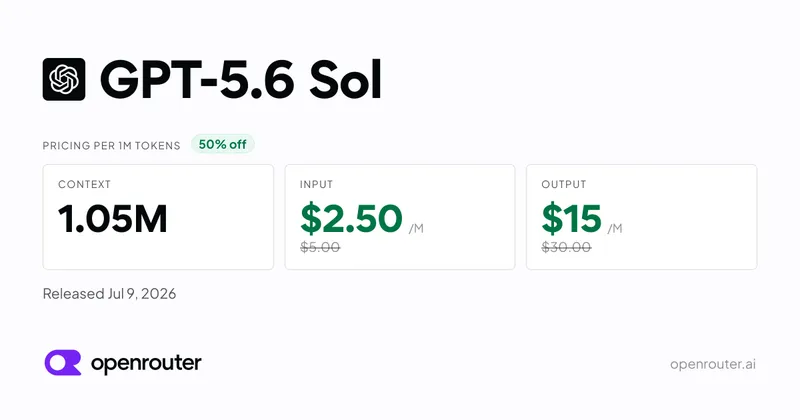
OpenAI’s GPT-5.6 Sol is a frontier model for complex professional work and the top tier of the GPT-5.6 family. The gpt-5.6 alias routes requests to GPT-5.6 Sol, which roughly corresponds to the unsuffixed model tier in earlier GPT-5 families. It accepts text and image inputs and produces text output, with a 1,050,000-token context window, a maximum output of 128,000 tokens, and a February 16, 2026 knowledge cutoff. The model supports reasoning-effort settings of none, low, medium, high, xhigh, and max; medium is the default. It supports streaming, function calling, structured outputs, and a range of Responses API tools, including web search, file search, image generation, code interpreter, hosted shell, computer use, MCP, and tool search. Fine-tuning is not supported. GPT-5.6 Sol costs $4 per million input tokens, $0.40 per million cached-input tokens, and $20 per million output tokens. OpenAI says these rates represent 20% lower input pricing and 33% lower output pricing, with promotional pricing available at least through November 21, 2026. Requests containing more than 272,000 input tokens are billed at twice the input rate and 1.5 times the output rate for the entire request.
Key Takeaways
- GPT-5.6 Sol is OpenAI’s frontier GPT-5.6 model for complex professional work, and the gpt-5.6 alias routes to it.
- The model supports text and image inputs, text output, up to 1,050,000 context tokens, and up to 128,000 output tokens.
- GPT-5.6 Sol costs $4 per million input tokens and $20 per million output tokens, with cached input priced at $0.40 per million tokens.
- The model supports configurable reasoning effort and Responses API tools including web search, code interpreter, computer use, and MCP.
What the discussion said
The thread treated the 20% headline as only part of the story: commenters focused on whether Sol’s lower API price can dent Claude Code’s grip on coding workflows. Some developers say Sol is now the sharper, less meandering coding assistant and that Codex plans deliver far more usable token capacity. Others have tested both and still find Claude materially more reliable, arguing that its position is earned by results rather than brand inertia. Several readers see rapidly changing model quality as a reason to switch providers every few weeks, while enterprises may be slower to retool around each new winner. The broader reaction welcomed price pressure, especially from DeepSeek and other open models, as a force pushing frontier labs toward commodity pricing. Yet practical comparisons were uneven: one user found DeepSeek and GLM unsuitable for production because they looped, consumed budget, and required close supervision, whereas US models completed the same work cleanly. Skeptics also questioned OpenAI’s commercial execution: a discount on its premium model sits awkwardly beside reduced Codex subscription capacity and a costly instant chat model. The promotion appears temporary, and some readers suspect it is a customer-acquisition move before later price increases rather than a durable cost pass-through.
Where opinion split
The sharp dispute is whether lower Sol pricing can overcome Claude Code’s lead in developer workflows. Claude’s defenders say developers retain it because it produces better code, while Sol supporters say its current quality, concise behavior, and more generous Codex allowances already make it the stronger value. Both sides reject the idea that management mandates alone can settle that comparison.
Community Sentiment
Positives
- Sol is seen by several active users as a more direct coding model than Claude, avoiding verbose detours that slow down iterative programming.
- Codex’s larger token allowance makes the cheaper model practically useful for heavy coding sessions, not merely attractive on a per-token price sheet.
- Competition from DeepSeek and open-model ecosystems is forcing US frontier labs to cut prices, giving customers leverage against concentrated AI pricing.
- Some developers are successfully adding low-cost open models to agentic workflows, showing that cheaper alternatives can cover meaningful portions of the stack.
Concerns
- Claude Code remains the preferred tool for some developers despite Codex costing less, suggesting OpenAI has not clearly won the quality comparison that drives adoption.
- Reports of sharply reduced Codex weekly capacity undermine the value proposition for long-standing subscribers and may push heavy users to cancel.
- Production users describe some Chinese open models as looping until budgets vanish and needing constant oversight, a severe failure mode for autonomous agents.
- The advertised reduction is temporary promotional pricing, making it unclear whether customers are seeing lasting inference efficiencies or a short-term market-share bid.