Explorative modeling: Train on the best of K guesses
alexiglad.github.io
August 1, 2026
17 min read
🔥🔥🔥🔥🔥
51/100
Summary
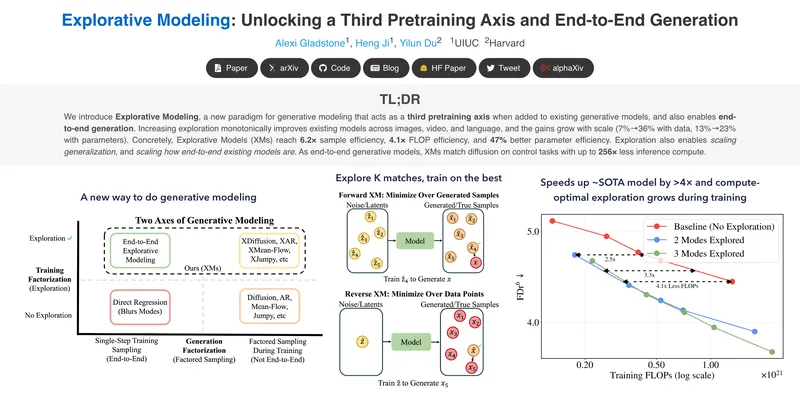
Explorative Modeling introduces a third pretraining axis for generative models, enhancing end-to-end generation capabilities. Increased exploration leads to improved performance across images, video, and language, with benefits scaling alongside model size.
Key Takeaways
- Explorative Modeling introduces a third pretraining axis for generative models, enhancing their performance in images, video, and language.
- The new paradigm achieves up to 6.2× sample efficiency, 4.1× FLOP efficiency, and 47% better parameter efficiency compared to existing models.
- Explorative Models match diffusion models on control tasks while requiring up to 256× less inference compute.
- Increasing exploration in generative modeling leads to improved performance gains that scale with data and parameters.
Coverage & discussions
Hacker News · alexiglad.github.io
Community discussions
Community Sentiment
Positives
- This seems like an important discovery. It hits a sweet spot of being effective and very simple to implement.
- The pseudocode comparison in the accompanying GitHub page is clear and helpful, showcasing the method's practicality.
- A well-structured blog post by the author makes the concepts easy to follow and digest.
Concerns
- This work overclaims its novelty, neglecting significant prior research that undermines its supposed innovation.
- The author seems confused about generative modeling, misunderstanding how previous approaches handle the 'blur problem'.
- There are downsides like K-1 extra forward passes during training and inaccurate sampling behavior that could hinder performance.