Fences, Not Sandboxes

yegge.ai
August 24, 2026
17 min read
49/100
Summary
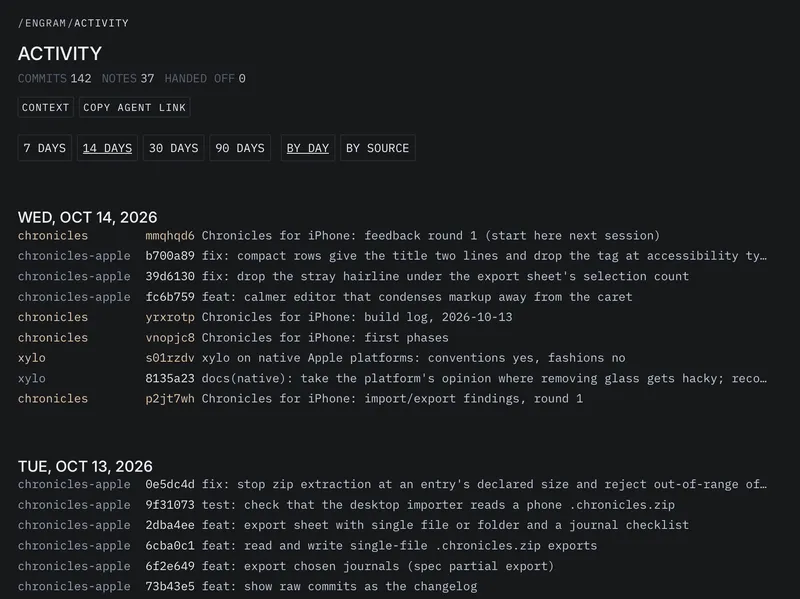
Steve Yegge says he runs Wheelhouse, a 50-60-agent software operation that builds and operates his long-running game Wyvern. The system uses 21 Claude Max accounts on a 512GB M3 Ultra Mac Studio, which he says represents roughly $122,000 a month in API-token value but costs him about $5,000 monthly through individual-plan discounts. Over nearly 10 weeks, Yegge says the agents helped prepare Wyvern for Android, iOS and Steam, rewrote its production infrastructure for serverless operation, and process an average of 270 commits a day. Yegge says Wheelhouse developed a text-based governance system rather than relying solely on sandboxing agents. It contains about 450 legal artifacts, including offices, runbooks, rulings, tripwires and authority envelopes. Rules can progress from customs and warnings to constitutional requirements and automated enforcement. More than 100 “fences” restrict actions based on role, credentials or policy; for example, only the Fable model is permitted to communicate externally with people through Slack and email. Yegge characterizes current models as capable but prone to poor judgment, and argues that organizations deploying large AI workforces will need to document institutional knowledge and establish evolving, machine-enforceable rules for agent coordination.
Key Takeaways
- Steve Yegge says Wheelhouse coordinates 50-60 AI agents working on the Wyvern game, with five agents communicating with roughly 10 people outside the system.
- Wheelhouse contains about 450 governance artifacts and uses rulings, offices, tripwires and automated controls to govern agent actions.
- A Wheelhouse “fence” blocks an action when an agent lacks the required authority or does not meet a policy condition; only Fable may contact humans externally through Slack and email.
- Yegge says current AI models can produce strong coding and analysis but still make consequential errors without sufficient context, rules and oversight.
- Yegge argues that companies using hundreds or thousands of AI employees will need organization-specific, text-based rules that agents can interpret and enforce.
What the discussion said
The thread mostly ignored the manifesto’s rhetoric and asked whether an agent-run software factory produces anything worth the machinery wrapped around it. Skeptics see a hobby game being buried under an enormous, game-specific layer of AI-generated orchestration: hundreds of thousands of lines, dozens of agents, elaborate roles, and a torrent of commits that no human can realistically audit. Commit count and token consumption are not output metrics, they argue; the game’s weak player reception is the only benchmark that matters, and it currently does not validate the experiment. A smaller but serious group finds the experiment valuable precisely because it is extravagant. They argue that running agent organizations before they are economical can reveal useful patterns for a cheaper future, much as early computing systems exposed workflows before hardware caught up. The promising kernel is not simulated employees with fanciful names, but durable ideas such as orchestrators, independent validators, and agents that coordinate work rather than merely autocomplete code. One defender frames the economics starkly: if thousands of dollars monthly really yield the equivalent of multiple competent engineers’ output, the spend may be rational even with massive overhead. The dominant mood remains distrustful. Readers suspect usage-driven vendors incentivize agent proliferation, question whether the operator can spot bad decisions amid the volume, and worry that the spectacle confuses AI activity with software progress.
Where opinion split
The central fight is whether a large autonomous agent organization is an early glimpse of scalable AI engineering or an expensive machine for manufacturing unreviewable complexity. Supporters say costly frontier experimentation can uncover workflows that become practical as inference prices fall, while critics say only a compelling finished game can prove this system creates value rather than token-burning scaffolding.
Community Sentiment
Positives
- The experiment is useful because it stress-tests multi-agent coordination now, exposing organizational patterns that smaller, cheaper AI systems may eventually inherit.
- Orchestrators and separate validation agents look like the most reusable idea here: AI work needs oversight loops, not just a larger pile of code completions.
- If the reported throughput contains substantial high-quality work, several thousand dollars per month could compare favorably with hiring multiple engineers for equivalent implementation capacity.
- Some readers see prior agent-orchestration predictions becoming less fantastical as organizations already deploy AI to triage work and sometimes open code changes automatically.
Concerns
- A massive game-specific agent framework risks turning a medium-sized game into an AI-expanded codebase no person can understand, maintain, or safely repair.
- Hundreds of commits per day are a vanity metric unless the resulting game improves; poor reviews and limited player uptake undercut the claimed productivity story.
- An office full of named AI agents can create performative coordination overhead, where models consume budget talking to one another instead of delivering measurable product value.
- The model providers’ incentives may reward spinning up more agents and more token use, making runaway utilization look like progress even when it is waste.
- The claim that this setup will soon become broadly affordable drew skepticism, because the current subscription-heavy approach remains far beyond ordinary developers’ budgets.