Report · ryanmadden.net
GPT-5.6 Sol can beat Factorio on peaceful mode
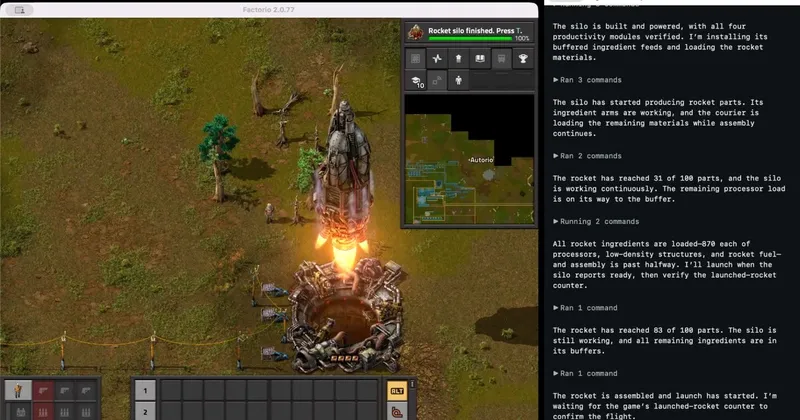
ryanmadden.net
Source published October 31, 2026
Summary: 1 min read
56/100
Summary
GPT-5.6 Sol completed a peaceful Factorio run and launched a rocket in 13.5 hours of game time while running in Codex at a low thinking level. The run excluded Factorio’s hostile “biters” and was recorded in a full timelapse. Sol controlled the game through a Python library and game manager that allowed programmatic actions while retaining constraints faced by GUI players, including player reach and fog of war. Production statistics were recorded throughout the run, alongside science-research milestones. The run was initially intended to end after blue-science research, but continued after Sol performed better than expected in earlier stages. Late-game factory scaling created significant problems. Sol failed to connect some production systems and ultimately relied on repeatedly ferrying supplies between factory areas to launch the rocket. The result improved on prior GPT-5.5 attempts, which failed to use transport belts. Ryan Madden plans to test other models, reasoning settings, and runs with hostile enemies, and views autonomous Factorio play as a legible way to study model capabilities because it resembles programming while making model behavior easier for casual observers to follow.
Key Takeaways
- GPT-5.6 Sol launched a rocket and completed a peaceful Factorio run in 13.5 hours of game time while operating in Codex at a low thinking level.
- A Python-based control library let Sol play Factorio programmatically while enforcing GUI-player constraints such as reach and fog of war.
- Late-game scaling issues left Sol unable to connect some production systems, so it repeatedly transported supplies manually between factory areas to achieve the rocket launch.
- The run improved on prior GPT-5.5 tests, which suffered from failures to use Factorio transport belts.
What the discussion said
Commenters treated the rocket launch less as proof of general game mastery than as a revealing stress test for agent planning. They agreed that vision-only control, keyboard and mouse operation, and completing a long, stateful game are real advances over the brittle demos of a few years ago. Several also saw practical promise in a narrower role: an agent that monitors multiplayer factories, extends outposts, or flags production failures could be genuinely useful. The reported cost, roughly consumer-subscription scale for a full run, made the experiment feel accessible rather than a giant-lab spectacle. But peaceful Factorio stripped out the pressure that would expose slow decision loops: without enemies, the model can deliberate indefinitely and recover from wasteful choices. The deeper criticism was that it reached the finish by behaving unlike a competent Factorio player, using the avatar as a high-throughput courier, hand-feeding machines, and patching logistics gaps instead of designing scalable belt-based production. Readers connected that pattern to a broader weakness in coding agents: they can execute local steps yet fail to form durable architecture. Skeptics also cautioned that a well-documented old game is a poor measure of discovery, since training material may include walkthroughs, planners, and complete factory blueprints. Evidence from tougher strategy games and enemy-enabled Factorio was cited as suggesting the capability remains fragile.
Where opinion split
The dispute is whether a peaceful, vision-only Factorio completion demonstrates meaningful autonomous intelligence or mostly retrieval and patient execution. Supporters see a model perceiving screens and carrying out a complex multihour task without privileged game-state access; critics argue that peaceful mode removes real-time stakes while abundant guides and blueprints, plus manual hauling, let it bypass the game's central automation challenge.
Coverage & discussions
Hacker News · ryanmadden.net
Community discussions
Community Sentiment
Positives
- Vision-only completion of a long factory-building game marks a substantial jump from earlier agents that needed privileged state, bespoke harnesses, or tightly scripted tasks.
- A low-cost run on a consumer plan makes extended AI-agent experiments feel within reach of independent developers rather than reserved for frontier labs.
- Small language models could enrich games when designed around them, especially as contextual NPC systems or persistent assistants rather than bolted-on chat windows.
- A factory-maintenance agent that spots breakdowns and expands remote outposts could turn LLM control into a useful cooperative-game tool instead of a novelty speedrun.
Concerns
- Peaceful mode removes the real-time combat constraint, allowing the agent unlimited deliberation where enemy pressure would punish slow perception and action loops.
- The model repeatedly substitutes player inventory hauling and hand-feeding for belts and scalable logistics, reaching the rocket while missing Factorio's core automation lesson.
- Its improvised factory layout looks like local problem-solving without a forward plan, echoing the architectural blind spots readers see in coding agents.
- A heavily documented game may reward absorbed walkthroughs, calculators, and reusable blueprints more than genuine exploration, hypothesis testing, or strategy invention.
Related Articles

Fable 5 vs. GPT-5.6 Sol on an NP-Hard Problem: Does /goal help?
Jul 18, 2026

GPT 5.6 Sol is the best "vision" model OpenAI ever released
Aug 17, 2026

We ran AI agent swarms in Minecraft and Mindustry
Oct 29, 2026

GPT-5.4
Mar 5, 2026
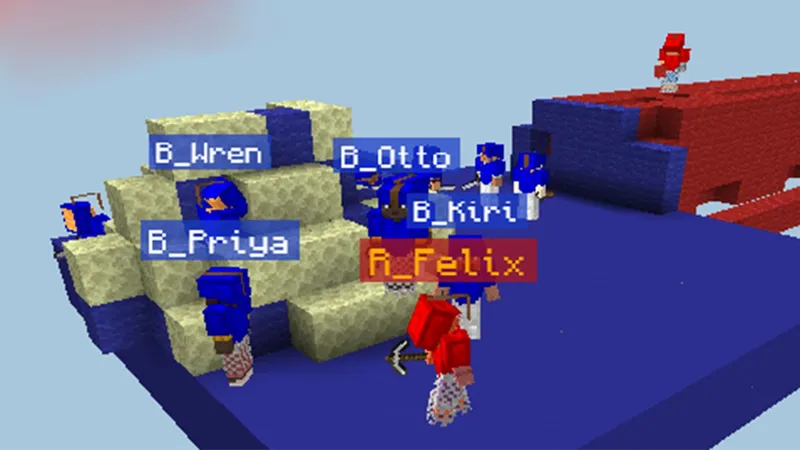
AI agent swarms in Minecraft fail to build civilization, drown in bureaucracy
Nov 1, 2026