Report · github.com
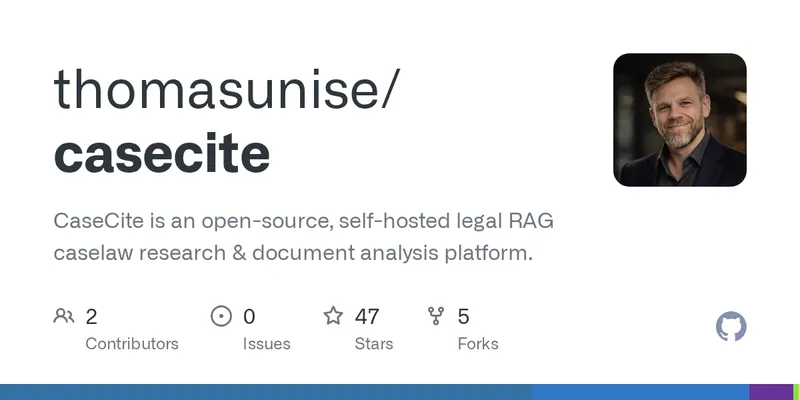
Harvey raised 500M for legal AI, I built the same and open sourced it
github.com
Source published October 28, 2026
Summary: 2 min read
46/100
Summary
CaseCite is an Apache 2.0-licensed, self-hosted legal research and document-analysis platform that lets firms upload documents, search and chat over them, research cases and judges, review contracts, and draft documents. It stores document originals, search indexes, chat histories, and analyses on the firm’s deployment, while AI requests send questions and relevant document text to configured providers under the firm’s own API keys. Its research system combines semantic retrieval with BM25 keyword rescoring and source citations. Contract tools analyze documents, compare two to four contracts against a baseline, and export redlines or drafts. Drafting can use up to four selected knowledge-base documents and supports section-by-section generation for long documents. Case-law functions, including case views, judge analytics, citation checks, dockets, oral arguments, and trends, rely exclusively on CourtListener. Citation checking scans citing opinions for negative-treatment language and is not presented as a Shepard’s or KeyCite replacement. CaseCite supports OpenAI, Anthropic, and Gemini for language-model tasks, and OpenAI, Voyage, or Cohere for embeddings. Firms can host OpenAI-compatible chat and embedding services to keep document text within their own network. Uploaded originals and API keys use AES-256-GCM encryption, but derived text in vector chunks, chat history, analyses, Postgres, and Redis requires host-level disk encryption. CaseCite has no SOC 2, ISO 27001, or HIPAA certification.
Key Takeaways
- CaseCite is an open-source, self-hosted platform for legal document research, contract review, drafting, and CourtListener-based case-law research.
- AI features transmit prompts and relevant document text to providers selected by the deployment; self-hosted chat and embedding endpoints can keep that text on the firm’s network.
- CaseCite’s research workflow combines semantic retrieval, BM25 rescoring, and inline citations to source documents.
- CourtListener is CaseCite’s only case-law source, and a CourtListener API token is required for citation checks and practical use at scale.
- CaseCite encrypts uploaded originals and stored API keys with AES-256-GCM, while vector chunks, chat history, and analyses depend on deployment-level disk encryption.
What the discussion said
The thread spent far less time celebrating a cheap Harvey substitute than dismantling the claim that it is equivalent. Several commenters argued that legal AI is not merely a language model wrapped around documents: large firms buy workflow integration, configurable downstream behavior, implementation help, operational support, and a vendor they can point to when clients or counterparties ask how sensitive legal work is handled. In that view, Harvey’s value is trust, risk allocation, and the unglamorous work of getting conservative professionals to adopt the tool, not a secret model capability. The sharpest criticism targeted credibility. Readers objected that the project was initially source-available rather than genuinely open source, with license-key restrictions that contradicted the headline. Even after a reported Apache relicensing, skeptics questioned whether a small, quickly assembled codebase, apparently lacking access to major legal databases and visible legal-domain expertise, could support a claim of functional parity. A few participants defended the broader premise indirectly: legal-specific AI can be genuinely useful, and self-hosted or jurisdiction-conscious document search offers real appeal. But the dominant reaction was that open code alone does not reproduce a mature legal-AI product or earn the institutional trust it sells on.
Where opinion split
The central dispute is whether legal AI is basically a replicable LLM-and-RAG wrapper or a full-service, trusted legal product. Skeptics of Harvey say firms are overpaying for a polished wrapper; defenders argue the integrations, legal tailoring, adoption support, data access, and liability posture are precisely the difficult product, not decorative extras.
Coverage & discussions
Hacker News · github.com
Community discussions
Community Sentiment
Positives
- Legal-focused AI can deliver real professional value when it is deeply tailored to attorneys’ tasks rather than offered as a generic chatbot.
- Self-hosted document analysis with offline, European, and frontier-model options points toward legal AI deployments that can better fit strict data-handling requirements.
- Harvey’s specialized workflows and support appear useful enough that major firms can get cautious legal professionals using AI in day-to-day practice.
Concerns
- Calling a restricted, license-key-controlled repository open source undermines the project’s central pitch and makes its governance claims look careless.
- A tiny, apparently rushed codebase does not substantiate parity with a heavily deployed legal-AI platform, especially in a domain where errors carry professional risk.
- Without broad access to case law and jurisprudence, a legal research system cannot credibly present itself as a complete replacement for established legal AI.
- Treating Harvey as only an LLM wrapper ignores the costly moat in integrations, configurable workflows, implementation support, and institutional accountability.
Related Articles
CEO fired developers to make room for AI. Developers create open source AI CEO
Aug 27, 2026
Odysseus – self-hosted AI workspace
May 31, 2026
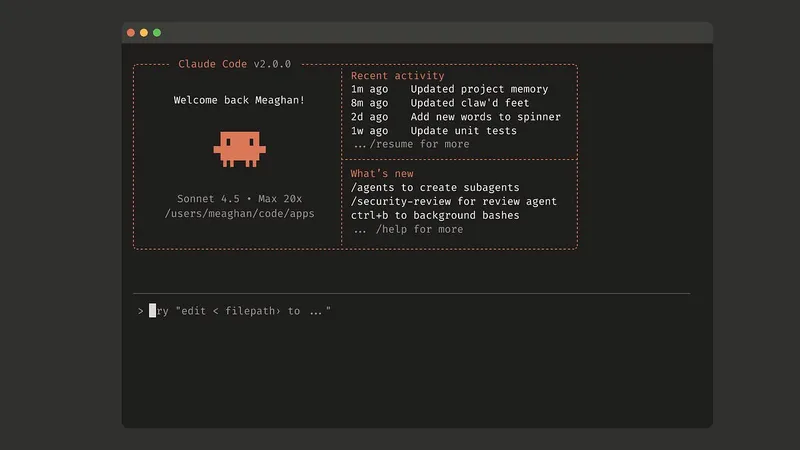
Claude Code – Everything You Can Configure That the Docs Don't Tell You
May 29, 2026
Stop wasting tokens and re explaining your project between sessions
Jun 21, 2026
Neckbeard – A DevOps/platform/SRE plugin for your agent
Oct 14, 2026