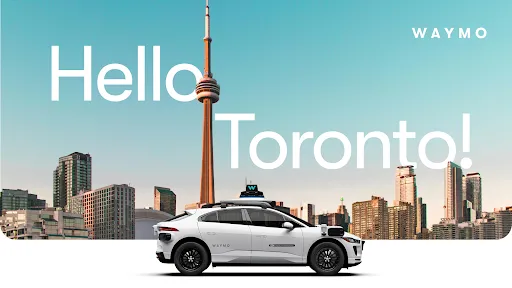
Hello Toronto – Waymo Is En Route
waymo.com
October 16, 2026
6 min read
60/100
Summary
Waymo plans to launch its fully autonomous ride-hailing service in Toronto in 2028, marking the company’s first expansion into Canada. In the coming days, Waymo vehicles will begin manually driven operations on Toronto streets for high-definition mapping and validation tests, with trained autonomous-vehicle specialists behind the wheel. Waymo says the phased testing is intended to adapt its Waymo Driver system to Toronto’s local driving conditions. Waymo has partnered with Toronto-headquartered Element Fleet Management for end-to-end fleet management. The companies plan to invest in hundreds of jobs over time, including fleet maintenance, validation driving, customer service and operational roles. Waymo also cites existing Canadian relationships with Canada Pension Plan Investment Board, a long-term investor, and manufacturer Magna International. Waymo says its all-weather Driver could complement Toronto’s existing transportation options. Based on more than 400 million fully autonomous kilometers driven, the company says its vehicles were involved in 95% fewer crashes involving serious injury or worse than human drivers in the cities where it operates. Waymo is also working with accessibility and mobility groups including BALANCE for Blind Adults, CNIB, Community Living Toronto, Connected Canadians and Epilepsy Ontario as it prepares the service.
Key Takeaways
- Waymo plans to begin fully autonomous ride-hailing service in Toronto in 2028, its first Canadian market.
- Waymo vehicles will initially operate manually in Toronto to map roads and validate the Waymo Driver with trained specialists behind the wheel.
- Element Fleet Management will provide end-to-end fleet management services for Waymo’s Toronto operation.
- Waymo and its partners plan to create hundreds of Toronto roles over time in fleet maintenance, validation driving, customer service and operations.
- Waymo says data from more than 400 million fully autonomous kilometers show its vehicles had 95% fewer serious-injury-or-worse crashes than human drivers in its operating cities.
What the discussion said
The thread treated Toronto less as a market-expansion story than as a brutal real-world evaluation of autonomous driving. Winter dominated: commenters focused on lidar clutter from falling snow, invisible lane markings under slush, improvised tire-track lanes, ice-bound intersections, snowbanks narrowing roads, potholes, and Toronto streetcars. Some expect the service to simply pause after major storms, while others point to ongoing cold-weather testing in Minneapolis as evidence that these are hard engineering problems rather than fatal ones. Experience reports produced a more balanced picture. Regular riders describe dependable, almost futuristic transport that drives more calmly than many people and gives pedestrians and cyclists a less distracted road user. The appeal is not merely novelty: a driverless ride can avoid harassment, fare manipulation, reckless fatigue, or unwanted conversation, while potentially cutting the labor share that makes transit frequency expensive. Yet one failed Austin trip, where a short journey turned into a long detour and required human support to end, reinforced doubts about operational reliability and dependence on current road maps. Safety and urban impact remained unsettled. Critics see robotaxis chiefly as job displacement and another prop for car-centric cities, especially compared with transit and protected cycling. Supporters counter that autonomous systems should be judged against ordinary human driving, which already produces far more serious harm, while demanding clear legal accountability when a vehicle behaves wrongly.
Where opinion split
The sharpest dispute is whether robotaxis are socially useful mobility or automation that mainly removes driving jobs and entrenches cars. Critics argue they cannot fix congestion or street disruption and should not outrank transit and cycling investment; supporters argue safer, more predictable rides, protection from bad driver behavior, and lower operating costs create meaningful public value if cities regulate them properly.
Community Sentiment
Positives
- Driverless rides can shield passengers from harassment, fare scams, exhausted driving, and intrusive encounters, making taxi travel more predictable rather than merely cheaper.
- Several riders say Waymos drive more patiently than typical motorists, a tangible gain for pedestrians and cyclists who are tired of distracted or aggressive human drivers.
- Removing the driver cost could make frequent transit service materially cheaper, with one comparison suggesting labor consumes roughly a third of city-bus operating budgets.
- Longtime users describe the service as consistently practical and unusually reliable, turning autonomous driving from a demo into a routine transportation option.
Concerns
- Snow, slush, erased lane markings, ice, narrowed lanes, and informal tire-track routes expose exactly the perception and planning edge cases Toronto must survive before autonomy earns trust.
- A reported Austin ride that ballooned from minutes into a lengthy failure suggests the system can still lose the plot when roads or routing data change, even if its vehicle control looks competent.
- A vehicle entering a crowded farmers market sharpened fears that autonomous fleets can make bad decisions without an obvious criminal driver, leaving accountability rules underdeveloped.
- Critics see robotaxis as labor-displacing car dependency in glossy form: they do not reduce trip demand, road disruption, or the need for better transit and cycling infrastructure.
Related Articles
Waymo in Portland
Apr 28, 2026
Servus München: Waymo Is Coming to Germany
Aug 25, 2026
Waymo says can't avoid bike lanes because riders want to be dropped off in them
Apr 26, 2026
Beginning fully autonomous operations with the 6th-generation Waymo driver
Feb 12, 2026
Waymo seeking about $16B near $110B valuation
Feb 2, 2026