Report · religionnews.com
Kentucky man becomes the first humanist granted religious exemption from AI
religionnews.com
Source published October 28, 2026
Summary: 2 min read
67/100
Summary
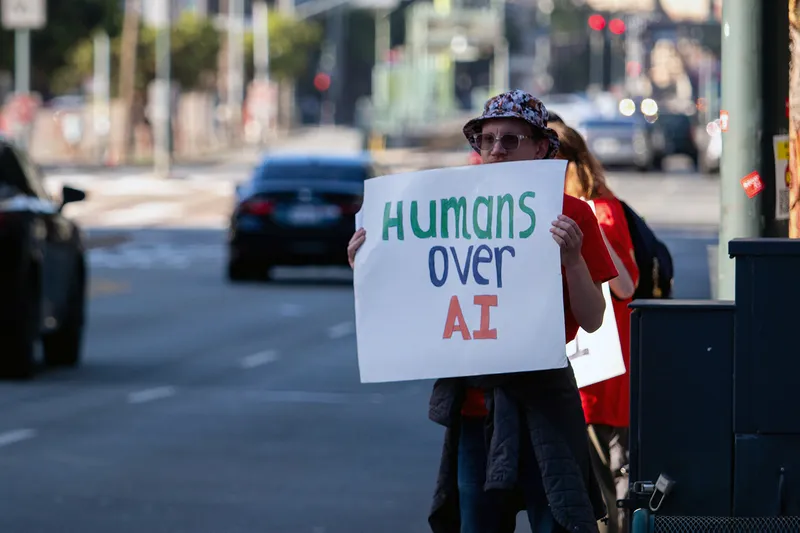
The University of Kentucky granted research administrator David Durman a religious accommodation in September allowing him to avoid personally using AI to complete his work. Durman, 45, requested the exemption with assistance from the American Humanist Association after the university began asking employees to incorporate AI tools such as Microsoft Teams Copilot, Claude and ChatGPT into their workflows. He said delegating thinking to AI conflicts with his humanist commitment to moral agency, human presence and human flourishing. The accommodation was granted under Title VII, the federal employment law requiring employers to accommodate sincerely held religious beliefs unless doing so creates an undue hardship. Durman helps university researchers prepare grant applications and said he can perform his duties without AI or effects on colleagues. A Sept. 25 letter from the university’s Office of Equal Opportunity said he may still need to attend meetings or submit materials through systems involving AI, but is excused from using AI himself for his tasks. The American Humanist Association said it believes the case is the first AI-use religious exemption granted to a humanist. Federal courts have recognized humanism as qualifying for religious protections, according to AHA staff attorney Alexandria Huiskens. Durman’s request followed an AI exemption awarded to Unitarian Universalist software engineer Erin Maus.
Key Takeaways
- The University of Kentucky allowed David Durman to opt out of personally using AI for work as a religious accommodation under Title VII.
- Durman said AI use conflicts with his humanist beliefs because he views independent thought, authentic listening and personal responsibility as necessary to moral agency and human flourishing.
- The exemption permits Durman to avoid using AI to complete tasks, while still requiring him to participate in meetings or systems that may involve AI.
- The American Humanist Association believes Durman is the first humanist to receive a religious workplace exemption from using AI.
What the discussion said
Commenters treated the exemption less as a quirky legal win than as an early test of whether people can remain full participants in AI-saturated work without delegating judgment to models. Several readers found the underlying ethic credible: if a task requires moral reasoning, understanding consequences, or responsibility toward other people, handing the cognitive work to an LLM can hollow out the human role even when the output is faster. They argued that impossible AI-era deadlines should be renegotiated rather than used to force unexamined automation. Others saw the stance as impractical or selectively anti-technology. Refusing email once damaged careers, they noted, and workers who reject AI may face the same pressure once AI-assisted output becomes the baseline. The thread also distinguished casual knowledge-work chatbots from software teams running coordinated fleets of coding agents, suggesting that AI’s workplace impact will not be uniform. Skeptics rejected the idea that LLMs are an existentially novel threat, while even some supporters worried that productivity gains could let employers sidestep accommodations entirely. There was broad interest in protecting sincere conscientious refusal, but little confidence that individual protections can withstand a labor market organized around AI speed.
Where opinion split
The sharp dispute was whether declining AI for ethical reasons is a defensible way to preserve human moral agency or simply an unsustainable refusal of a productivity tool. Supporters argued that decisions affecting others demand accountable human thought and that deadlines, not judgment, should give way; critics argued that work has always required adopting enabling technology and that an employer cannot indefinitely carry an employee who rejects essential tools.
Coverage & discussions
Hacker News · religionnews.com
Community discussions
Community Sentiment
Positives
- Keeping consequential decisions in human hands preserves responsibility and moral development, rather than turning workers into rubber stamps for model-generated judgments.
- The exemption gives conscientious AI abstention a foothold before automated workflows make opting out economically impossible.
- The contrast between one-off chatbot assistance and fleets of coding agents shows that AI adoption has materially different risks and benefits across occupations.
- Local, user-controlled AI was presented as a route to gaining useful capability without surrendering autonomy to always-connected platforms.
Concerns
- AI-assisted output may soon become the workplace baseline, leaving people who refuse models professionally stranded unless they can retire or occupy unusually protected roles.
- Organizations can weaponize AI-driven timelines, treating human deliberation as a bottleneck even when rushed automated decisions create downstream harm.
- Some commenters see anti-AI rhetoric as inflated fear of language models, warning that treating ordinary automation as a civilizational menace distorts sensible choices.
- A personal ban can look arbitrary when people already outsource physical labor and rely on vast networks of human expertise; opponents question why cognition alone receives special status.
Related Articles
You don’t need to believe in a god to get a religious exemption from using AI at work
Oct 30, 2026

Amazon scraps AI leaderboard to stop workers chasing usage scores
May 28, 2026

Amazon Employees Say AI Is Just Increasing Workload
Mar 12, 2026

‘If it wasn’t for ChatGPT my brother would still be alive’: inside OpenAI’s safety unit
Nov 1, 2026

Brazilian Court Sanctions Lawyers for Prompt Injection in Court Filing
Nov 1, 2026