Kimi K3 Architecture Overview and Notes
sebastianraschka.com
July 28, 2026
2 min read
🔥🔥🔥🔥🔥
67/100
Summary
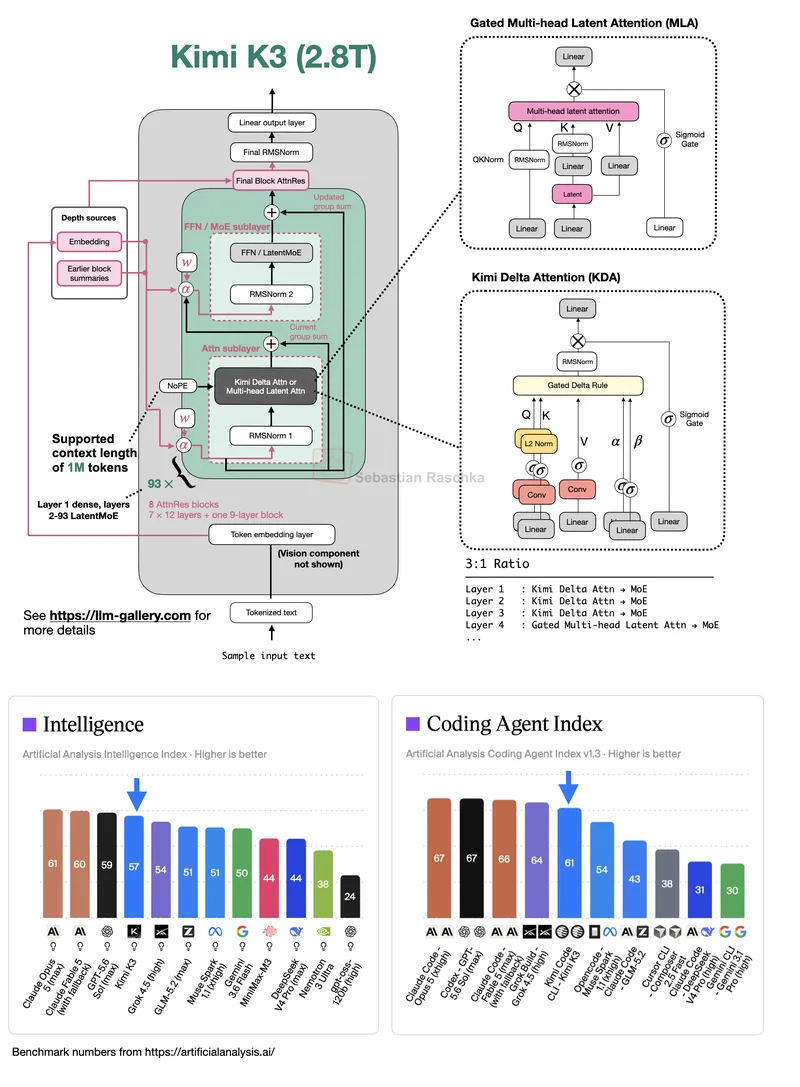
The Kimi K3 architecture is a scaled-up production version of the Kimi Linear model, increasing from 48 billion parameters to 2.8 trillion parameters. A new component in Kimi K3 is the LatentMoE, which enhances its capabilities as the largest open-weight model currently available.
Key Takeaways
- The Kimi K3 architecture is a scaled-up version of the Kimi Linear model, increasing from 48 billion to 2.8 trillion parameters.
- Kimi K3 introduces the LatentMoE component, which compresses large linear layers similarly to multi-head latent attention.
- The architecture replaces existing components with efficiency-tweaked versions, enhancing inference efficiency.
- Kimi K3 eliminates RoPE layers in favor of NoPE (No Positional Embeddings) and includes native multimodal support.
Coverage & discussions
Hacker News · sebastianraschka.com
Community discussions
Community Sentiment
Positives
- Raschka's insights are a rare gem in a sea of lazy LLM summaries — his clarity stands out and is worth following.
- The architectural choices like KDA and NoPE in Kimi K3 lead to impressive real-world performance, showcasing solid engineering.
- The decision to go with NoPE everywhere is intriguing; it suggests a bold move away from conventional methods that could redefine expectations.
Concerns
- The lack of positional embeddings raises eyebrows — is this just a recipe for token soup, or does attention really compensate?
- There's skepticism about Kimi K3's performance at frontier scale; will it really hold up against established models like Opus and Fable?
- Concerns linger about the implementation of KV-caches leading to inefficiencies, potentially complicating inference and performance.