LayerFS: The filesystem for AI coding agents
layerfs.ai
October 21, 2026
2 min read
45/100
Summary
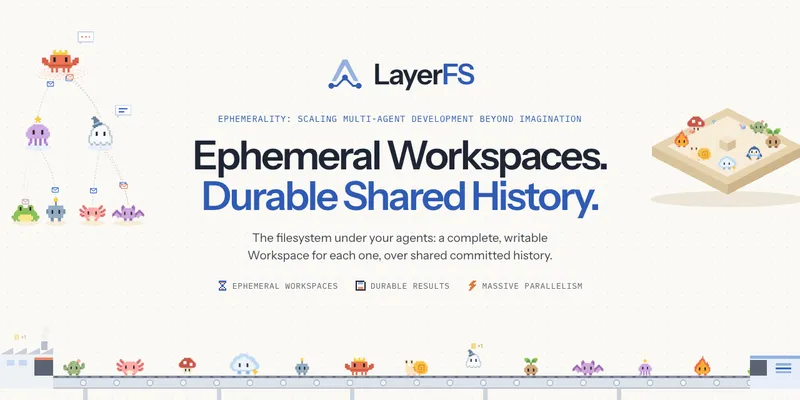
LayerFS is presented as a filesystem for AI coding agents that separates persistent storage from short-lived compute. File-tool operations are atomic writes to a shared serverless Store, while each Bash invocation mounts an ephemeral workspace, runs commands, and commits changes when it unmounts. Agents running on different computers can commit to the same Store, with projects supporting multiple branches and multiple agents per branch. Every tool call creates a commit on its branch. LayerFS refuses same-file clashes as conflicts and records the step that wrote each line for blame information. Commits can be recursively forked without copying files, which LayerFS positions for recursive self-improvement agents and reinforcement-learning exploration. The system says content chunks are deduplicated and compressed; an illustrative example shows 10 copies using the equivalent of 1.05 copies after deduplication and 0.31 copies after compression. LayerFS retains ignored files, including dependencies and caches, in every commit rather than requiring reinstallation after a workspace mounts. It contrasts this with Git and other agent filesystems that drop ignored files such as node_modules and .cache. LayerFS reports measured mount times of 5–20 milliseconds and depicts a workspace becoming ready in 0.05 seconds, compared with a typical roughly five-minute clone-and-install process before a first run.
Key Takeaways
- LayerFS commits each AI agent file or Bash tool call to a branch in a shared serverless Store, while Bash commands run in ephemeral mounted workspaces.
- LayerFS can refuse conflicting edits to the same file and associates individual lines with the commit step that wrote them.
- LayerFS says forks are metadata-only operations that do not copy files, enabling recursive branching of commits.
- LayerFS retains ignored dependency and cache files in commits, and reports 5–20 millisecond mount times instead of reinstalling dependencies.
What the discussion said
Commenters spent less time on the promised agent workflow and more on whether LayerFS is a genuinely new storage primitive or familiar filesystem ideas repackaged for the AI-agent boom. Several readers pointed to older research, a patent, and established layered or copy-on-write filesystems, arguing that versioned state, deduplication, and filesystem layers have long histories. The sharpest skepticism was that AI branding can make solved infrastructure look novel without proving a meaningful technical departure. Supporters did identify a potentially useful distinction: LayerFS appears to work at a content and version-history level rather than merely managing blocks, which could fit coding agents that constantly create overlapping workspaces, commits, and snapshots. Its deduplication benchmark was treated as a reason to investigate, not as proof that it is production-ready. One reader was particularly interested in the prospect of persistent, self-hosted agent state that can move between machines and coding harnesses instead of leaving sessions fragmented. Confidence in the release remained low. Readers questioned how a v1 can claim maturity while core architecture documentation is still absent, and the disclosure that a very large Rust codebase was LLM-produced intensified concern about verification, maintenance, and operational reliability. The general mood was curious about the problem, but unconvinced that this implementation has earned trust over battle-tested filesystems.
Where opinion split
The central dispute is whether LayerFS offers a real agent-specific advance or merely renames mature layered and versioned filesystem techniques. Defenders argue that content-aware handling of versioned data and deduplication could materially reduce the storage churn of coding-agent workflows; critics say the same goals have been addressed by established filesystems and prior research, while this project lacks the maturity and evidence to justify its novelty claims.
Coverage & discussions
Hacker News · layerfs.ai
Community discussions
Community Sentiment
Positives
- Content-aware deduplication aimed at rapidly branching agent workspaces could make repeated coding-agent experiments far less wasteful than ordinary block-level storage.
- A portable, self-hosted record of agent sessions across machines and coding harnesses addresses a real pain point: valuable context currently dies in scattered local environments.
- Producing a roughly quarter-million-line Rust system with LLM assistance looks technically striking, and suggests AI-assisted engineering can now attempt infrastructure-scale projects.
Concerns
- The project is being judged against long-standing layered, copy-on-write, and versioned filesystem work, so AI-agent framing alone does not establish a new technical contribution.
- A 1.0 label without available architecture details gives readers little basis to assess correctness, durability, or whether agent-specific claims survive scrutiny.
- LLM-generated infrastructure at this scale raises a hard trust problem: an impressive code count is not evidence that a filesystem has been audited or can survive production failures.
- Battle-tested kernel filesystems already handle mission-critical workloads, making an unproven agent-focused alternative difficult to justify without dramatic measured gains.