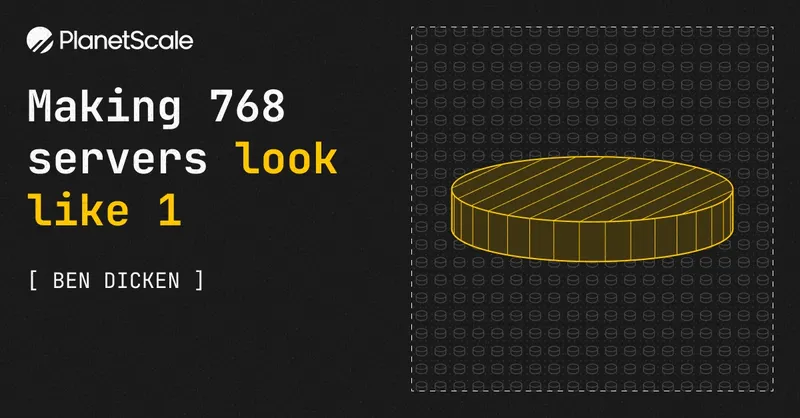
Making 768 servers look like 1
planetscale.com
July 16, 2026
11 min read
🔥🔥🔥🔥🔥
55/100
Summary
PlanetScale utilizes 768 servers to efficiently manage infrastructure for applications with millions of customers and high query volumes. Database sharding is employed to distribute queries and data across multiple servers, addressing the scaling challenges of traditional single database servers.
Key Takeaways
- Database sharding is essential for scaling relational databases like Postgres or MySQL beyond a few terabytes of data.
- High query volume can lead to CPU and I/O constraints, causing performance bottlenecks in database servers.
- Read-replicas can enhance scalability by handling read queries, but they do not alleviate write bottlenecks, which are limited to a single primary server.
- OpenAI utilizes 50 read-replicas on a single primary database to manage high traffic effectively.
Coverage & discussions
Hacker News · planetscale.com
Community discussions
Community Sentiment
Positives
- The article provides a solid technical perspective on database sharding, pushing readers to think critically about when to implement it.
- The visuals in the article are well-crafted and easy to understand, enhancing the discussion around complex topics like sharding.
- Sharding strategies like those used by Vitess and Neki allow for flexible configurations, which can be a game-changer for scaling databases effectively.
Concerns
- Skeptics argue that 768 servers can't truly behave like one, raising concerns about the hidden complexities of cross-shard queries and transactions.
- Many commenters doubt the practicality of sharding, suggesting that it complicates things rather than simplifying them, especially with auto-incrementing IDs.
- Real-world examples show that single database servers can still handle massive loads, challenging the need for such extensive sharding setups.