Mechanical Turk shutting down September 30
mturk.com
August 26, 2026
4 min read
68/100
Summary
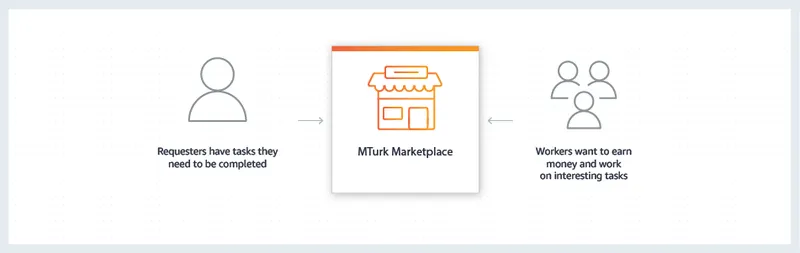
Amazon Mechanical Turk (MTurk) is a crowdsourcing marketplace that lets individuals and businesses outsource virtual work to a global, on-demand workforce available around the clock. Organizations can submit tasks through a user interface or API, dividing large manual projects into smaller internet-based microtasks completed by distributed workers on a pay-per-task basis. MTurk supports data validation, research, survey participation, content moderation, data deduplication, product and image categorization, and data collection from websites. Amazon positions the service as a way to handle repetitive manual work quickly, adjust workforce capacity without scaling an in-house team, and reduce the labor and overhead costs of managing temporary workers. For machine learning, MTurk can collect and annotate training data, support iterative model corrections, and provide human-in-the-loop feedback to validate and retrain models. Tasks can include drawing bounding boxes for computer-vision datasets when automation is insufficient and expert teams cannot process the volume alone. Allen Institute for AI engineering director Michael Schmitz said AI2 uses crowdsourcing platforms including MTurk to create human-annotated datasets for training systems and measuring AI progress. Food Genius executive director David Falck said workers gather menu, website, and other information to identify consumer insights and market trends.
Key Takeaways
- Amazon Mechanical Turk connects organizations with a global, on-demand workforce for virtual microtasks completed over the internet.
- MTurk supports work including data validation, research, surveys, content moderation, data deduplication, categorization, and web data collection.
- Developers can access MTurk workers through a flexible user interface or direct API integration.
- MTurk can support machine-learning workflows by collecting and annotating training data and incorporating human feedback to validate or retrain models.
- Amazon says its pay-per-task model can help organizations manage temporary-workforce costs and scale manual work without expanding in-house staff.
What the discussion said
Commenters treated the shutdown less as the death of human-in-the-loop AI than as evidence that Amazon let an old, horizontal marketplace decay while the valuable work moved elsewhere. Many argued that Mechanical Turk’s bread-and-butter microtasks, from simple classification to transcription, have become easy enough for language models that paying humans and then checking their work no longer makes economic sense. Several people also suspected workers were already using AI or task-arbitrage schemes, making a platform built around tiny payments and speed especially vulnerable to unreliable output. The thread did not conclude that humans are obsolete. Readers pointed to the continued demand for expert labeling, RLHF, moderation, model evaluation, and potentially remote assistance for deployed robots. Their distinction was sharp: commodity tasks are being automated, while trustworthy human judgment is becoming more specialized, better paid, and increasingly sold directly to large AI companies rather than through an open marketplace. That shift leaves concern for workers in lower-income regions who relied on the platform, and for researchers who need verified human rather than model-generated judgments. Amazon also drew criticism for seemingly abandoning a service with active demand, poor transition communication, and at least one reported model-evaluation workflow that produced near-random labels at meaningful cost. Nostalgia surfaced around early crowdsourced transcription and search efforts, but it was tempered by memories of monotonous, penny-scale work and questionable data quality.
Where opinion split
The sharpest dispute was whether closing Mechanical Turk is a baffling retreat just as AI needs more human feedback, or the inevitable end of a marketplace whose core tasks are now automatable. One side saw untapped opportunities in AI training, tuning, and robot support; the other argued that cheap, general microtasks cannot survive once models can perform them and verification requires genuine domain expertise.
Community Sentiment
Positives
- LLMs can absorb the most monotonous penny-scale labeling work, sparing people from repetitive tasks that offered little beyond a few dollars and unreliable output.
- Human feedback has not vanished; specialized labeling, RLHF, moderation, and model evaluation remain valuable where expert judgment can materially improve production AI.
- Mass-market robot deployment could revive on-demand human assistance, turning remote intervention into a practical bridge for machines that fail on messy physical tasks.
- Replacing pooled crowd judgments with multiple model judgments is already working for some classification workflows, showing how quickly routine evaluation has become automatable.
Concerns
- Mechanical Turk’s speed-for-pennies incentives reportedly produced weak labels long before LLMs, undermining research and training pipelines that treated crowd responses as trustworthy ground truth.
- AI-assisted task arbitrage may have made an already fragile human-data marketplace even harder to trust, because requesters cannot easily tell careful human work from automated answers.
- The migration of data work toward large AI vendors risks shutting out casual workers and could hit people in low-infrastructure countries who depended on microtask income.
- A reported Bedrock-linked human-labeling experiment delivered accuracy barely above chance after spending real money, raising doubts about Amazon’s handling of AI evaluation quality.
- Amazon appears to have neglected a potentially strategic human-feedback service while competitors actively recruit labelers for frontier-model development.
Related Articles
Amazon will stop accepting new customers for Mechanical Turk
Jul 6, 2026

Mark Zuckerberg had a bold plan to replace Meta staff with AI
Aug 26, 2026

AI is hitting entry-level jobs hardest, Stanford study finds
Aug 25, 2026
English ↔ Claudish Translator
Aug 22, 2026

Google buys crashed airline Spirit's data at auction, because AI
Aug 18, 2026