English ↔ Claudish Translator
programasweights.com
August 22, 2026
1 min read
44/100
Summary
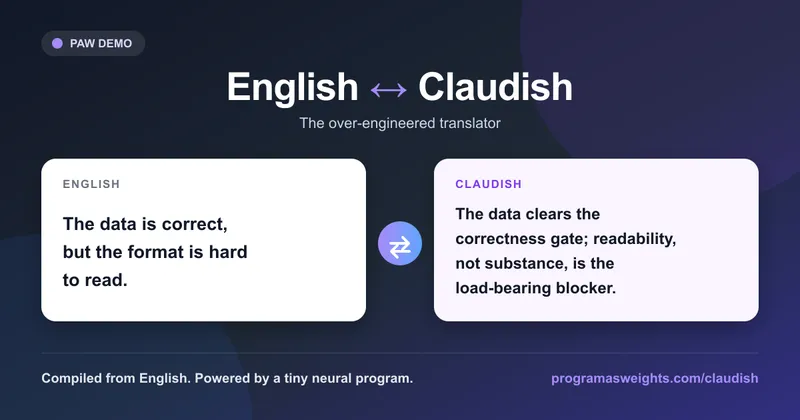
Claudish is a bidirectional translator between English and a language called Claudish. It is powered by compiled neural programs with 0.6 billion parameters. The translator supports conversion from English to Claudish and from Claudish back to English.
What the discussion said
The thread treats the translator less as a novelty than as an uncomfortably accurate diagnosis of Claude’s recurring prose habits. Several commenters report that even the tool’s own failure message sounds like the model: slightly off grammar, inflated metaphors, and a tendency to turn ordinary technical status into invented ritual language. The running joke lands because readers recognize the same voice in real outputs, especially long rewrites that preserve a source’s surface while flattening its meaning into grandiose abstractions. The practical question underneath the mockery is how to remove that voice from useful AI-assisted work. Readers want system prompts, repository-wide cleanup skills, or a second cheap model that rewrites Claude’s visible output before humans see it. But the pessimistic view is that this is not a prompt-level defect: at least one commenter sees it as a deep post-training judgment problem, particularly in the newer Opus model. Others speculate that the style may be intentional, perhaps inherited from internal training examples, used as a detectable signature, or designed to separate the model from ordinary human conventions. Those theories remain unproven; the clearest consensus is that the style is conspicuous enough to need a cleanup layer for professional writing and coding workflows.
Where opinion split
The sharpest dispute is whether Claude’s peculiar language is an accidental quality failure or a deliberate training choice. Critics argue that replacing established technical vocabulary with opaque invented terms reflects bad judgment that prompting cannot reliably repair. Speculators counter that a distinct register could arise from post-training data or even help control which human conventions and biases the model absorbs, though nobody offers evidence that it succeeds at that goal.
Community Sentiment
Positives
- A repository-wide rewriting skill could make Claude’s otherwise useful coding help practical by stripping its recognizable verbal tics from generated documentation and explanations.
- A deliberately distinct model register might, in theory, give post-training tighter control over inherited human conventions and biases rather than merely copying ordinary prose.
- Routing visible Claude output through a cheaper non-Anthropic editor is seen as a workable way to preserve model capability while presenting cleaner language to users.
Concerns
- The translator’s broken output is funny because commenters repeatedly encounter the same malformed, self-serious phrasing in Claude’s real responses.
- Claude is accused of discarding established engineering jargon for made-up process metaphors, making reasoning harder to audit and technical collaboration needlessly confusing.
- Several readers doubt prompting can cure the problem, framing the newer Opus model’s writing as a fundamental judgment defect rather than a surface style setting.
- Long-form transformations appear to retain a source’s cadence while compressing its meaning into vague abstractions, undermining trust in the model’s rewriting quality.