Report · nurse.org
Nurses Sound Alarm as 'Uber for Nursing' Apps Push to Deregulate Healthcare
nurse.org
Source published November 1, 2026
Summary: 2 min read
57/100
Summary
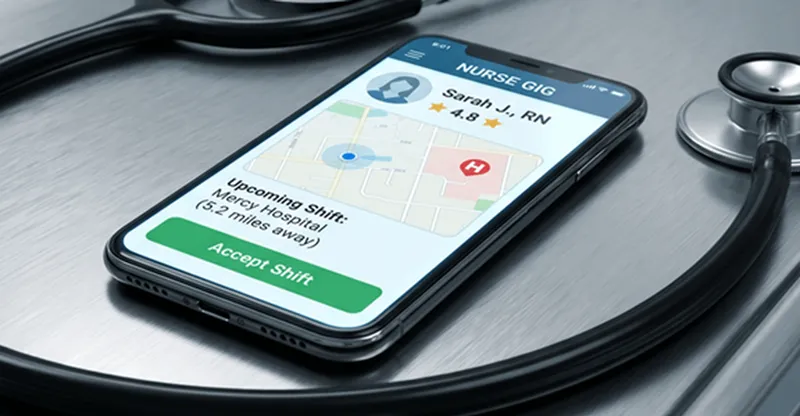
The AI Now Institute’s April 21, 2026 report, Uber for Nursing Part II, says gig staffing platforms including Clipboard Health, ShiftKey, CareRev and IntelyCare are lobbying state governments to exempt their businesses from rules governing traditional healthcare staffing agencies. Since 2022, lawmakers in at least 17 states have introduced related bills, the institute says. New York instead classified gig nursing platforms as healthcare staffing agencies in 2025; the report says Clipboard Health, Nursa and KARE then stopped operating in the state. The report says these apps use algorithmic pricing, nurse ratings and shift-bidding systems to fill hospital and long-term-care shifts. CareRev’s Smart Rates system recommends hourly rates using market demand and past performance, according to the institute, while some Quick Bid systems award shifts to the lowest bidder. A companion Roosevelt Institute brief found that some platforms use data-broker information on nurses’ debt levels to offer lower pay to workers with higher debt. The AI Now Institute says contractor classification can deny nurses benefits and workplace protections, while cancellations, ratings and a lack of paid orientation can affect work opportunities and safety. The ten largest gig-nursing platforms have raised about $1.4 billion, the report says, including ShiftKey’s reported $2 billion valuation and Clipboard Health’s $1.3 billion valuation.
Key Takeaways
- The AI Now Institute says gig-nursing platforms are seeking exemptions from traditional healthcare staffing rules in at least 17 states.
- Algorithmic rates, performance ratings and bidding systems can result in different pay for nurses performing the same shift, according to the AI Now Institute.
- New York’s 2025 law treated gig-nursing apps as healthcare staffing agencies, requiring registration and wage reporting and barring independent-contractor classification.
- The ten most prominent gig-nursing platforms have raised roughly $1.4 billion in funding, according to the AI Now Institute.
What the discussion said
The thread was overwhelmingly about labor deregulation and healthcare economics, not AI. Its limited AI discussion surfaced when one commenter imagined home-based care that uses AI to extract medical information and bypass insurers, while others pushed back hard on treating clinical work as mere paperwork. The optimistic case was practical rather than utopian: AI could help patients navigate care, reduce middlemen, and take repetitive administrative work off clinicians’ plates, leaving scarce staff more time for patients. Skeptics argued that this framing dangerously compresses medicine into diagnosis lookup and information retrieval. They stressed that nurses have tightly defined scopes of practice and that a patient should not substitute an AI system for qualified medical assessment or treatment. Even commenters willing to imagine some physicians being aided by language models drew a line between AI as a clinical assistant and AI as an autonomous decision-maker. There was no serious claim that the nursing marketplace itself was an AI innovation; concern instead centered on whether technology platforms and algorithmic pricing could turn already strained care work into a race to the bottom. The narrow consensus was that automation may relieve administrative burden, but it cannot justify lowering standards for bedside care.
Where opinion split
The sharp dispute was whether AI can meaningfully replace core medical judgment or mainly assist it. Optimists saw information extraction and routine guidance as a large enough share of care to cut costs and middlemen; critics argued that diagnosis, triage, physical assessment, and accountable treatment are precisely the parts that cannot safely be reduced to an LLM interaction.
Coverage & discussions
Hacker News · nurse.org
Community discussions
Community Sentiment
Positives
- AI could strip repetitive administrative work from hospitals, freeing expensive clinical time for direct patient care instead of paperwork and avoidable workflow delays.
- Used as a tool alongside a real clinician, language models may make routine medical information easier to navigate and support lower-friction access to care.
Concerns
- Calling medical practice mostly information extraction badly understates the hands-on judgment, triage, and responsibility that make clinical care safe.
- Letting patients diagnose or treat themselves through AI risks replacing accountable professional assessment with persuasive but unreliable automated advice.
Related Articles
Kaiser nurses say AI, workplace surveillance are making their jobs, care worse
Jul 17, 2026

Theranos whistleblower Tyler Shultz warns that the AI boom is ‘a great opportunity to go deceive people’
Oct 30, 2026

31-Year-Old Woman Reduced Epilepsy Medication After ChatGPT Advice: Report Links Case to Her Death
Oct 29, 2026
Parents sue OpenAI, alleging GPT-4o coached their daughter off seizure medication
Oct 27, 2026

Early progress on accelerating drug development with Claude
Oct 27, 2026