Report · github.com
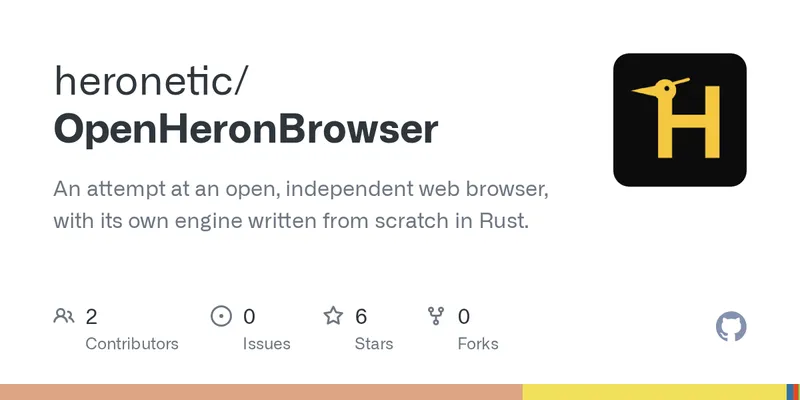
OpenHeronBrowser – a new browser engine in Rust, built with Claude. Acid3 97/100, runs Discord, VS Code for the Web, and Windows 1.01 in v86
github.com
Source published October 27, 2026
Summary: 1 min read
25/100
Summary
Heronetic has released OpenHeronBrowser 1.0.0, an early desktop web browser for Windows, macOS and Linux built around a new Rust web engine rather than Chromium’s Blink, Apple’s WebKit or Mozilla’s Gecko. The project contains about 85,000 lines of Rust for its engine, browser and cryptography, plus roughly 23,000 lines of JavaScript for DOM and Web APIs. It is licensed under Apache 2.0 and uses the Boa interpreter for JavaScript and wasmi for WebAssembly. OpenHeronBrowser implements HTML parsing, DOM features including Shadow DOM and custom elements, modern CSS selectors and layout, Canvas 2D, WebCrypto, IndexedDB, Workers, WebAssembly, tabs, developer tools, a PDF viewer and the HeronBlock content blocker. It scored 97/100 on Acid3, passed Acid2, and scored 483/555 on html5test.com; selected web-platform-test subsets passed 66,596 of 69,049 subtests. Heronetic says it can render and sign into many major sites, including GitHub, Microsoft, Discord and ChatGPT. The browser is explicitly not intended for sensitive use. Tabs share a process and pages are not sandboxed, while rendering is CPU-only and JavaScript has no JIT compiler. Video playback, full audio playback, WebGL, WebAssembly threads, a password manager and sync are absent; Gmail sign-in is blocked and Cloudflare managed challenges usually fail.
Key Takeaways
- OpenHeronBrowser 1.0.0 is a downloadable Rust-based browser for Windows, macOS and Linux with an independently written web engine.
- The project reports 97/100 on Acid3, an Acid2 pass, and 483/555 on html5test.com.
- OpenHeronBrowser includes HTML, CSS, DOM, WebAssembly and browser features such as tabs, developer tools, a PDF viewer and built-in ad and tracker blocking.
- Heronetic warns that OpenHeronBrowser is an early demo without page sandboxing and should not be used for banking, work or other sensitive activity.
- JavaScript is interpreted rather than JIT-compiled, and the browser lacks GPU acceleration, video playback, WebGL and WebAssembly threads.
What the discussion said
The conversation treated the project less as a breakthrough browser engine than as a stress test for AI-generated systems code. The sharpest reaction was distrust: a browser sits directly between users and passwords, payment details, and private sessions, so commenters saw a Claude-built implementation as exactly the sort of codebase that cannot earn trust through demos alone. Running heavyweight web apps, an old Windows image, and scoring well on Acid3 was acknowledged indirectly as an interesting proof of compatibility, but readers argued that existing mainstream browsers already clear those demonstrations. In other words, the showcased workloads do not establish a compelling advantage over mature engines. The most concrete technical criticism targeted the rendering stack. One commenter argued that the selected Tiny Skia path is conspicuously slow and questioned why the AI-assisted design did not choose Vello’s CPU or hybrid rendering options instead. Another thread focused on memory, with interest in whether a new engine could finally undercut Chromium-class browsers dramatically, but no one supplied measurements showing that it does. The discussion therefore converged on a demanding standard: AI can help produce an impressive prototype, yet browser claims need security review, real performance data, and a clear advantage before anyone should use it for sensitive work.
Where opinion split
The central dispute is whether an AI-built browser demo deserves to be treated as a usable alternative. Supportive curiosity rests on the possibility of a leaner engine and its apparent ability to handle demanding modern web applications; skeptics argue that compatibility demos are routine for established browsers, while unproven AI-generated security and questionable rendering choices make real-world use irresponsible.
Coverage & discussions
Community discussions
Community Sentiment
Positives
- The project’s ability to load Discord, web-based VS Code, and emulated Windows suggests the AI-assisted engine has reached more than toy-page compatibility.
Concerns
- A browser assembled with Claude is seen as an unacceptable place to enter credentials until its attack surface has been independently audited, because browsers guard nearly every sensitive online session.
- The rendering design drew criticism for relying on Tiny Skia despite its perceived slowness, with commenters arguing that Vello’s CPU or hybrid paths would better serve a performance-focused new engine.
- The advertised application demos fail to impress skeptics because Chrome and Firefox already run the same workloads; compatibility alone does not justify trusting a new AI-generated browser.
- Hopes for radically lower memory use remain unproven, and commenters want measurements against Firefox and Chromium rather than an assumption that a fresh engine is lighter.
Related Articles

Herdr: Agent multiplexer that lives in your terminal
Jun 29, 2026

MicroZig to Adopt Strict No LLM / No AI Policy
Oct 29, 2026
PaperPilot – Zero-Cloud, Pure-Rust PDF Engine with WASM and MCP
Oct 26, 2026

The reverts will continue until morale improves
Oct 19, 2026
Development statistics for the 7.2 kernel
Oct 17, 2026