Report · nullprogram.com
Prospero: A new coding harness for a more civilized age
nullprogram.com
Source published October 31, 2026
Summary: 2 min read
58/100
Summary
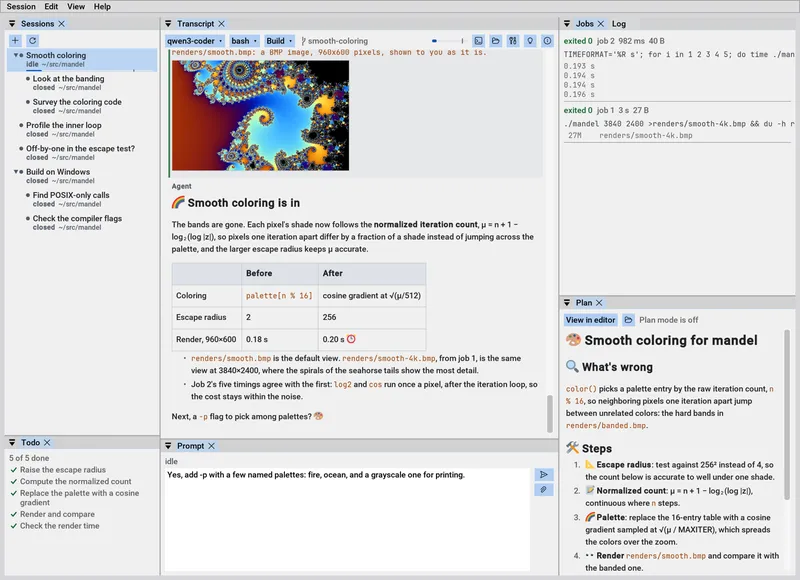
Prospero is a C++ coding harness for AI agents that the developer says uses roughly two orders of magnitude fewer resources than other available harnesses. It provides a Dear ImGui docking interface but does not include model providers; users can connect local or remote services such as llama.cpp, on-premises models, OpenRouter, Anthropic API, or OpenAI API. Agents can read and write files, run shell commands, spawn subagents, use Git worktrees, access MCP tools, search the web when enabled, and operate remotely through headless deployments over SSH or WSL. Vision-capable models can inspect and control the desktop through clicking, typing, and dragging, allowing live GUI testing without a per-application MCP integration. Prospero supports headless engines across x86/x86-64 and ARM64 combinations on macOS, Windows, and Linux; its Windows x86 engine also works on Windows XP. Its passive-rendering interface goes idle when no work is pending, rather than continuously redrawing. The software applies deadlines to operations, network requests, permissions, and agent communication to avoid indefinite waits, except in Plan mode. Timed-out shell commands become asynchronous background tasks, and Prospero is designed to terminate an entire process tree when a command stops. The free Community Edition is available on GitHub without built-in headless engines, while a DRM-free paid Professional Edition includes those engines and free updates. Both Windows and macOS builds are code-signed.
Key Takeaways
- Prospero is a coding harness that lets AI agents use tools such as file operations, shell commands, web search, MCP integrations, subagents, and Git worktrees.
- Prospero supports desktop control for vision-capable models, enabling agents to click, type, drag, test, and debug GUI applications.
- Prospero uses timeouts and watchdogs for most operations, converts timed-out shell commands into background tasks, and is designed to clean up whole process trees.
- The free Community Edition lacks built-in headless engines, while the paid Professional Edition includes engines for remote deployments and sessions across supported Windows, macOS, and Linux architectures.
What the discussion said
The thread focused less on Prospero’s headline promise than on what a coding-agent harness should feel like in daily use. A substantial group wants a real GUI: clickable agent output, linked files opened beside the conversation, durable asynchronous questions, and a way to coordinate selected subagents without treating one scrolling terminal as the whole workspace. For them, coding agents are no longer simple prompt-response tools; they are long-running, branching work sessions that need visual structure and recoverability. Others argued that text-in, text-out models fit terminals naturally, particularly for remote work, and see a GUI as unnecessary overhead. Commenters also circled the economics and portability of agent tooling. Claude subscriptions make its first-party coding product unusually attractive, but that subsidy forces people away from competing harnesses unless they accept API-priced usage. Several readers liked the prospect of a lightweight native application, attachable GUI, and local-model support, especially as agent tools make formerly roomy laptops feel constrained. Still, resource claims alone did not persuade everyone: a few megabytes saved in a terminal is trivial beside the RAM required for local models, and ergonomics matter more. Skeptics further questioned whether a one-person, opinionated harness can keep pace with the fast-moving agent ecosystem, while supporters valued its deliberate desktop-software feel and focused design.
Where opinion split
The sharp split is whether coding agents need GUI-first orchestration or are inherently terminal-native. GUI advocates say multi-agent, long-running work demands clickable context, parallel questions, and persistent visual state; terminal defenders say language models fundamentally exchange text, making a TUI the cleanest and most direct interface.
Coverage & discussions
Hacker News · nullprogram.com
Community discussions
Community Sentiment
Positives
- A GUI that turns agent transcripts into clickable, persistent workspace context could make multi-step coding work far less brittle than a single terminal scrollback.
- The headless-core-plus-attachable-GUI idea appeals because it can preserve efficient automation while giving humans a usable control surface for agents.
- Local-model compatibility and a very small runtime footprint are attractive as coding agents increasingly compete with developers’ own tools for machine resources.
- Claude Code’s integrated behavior can outperform a bare API connection for some workflows, showing that a harness’s embedded tooling materially shapes model usefulness.
Concerns
- Subscription-only access to subsidized Claude usage traps developers in the vendor’s preferred harness, while alternatives require materially pricier metered API calls.
- Terminal agents can misinterpret text typed during execution as an answer to a sudden confirmation prompt, creating an easy path to accidental agent decisions.
- A harness optimized around one author’s hard rules, such as universal operation deadlines, may be unusable for workflows that need a different tradeoff.
- Low memory use is not enough of a value proposition when local models dominate RAM consumption and competing harnesses already run comfortably in a terminal.