The compiler was supposed to end programming too
hrih.si
October 21, 2026
14 min read
49/100
Summary
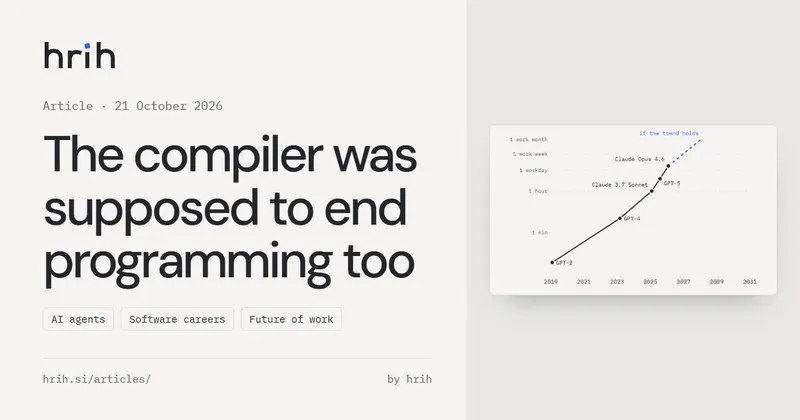
AI coding tools are automating more implementation work, while software teams face growing demands for specification, review, testing and verification. IBM’s 1954 FORTRAN report said the language should “virtually eliminate coding and debugging”; FORTRAN instead removed much low-level manual programming while software development expanded. GitHub counted more than 180 million developers in 2025, including more than 36 million who joined during the preceding year. Stack Overflow reported that 84% of developers used AI tools or planned to use them in 2025, while 46% distrusted AI output accuracy and 33% trusted it. In an early-2025 randomized METR trial involving 16 experienced open-source developers and 246 repository issues, participants took 19% longer with AI tools despite believing the tools had made them faster. METR’s task-time series found that Claude Opus 4.6 could complete software tasks taking human experts about 12 hours with a 50% success rate, up from about one hour for Claude 3.7 Sonnet a year earlier. Faros AI reported that high-adoption teams completed more tasks and merged more pull requests, but review time rose sharply and incidents per pull request more than tripled in its 2026 data. Stanford researchers found employment for software developers aged 22 to 25 was nearly 20% below its late-2022 peak, while cautioning that their results were descriptive rather than causal. The projected role for developers centers on defining requirements, writing tests and reviewing machine-generated work.
Key Takeaways
- FORTRAN automated low-level coding rather than eliminating software work, and AI coding tools may similarly shift developers toward higher-level tasks.
- Stack Overflow’s 2025 survey found that 84% of developers used AI tools or planned to, but more respondents distrusted AI output accuracy than trusted it.
- A METR randomized trial in early 2025 found that 16 experienced open-source developers took 19% longer on assigned issues when using AI tools, despite perceiving a productivity gain.
- Faros AI’s 2026 telemetry study reported higher task completion alongside much longer review times, more unreviewed pull requests and a more than threefold increase in incidents per pull request.
- Stanford researchers reported lower employment among software developers aged 22 to 25 relative to late 2022, but did not establish that AI caused the decline.
What the discussion said
The thread spent less time on the article’s imagined 2031 workday than on dismantling its compiler analogy. Many commenters argued that compilers already did eliminate an older kind of coding: manually translating a formal program into machine instructions. That success did not eliminate programming, but moved the valuable work upward into specification, design, and reasoning. Several readers think AI could trigger a much larger version of that shift, because natural-language requests can span implementation, review, workflow automation, and eventually much of screen-based knowledge work. Some cited personal experience with frontier models as evidence that coding capability has already crossed a threshold. The pushback was equally focused. A compiler accepts a precise, formal input and provides dependable semantics; an LLM begins with an ambiguous human request, emits artifacts that still need scrutiny, and cannot escape unclear product decisions by generating more code. Readers also rejected the claim that generated code is a clean abstraction today: users must retain, understand, test, and repair its output. A middle view held that agent coding succeeds where existing engineering guardrails—tests, linters, profilers, and constrained interfaces—turn probabilistic generation into something tractable. The likely change, even for skeptics, is less hand-written source and more work defining intent and verifying machine-produced changes.
Where opinion split
The sharp dispute is whether LLM agents are a genuine successor abstraction to programming or merely an unreliable producer of code. Optimists argue that capable agents, connected to company systems and guarded by tests, can absorb implementation and routine white-collar work; skeptics argue that ambiguous intent, non-deterministic output, and accountability mean humans still have to do the hard specification and verification.
Coverage & discussions
Hacker News · hrih.si
Community discussions
Community Sentiment
Positives
- Frontier coding models are seen by several commenters as already strong enough to automate substantial implementation work, pushing developers toward higher-level decisions rather than syntax.
- Agent-assisted coding can work remarkably well when tests, linters, profilers, and narrow tool interfaces catch mistakes before generated changes reach production.
- Natural-language workflow tools make programming-like automation accessible to people who would never write conventional code, widening who can build useful business processes.
- Even skeptics of the analogy expect a consequential shift toward directing agents and occasionally inspecting generated source instead of living in low-level implementation details.
Concerns
- Treating a vague product request as if it were executable intent mistakes natural language for a formal specification, leaving crucial choices about semantics, precision, and policy unresolved.
- Generated code is not yet a trusted abstraction because teams still inherit its concrete output and must understand, test, debug, and safely modify it.
- Claims that agents can dispense with reviews or answer every business-rule question drew skepticism from readers whose AI-generated code and review results remain unreliable.
- Cheap generation could accelerate bloated, poorly understood codebases, creating maintenance burdens that even stronger models may hesitate to simplify or delete.