The insider trading you're allowed to do
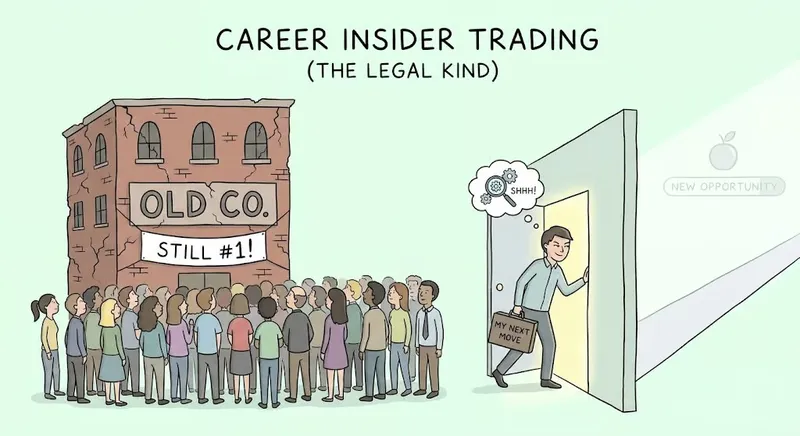
coached.com
October 16, 2026
6 min read
46/100
Summary
The Coached Weekly essay argues that employees can use nonpublic knowledge about their workplace to make career decisions, comparing that advantage to insider trading without trading securities. It cites Nokia after the iPhone’s 2007 launch: engineers reportedly recognized that Nokia’s products lagged behind, while outsiders still viewed the company as an industry leader. Some employees retrained or moved to Apple and Google before Nokia’s phone business was gone by 2013, while others waited until the decline was widely visible. The essay identifies internal signals such as repeatedly rewritten roadmaps, departures of key engineers, stalled migrations, customer enthusiasm, and the speed at which failing projects are stopped. It says employees can also identify promising internal initiatives before they become official priorities and more competitive destinations. It argues that financial results and formal confirmation often lag operational problems, citing research that found Nokia middle managers were reluctant to communicate bad news upward because executives were perceived as shooting messengers. AI adoption is presented as a particularly important current signal. The essay recommends assessing whether leaders personally use AI tools and how AI is affecting specific tasks in an employee’s role. It advises small career moves rather than dramatic exits, including building relevant skills, taking recruiter calls, networking with successful teams, and targeting growing parts of an industry during a job search.
Key Takeaways
- Employees may observe product weakness, talent departures, customer sentiment, and operational delays before those conditions are reflected in public company performance or layoffs.
- Nokia had a record year in 2007, when the iPhone launched, even though some Nokia engineers reportedly believed the company’s phones could not compete.
- The essay says researchers studying Nokia’s collapse found that bad news became more optimistic as it moved up the management hierarchy because middle managers feared reporting it directly.
- The essay recommends judging AI readiness by whether leaders personally use AI in their work and by identifying which tasks AI is already changing within a role.
- Suggested career responses include building skills for a potential next job, speaking with recruiters, and seeking opportunities on internal teams whose products or usage are growing.
What the discussion said
The thread spent almost all of its energy correcting the article’s treatment of insider trading, not discussing AI. The one clear AI-related reaction was sharply hostile to the article’s apparent production process. Several readers judged the prose as visibly machine-generated, apparently produced from a single prompt with little or no human editing, and saw the accompanying illustrations as similarly synthetic. That mattered more than mere style: they felt the result lacked the care, judgment, and credibility needed for an explainer about a legally nuanced subject. Readers did not identify any AI capability, research claim, or useful AI application worth praising. Instead, the article became an example of the growing fatigue with content that looks cheaply automated but still demands sustained reader attention. One commenter framed AI-written articles and AI-scripted videos as work-like sludge: tolerable only when someone is paid to process them, not something worth choosing voluntarily. There was no meaningful defense of the article’s AI-assisted presentation, nor any argument that automation had improved clarity, insight, or accessibility. The AI discussion therefore converged on a simple verdict: conspicuous generation without editorial transformation is a trust and quality failure, especially when the subject requires precise reasoning.
Community Sentiment
Concerns
- The article’s prose was seen as raw, single-prompt AI output, and the lack of visible human editing made a nuanced financial argument feel untrustworthy.
- Synthetic-looking comics compounded the impression of shameless automated filler rather than an explanation shaped by editorial judgment.
- Readers described AI-written articles and AI-scripted video as exhausting work-like content, signaling that cheap generation is actively reducing their willingness to engage.
Related Articles
Lines of code got a better publicist
Jun 11, 2026

Create value for others and don’t worry about the returns
Mar 11, 2026
Please stop the AI confidence theater
Jul 3, 2026

Big Tech : AI Isn’t Taking Your Job. Your Refusal to Use It Might.
Feb 7, 2026

AI Mania Is Eviscerating Global Decision-Making
Jul 19, 2026