Report · progressives.house.gov
US Reps Lead Democratic Resolution Opposing A.I. Bubble Bailout for Big Tech

progressives.house.gov
Source published October 30, 2026
Summary: 1 min read
71/100
Summary
DeepLogin posted a link titled “Reps. Casar, Waters Lead Democratic Resolution Opposing A.I. Bubble Bailout for Big Tech, Commit to Protecting American People Instead.” The linked item concerns a Democratic resolution led by Representatives Casar and Waters, according to its title. The post received 570 points and 418 comments. No further details about the resolution’s text, timing, sponsors, policy provisions, or legislative status are provided.
What the discussion said
The thread spent less time praising the resolution than interrogating whether an AI bailout is remotely likely and whether a collapse would justify one. Many commenters see the AI boom as a speculative, capital-hungry wager by firms wealthy enough to absorb their own mistakes. Their core claim is that a credible promise of no rescue would force investors, lenders, and executives to price failure honestly instead of treating federal support, defense contracts, or government adoption as implicit insurance. Several readers argued that an AI crash is unlike the 2008 banking crisis: losing money on data centers, model providers, and inflated tech shares may be painful, but AI is not yet indispensable to the credit system or everyday critical operations. They therefore favor bankruptcy and reorganization over taxpayer support, with some proposing public ownership or public access to compute if state money ever enters. A smaller group cautioned that blanket anti-bailout politics ignores how fast systemic contagion can develop and that rescues can protect the wider economy rather than reward investors. Broad skepticism remained about the resolution itself, since it is nonbinding and could be bypassed during a genuine emergency. Commenters also objected to the industry’s hype and its apparent preference for concentrated, resource-intensive centralized compute.
Where opinion split
The sharp dispute is whether an AI-sector rescue would ever be necessary to avert a broader economic emergency. Opponents say AI firms are not systemically vital like banks, so failure should wipe out speculative capital and discipline reckless buildout; defenders of intervention warn that very large, interconnected failures can spill beyond their original sector, making absolute no-bailout commitments dangerous.
Coverage & discussions
Hacker News · progressives.house.gov
Community discussions
Community Sentiment
Positives
- A preemptive refusal to rescue AI speculation could strip away the assumed federal safety net and make investors finally price data-center and model-provider risk honestly.
- Letting failed AI firms reorganize rather than protecting shareholders could preserve useful talent and compute while punishing the capital that funded unsustainable bets.
- Several commenters argue that an AI bust would be financially painful but not a 2008-style shutdown, because core commerce and credit do not yet depend on frontier models.
- If public money ever keeps AI infrastructure alive, some readers want public ownership or broadly available compute instead of a taxpayer-funded private monopoly.
Concerns
- Commenters see years of relentless AI promotion as having inflated expectations while the richest companies still position taxpayers to absorb a potential downside.
- Centralized frontier-model buildout is criticized as resource-intensive and exclusionary, especially when industry leaders dismiss capable consumer-hardware AI as inefficient.
- The industry is suspected of cultivating government ownership, public-sector deployment, and defense ties as a route to an eventual backstop rather than proving a durable business model.
- The resolution is widely dismissed as symbolic political theater: a nonbinding statement is unlikely to restrain lobbying or emergency action when a major AI company falters.
Related Articles
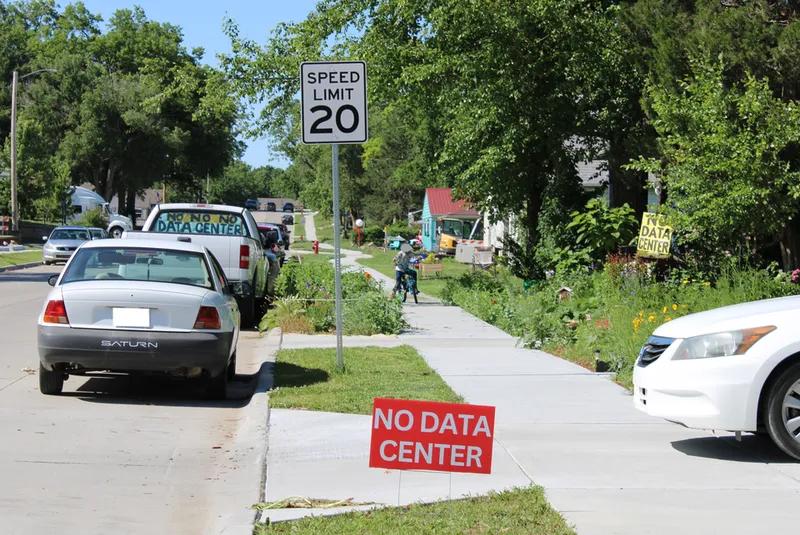
GOP urges top AI firms to do something about the toxic image of data centers
Aug 22, 2026

Governments, companies, nonprofits should invest in free, open source AI [pdf]
Jul 15, 2026

How the terrorist group Boko Haram uses frontier AI
Jul 10, 2026

Tidal AI Policy
Jun 29, 2026
Policy on the AI Exponential
Jun 10, 2026