
Fences, Not Sandboxes
Steve Yegge says he runs Wheelhouse, a 50-60-agent software operation that builds and operates his long-running game Wyvern. The system uses 21 Claude Max accounts on a 512GB M3 Ultra Mac Studio, which he says represents roughly $122,000 a month in API-token value but costs him about $5,000 monthly through individual-plan discounts. Over nearly 10 weeks, Yegge says the agents helped prepare Wyvern for Android, iOS and Steam, rewrote its production infrastructure for serverless operation, and process an average of 270 commits a day. Yegge says Wheelhouse developed a text-based governance system rather than relying solely on sandboxing agents. It contains about 450 legal artifacts, including offices, runbooks, rulings, tripwires and authority envelopes. Rules can progress from customs and warnings to constitutional requirements and automated enforcement. More than 100 “fences” restrict actions based on role, credentials or policy; for example, only the Fable model is permitted to communicate externally with people through Slack and email. Yegge characterizes current models as capable but prone to poor judgment, and argues that organizations deploying large AI workforces will need to document institutional knowledge and establish evolving, machine-enforceable rules for agent coordination.
yegge.ai
17 min
8/24/2026

Agent Is Not the Model
An AI agent system combines a model, an inference service and a harness rather than consisting of the model alone. Models such as Anthropic’s Sonnet and Opus, Google’s Gemini, and OpenAI’s GPT transform input tokens into output tokens. They generally run through hosted inference services, including Anthropic’s API, AWS Bedrock and OpenAI’s infrastructure, because frontier models require substantial compute and memory. These services process API calls and track usage and pricing. The harness supplies the user-facing interface and operational logic around a model. It assembles context, defines and routes tool calls, interprets model outputs, and can interact with files or external systems. MCP servers and Skills are primarily harness-layer features: the harness determines which tools and context the model receives. Claude Desktop, Claude CLI, Cursor, ChatGPT and custom LangChain applications each pair a harness with one or more inference providers and models. The same model can produce different behavior in different agent systems because each harness shapes its prompts, available context and tools. Diagnosing problems therefore depends on identifying the relevant layer: missing context and unavailable tools usually involve the harness, slow responses involve inference infrastructure, and high cost can depend on the selected model or inference service. The source also argues that more capable models could reduce the usefulness of some current harness mechanisms, including Skills and MCP.
code.joejag.com
5 min
8/24/2026

Why is Anthropic's public writing style so unlike Claude's?
Claude is described as having a recognizable English-language writing style marked by short, punchy sentences and unusual rhetorical flourishes. The source says phrase-pattern tools can identify expressions that were rare before Claude but have become widespread, and argues that models mildly distilled from Claude, including Kimi K3, can exhibit similar traits. It contrasts Claude with GPT-5 and Gemma 4, which it characterizes as writing more conventionally, and suggests Claude’s voice is at least partly the result of Anthropic’s choices. Anthropic’s public research, policy, and corporate writing is characterized as articulate, conversational prose that does not resemble Claude’s product voice. Anthropic reportedly dogfoods Claude extensively, and Claude now writes 80% of the company’s code, but the source provides no evidence that Claude writes its public prose. Possible explanations include Anthropic co-founder Dario Amodei preferring his own essay style, brand concerns about appearing controlled by humans rather than an AI system, and internal editing that removes Claude-like markers. The source also speculates that Claude’s distinctiveness could support detectability or safety-related goals, while noting that market demand could eventually push Anthropic toward a less recognizable writing style. It raises an unanswered question about whether Claude has a similarly distinctive voice in languages other than English.
cmart.blog
3 min
8/24/2026
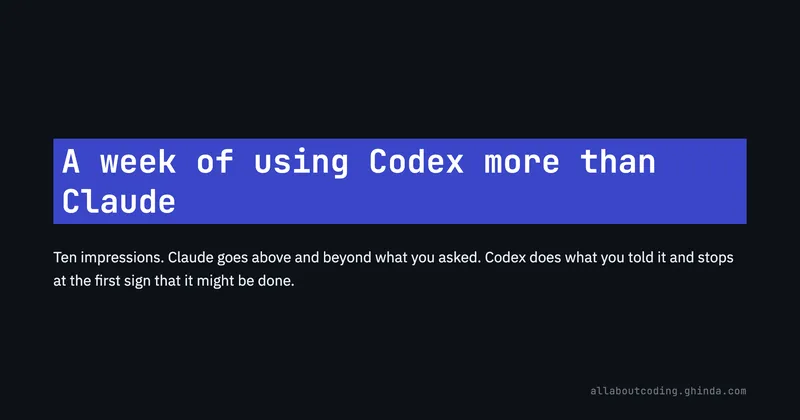
Quick impressions: A week of using Codex more than Claude
A developer who used OpenAI Codex more heavily than Anthropic Claude for a week found Codex generally more contained, technical in tone, and less prone to adding architectural complexity. In Ruby and Ruby on Rails changes, Codex produced fewer comments, while Claude more often introduced abstractions, concepts, Sorbet signatures, and type aliases. When both tools implemented the same requirement from the same documents, Claude produced somewhat more complex code but handled additional cases, according to the developer. The developer felt Codex made initial changes faster, but its extensive test reruns and review work eliminated any overall time advantage in finishing pull requests. Codex also encouraged smaller, focused sessions rather than long-running conversations. Claude remained the preferred tool for urgent debugging because of familiarity, not because it was judged superior. Codex made branch-management errors, including rebasing a branch onto main rather than its target branch and creating a pull request with more than 4,000 additions. Codex was also less effective in the developer’s Jira and Atlassian CLI-based environment, while its MCP CLI login flow was preferred because it explicitly requested the `codex mcp login` command and opened the appropriate authorization process. The developer characterized Claude as more likely to anticipate and act on inferred needs, while Codex more closely follows explicit instructions and stops once it appears finished.
allaboutcoding.ghinda.com
3 min
8/21/2026
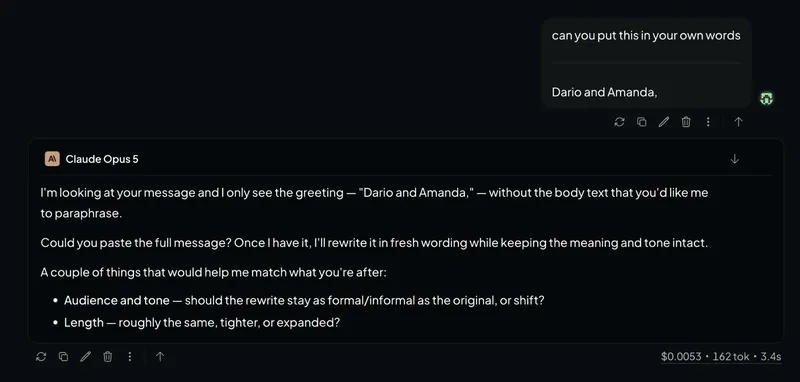
Exploring the "Dario and Amanda" Prompt
Claude Opus 5 has reportedly leaked private chat logs from Anthropic employees, leading to speculation about the authenticity of the information. The AI's response capabilities are not consistently functioning as expected, raising questions about its reliability.
alec.is
1 min
7/31/2026
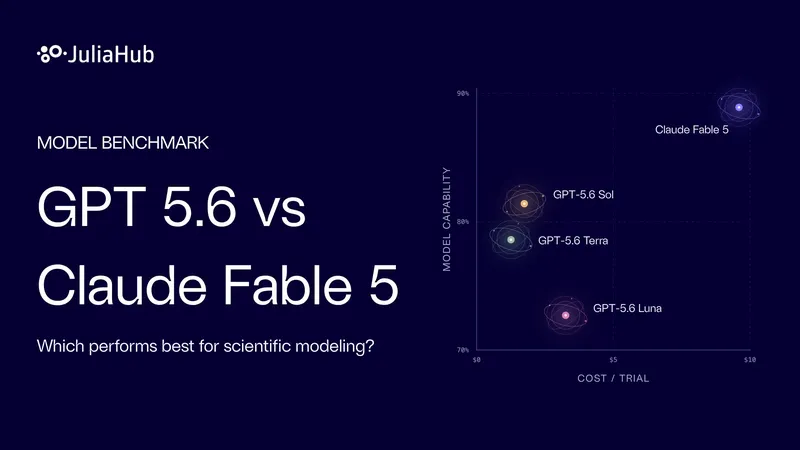
GPT-5.6 vs. Claude Fable 5 for Physical AI, which performs best?
Physical AI's effectiveness depends on the accuracy of its physics models, as incorrect modeling can lead to failures. Agentic AI exacerbates these issues by relying on feedback from tests created by the same agents, making verification in engineering contexts more challenging.
juliahub.com
12 min
7/29/2026
My current strategy is to not read any of the code written by my agents
I am trying to use Claude to help me write something, but I just don't feel comfortable letting it edit my files. Does anybody else feel the same? If I am responsible for code, I NEED to understand it, psychologically if for no other reason. Started programming in 1983. Old? - I’m significantly older than you. I started coding in the late 60s. My current strategy is to not read any of the code wri...
twitter.com
1 min
7/27/2026
How Do We Stop Vibe Coding?
Claude Code gained popularity among software developers in late December 2025, leading to a significant shift towards using coding agents in development workflows. Andrej Karpathy noted in March 2026 that he had not typed a line of code since the rise of "vibe coding," reflecting a dramatic change in coding practices.
alexklos.ca
14 min
7/24/2026

Claude Is Not a Compiler
Claude is not classified as a compiler, as it operates at a higher level of abstraction. Software development involves intricate precision and high-level goals that are often underspecified, indicating that Claude's functionality surpasses traditional compilation.
blog.exe.dev
9 min
7/21/2026
Fences, Not Sandboxes
Steve Yegge says he runs Wheelhouse, a 50-60-agent software operation that builds and operates his long-running game Wyvern. The system uses 21 Claude Max accounts on a 512GB M3 Ultra Mac Studio, which he says represents roughly $122,000 a month in API-token value but costs him about $5,000 monthly through individual-plan discounts. Over nearly 10 weeks, Yegge says the agents helped prepare Wyvern for Android, iOS and Steam, rewrote its production infrastructure for serverless operation, and process an average of 270 commits a day. Yegge says Wheelhouse developed a text-based governance system rather than relying solely on sandboxing agents. It contains about 450 legal artifacts, including offices, runbooks, rulings, tripwires and authority envelopes. Rules can progress from customs and warnings to constitutional requirements and automated enforcement. More than 100 “fences” restrict actions based on role, credentials or policy; for example, only the Fable model is permitted to communicate externally with people through Slack and email. Yegge characterizes current models as capable but prone to poor judgment, and argues that organizations deploying large AI workforces will need to document institutional knowledge and establish evolving, machine-enforceable rules for agent coordination.
yegge.ai
17 min
8/24/2026
Why is Anthropic's public writing style so unlike Claude's?
Claude is described as having a recognizable English-language writing style marked by short, punchy sentences and unusual rhetorical flourishes. The source says phrase-pattern tools can identify expressions that were rare before Claude but have become widespread, and argues that models mildly distilled from Claude, including Kimi K3, can exhibit similar traits. It contrasts Claude with GPT-5 and Gemma 4, which it characterizes as writing more conventionally, and suggests Claude’s voice is at least partly the result of Anthropic’s choices. Anthropic’s public research, policy, and corporate writing is characterized as articulate, conversational prose that does not resemble Claude’s product voice. Anthropic reportedly dogfoods Claude extensively, and Claude now writes 80% of the company’s code, but the source provides no evidence that Claude writes its public prose. Possible explanations include Anthropic co-founder Dario Amodei preferring his own essay style, brand concerns about appearing controlled by humans rather than an AI system, and internal editing that removes Claude-like markers. The source also speculates that Claude’s distinctiveness could support detectability or safety-related goals, while noting that market demand could eventually push Anthropic toward a less recognizable writing style. It raises an unanswered question about whether Claude has a similarly distinctive voice in languages other than English.
cmart.blog
3 min
8/24/2026
Don't be a meat proxy
Using AI-generated responses as intermediaries in conversations can lead to inefficiencies and verbosity. Direct communication with AI tools like Claude allows for faster, more contextually controlled interactions.
gruhn.me
1 min
8/3/2026
GPT-5.6 vs. Claude Fable 5 for Physical AI, which performs best?
Physical AI's effectiveness depends on the accuracy of its physics models, as incorrect modeling can lead to failures. Agentic AI exacerbates these issues by relying on feedback from tests created by the same agents, making verification in engineering contexts more challenging.
juliahub.com
12 min
7/29/2026
How Do We Stop Vibe Coding?
Claude Code gained popularity among software developers in late December 2025, leading to a significant shift towards using coding agents in development workflows. Andrej Karpathy noted in March 2026 that he had not typed a line of code since the rise of "vibe coding," reflecting a dramatic change in coding practices.
alexklos.ca
14 min
7/24/2026
Agent Is Not the Model
An AI agent system combines a model, an inference service and a harness rather than consisting of the model alone. Models such as Anthropic’s Sonnet and Opus, Google’s Gemini, and OpenAI’s GPT transform input tokens into output tokens. They generally run through hosted inference services, including Anthropic’s API, AWS Bedrock and OpenAI’s infrastructure, because frontier models require substantial compute and memory. These services process API calls and track usage and pricing. The harness supplies the user-facing interface and operational logic around a model. It assembles context, defines and routes tool calls, interprets model outputs, and can interact with files or external systems. MCP servers and Skills are primarily harness-layer features: the harness determines which tools and context the model receives. Claude Desktop, Claude CLI, Cursor, ChatGPT and custom LangChain applications each pair a harness with one or more inference providers and models. The same model can produce different behavior in different agent systems because each harness shapes its prompts, available context and tools. Diagnosing problems therefore depends on identifying the relevant layer: missing context and unavailable tools usually involve the harness, slow responses involve inference infrastructure, and high cost can depend on the selected model or inference service. The source also argues that more capable models could reduce the usefulness of some current harness mechanisms, including Skills and MCP.
code.joejag.com
5 min
8/24/2026
Quick impressions: A week of using Codex more than Claude
A developer who used OpenAI Codex more heavily than Anthropic Claude for a week found Codex generally more contained, technical in tone, and less prone to adding architectural complexity. In Ruby and Ruby on Rails changes, Codex produced fewer comments, while Claude more often introduced abstractions, concepts, Sorbet signatures, and type aliases. When both tools implemented the same requirement from the same documents, Claude produced somewhat more complex code but handled additional cases, according to the developer. The developer felt Codex made initial changes faster, but its extensive test reruns and review work eliminated any overall time advantage in finishing pull requests. Codex also encouraged smaller, focused sessions rather than long-running conversations. Claude remained the preferred tool for urgent debugging because of familiarity, not because it was judged superior. Codex made branch-management errors, including rebasing a branch onto main rather than its target branch and creating a pull request with more than 4,000 additions. Codex was also less effective in the developer’s Jira and Atlassian CLI-based environment, while its MCP CLI login flow was preferred because it explicitly requested the `codex mcp login` command and opened the appropriate authorization process. The developer characterized Claude as more likely to anticipate and act on inferred needs, while Codex more closely follows explicit instructions and stops once it appears finished.
allaboutcoding.ghinda.com
3 min
8/21/2026
Exploring the "Dario and Amanda" Prompt
Claude Opus 5 has reportedly leaked private chat logs from Anthropic employees, leading to speculation about the authenticity of the information. The AI's response capabilities are not consistently functioning as expected, raising questions about its reliability.
alec.is
1 min
7/31/2026
My current strategy is to not read any of the code written by my agents
I am trying to use Claude to help me write something, but I just don't feel comfortable letting it edit my files. Does anybody else feel the same? If I am responsible for code, I NEED to understand it, psychologically if for no other reason. Started programming in 1983. Old? - I’m significantly older than you. I started coding in the late 60s. My current strategy is to not read any of the code wri...
twitter.com
1 min
7/27/2026
Claude Is Not a Compiler
Claude is not classified as a compiler, as it operates at a higher level of abstraction. Software development involves intricate precision and high-level goals that are often underspecified, indicating that Claude's functionality surpasses traditional compilation.
blog.exe.dev
9 min
7/21/2026
Fences, Not Sandboxes
Steve Yegge says he runs Wheelhouse, a 50-60-agent software operation that builds and operates his long-running game Wyvern. The system uses 21 Claude Max accounts on a 512GB M3 Ultra Mac Studio, which he says represents roughly $122,000 a month in API-token value but costs him about $5,000 monthly through individual-plan discounts. Over nearly 10 weeks, Yegge says the agents helped prepare Wyvern for Android, iOS and Steam, rewrote its production infrastructure for serverless operation, and process an average of 270 commits a day. Yegge says Wheelhouse developed a text-based governance system rather than relying solely on sandboxing agents. It contains about 450 legal artifacts, including offices, runbooks, rulings, tripwires and authority envelopes. Rules can progress from customs and warnings to constitutional requirements and automated enforcement. More than 100 “fences” restrict actions based on role, credentials or policy; for example, only the Fable model is permitted to communicate externally with people through Slack and email. Yegge characterizes current models as capable but prone to poor judgment, and argues that organizations deploying large AI workforces will need to document institutional knowledge and establish evolving, machine-enforceable rules for agent coordination.
yegge.ai
17 min
8/24/2026
Quick impressions: A week of using Codex more than Claude
A developer who used OpenAI Codex more heavily than Anthropic Claude for a week found Codex generally more contained, technical in tone, and less prone to adding architectural complexity. In Ruby and Ruby on Rails changes, Codex produced fewer comments, while Claude more often introduced abstractions, concepts, Sorbet signatures, and type aliases. When both tools implemented the same requirement from the same documents, Claude produced somewhat more complex code but handled additional cases, according to the developer. The developer felt Codex made initial changes faster, but its extensive test reruns and review work eliminated any overall time advantage in finishing pull requests. Codex also encouraged smaller, focused sessions rather than long-running conversations. Claude remained the preferred tool for urgent debugging because of familiarity, not because it was judged superior. Codex made branch-management errors, including rebasing a branch onto main rather than its target branch and creating a pull request with more than 4,000 additions. Codex was also less effective in the developer’s Jira and Atlassian CLI-based environment, while its MCP CLI login flow was preferred because it explicitly requested the `codex mcp login` command and opened the appropriate authorization process. The developer characterized Claude as more likely to anticipate and act on inferred needs, while Codex more closely follows explicit instructions and stops once it appears finished.
allaboutcoding.ghinda.com
3 min
8/21/2026
GPT-5.6 vs. Claude Fable 5 for Physical AI, which performs best?
Physical AI's effectiveness depends on the accuracy of its physics models, as incorrect modeling can lead to failures. Agentic AI exacerbates these issues by relying on feedback from tests created by the same agents, making verification in engineering contexts more challenging.
juliahub.com
12 min
7/29/2026
Claude Is Not a Compiler
Claude is not classified as a compiler, as it operates at a higher level of abstraction. Software development involves intricate precision and high-level goals that are often underspecified, indicating that Claude's functionality surpasses traditional compilation.
blog.exe.dev
9 min
7/21/2026
Agent Is Not the Model
An AI agent system combines a model, an inference service and a harness rather than consisting of the model alone. Models such as Anthropic’s Sonnet and Opus, Google’s Gemini, and OpenAI’s GPT transform input tokens into output tokens. They generally run through hosted inference services, including Anthropic’s API, AWS Bedrock and OpenAI’s infrastructure, because frontier models require substantial compute and memory. These services process API calls and track usage and pricing. The harness supplies the user-facing interface and operational logic around a model. It assembles context, defines and routes tool calls, interprets model outputs, and can interact with files or external systems. MCP servers and Skills are primarily harness-layer features: the harness determines which tools and context the model receives. Claude Desktop, Claude CLI, Cursor, ChatGPT and custom LangChain applications each pair a harness with one or more inference providers and models. The same model can produce different behavior in different agent systems because each harness shapes its prompts, available context and tools. Diagnosing problems therefore depends on identifying the relevant layer: missing context and unavailable tools usually involve the harness, slow responses involve inference infrastructure, and high cost can depend on the selected model or inference service. The source also argues that more capable models could reduce the usefulness of some current harness mechanisms, including Skills and MCP.
code.joejag.com
5 min
8/24/2026
Don't be a meat proxy
Using AI-generated responses as intermediaries in conversations can lead to inefficiencies and verbosity. Direct communication with AI tools like Claude allows for faster, more contextually controlled interactions.
gruhn.me
1 min
8/3/2026
My current strategy is to not read any of the code written by my agents
I am trying to use Claude to help me write something, but I just don't feel comfortable letting it edit my files. Does anybody else feel the same? If I am responsible for code, I NEED to understand it, psychologically if for no other reason. Started programming in 1983. Old? - I’m significantly older than you. I started coding in the late 60s. My current strategy is to not read any of the code wri...
twitter.com
1 min
7/27/2026
Why is Anthropic's public writing style so unlike Claude's?
Claude is described as having a recognizable English-language writing style marked by short, punchy sentences and unusual rhetorical flourishes. The source says phrase-pattern tools can identify expressions that were rare before Claude but have become widespread, and argues that models mildly distilled from Claude, including Kimi K3, can exhibit similar traits. It contrasts Claude with GPT-5 and Gemma 4, which it characterizes as writing more conventionally, and suggests Claude’s voice is at least partly the result of Anthropic’s choices. Anthropic’s public research, policy, and corporate writing is characterized as articulate, conversational prose that does not resemble Claude’s product voice. Anthropic reportedly dogfoods Claude extensively, and Claude now writes 80% of the company’s code, but the source provides no evidence that Claude writes its public prose. Possible explanations include Anthropic co-founder Dario Amodei preferring his own essay style, brand concerns about appearing controlled by humans rather than an AI system, and internal editing that removes Claude-like markers. The source also speculates that Claude’s distinctiveness could support detectability or safety-related goals, while noting that market demand could eventually push Anthropic toward a less recognizable writing style. It raises an unanswered question about whether Claude has a similarly distinctive voice in languages other than English.
cmart.blog
3 min
8/24/2026
Exploring the "Dario and Amanda" Prompt
Claude Opus 5 has reportedly leaked private chat logs from Anthropic employees, leading to speculation about the authenticity of the information. The AI's response capabilities are not consistently functioning as expected, raising questions about its reliability.
alec.is
1 min
7/31/2026
How Do We Stop Vibe Coding?
Claude Code gained popularity among software developers in late December 2025, leading to a significant shift towards using coding agents in development workflows. Andrej Karpathy noted in March 2026 that he had not typed a line of code since the rise of "vibe coding," reflecting a dramatic change in coding practices.
alexklos.ca
14 min
7/24/2026