
How to Formalize All of Mathematics
A group of mathematicians and formalization researchers argues that AI can help formalize most of mathematics within three years, but only if the resulting Lean libraries are reusable, reviewed, documented, and governed by mathematical communities. They warn that rapidly generated code has limited value when nobody can understand, extend, or trust it. The authors cite an AI-generated formalization of Maryna Viazovska’s sphere-packing work that its original team discarded because cleanup was harder than rebuilding it, and say Anthropic’s 13-million-line, 11-day formal verification of Fermat’s Last Theorem is unlikely to replace a more modern formalization. They support coordinated efforts built around Mathlib, an open-source Lean library with 65 reviewers and 950 contributors that received the 2026 Jean-Pierre Demailly Prize for Open Science in Mathematics. Tau Ceti uses AI-written contributions and AI adversarial review under expert-curated roadmaps; it has grown beyond Mathlib’s 3 million lines of code and includes results such as Riemann–Roch and Chebotarev density. Formal Frontier uses AI-agent systems to turn source texts into interconnected libraries, with 41 released libraries totaling about 200,000 lines. The authors call for open-source interoperability, public review, avoidance of duplicated results, links to literature, sustained compatibility with Lean and Mathlib, and mathematician control over infrastructure and resources.
xenaproject.wordpress.com
12 min
11h ago

Artificial intelligence is capitalism's final destination
Arundhati Roy’s 15 October 2026 essay argues that artificial intelligence is concentrating economic and political power while damaging human creativity, work, language and social trust. She says generative AI has unsettled education and publishing by making authorship harder to verify, and she describes Anthropic’s use of her books without permission to train large language models; she received a proposed class-action settlement offering several thousand dollars per title. Roy contrasts AI-industry warnings of existential risk with whistleblowers’ concerns about military uses, environmental costs, labour exploitation and algorithmic bias. She cites Meredith Whittaker’s 2019 resignation from Google over machine-vision work for US drones and Timnit Gebru’s 2020 firing after research on large language models’ environmental and social harms. Roy argues that major AI companies’ calls for regulation could entrench dominant firms by tying them more closely to state security systems and limiting smaller competitors. Roy also warns that data centres require large amounts of land, water and energy, citing planned facilities in Visakhapatnam, India, including a $15 billion Google hub. She says low-paid workers provide data and perform work that can train systems intended to automate their jobs. Her essay calls AI-driven extraction of cultural works, human data and natural resources a new form of colonisation and urges resistance rather than relying only on regulation.
equator.org
25 min
13h ago

The turbulent AI era is here
A Gates Notes post titled “The turbulent AI era is here” was submitted by LVB and received a score of 52 points with 14 comments. The available information does not provide details about the post’s arguments, technologies, people, events, or claims.
gatesnotes.com
1 min
8/26/2026

Bill Gates: The turbulent AI era is here
Bill Gates has characterized the current period as a turbulent AI era requiring critical choices. His remarks appeared in a Gates Notes post titled “A turbulent AI era and critical choices to make,” within a series focused on making AI work for everyone. The post was submitted to a discussion site by user ilamont, where it received 135 points and 202 comments. The available source text provides no further details about Gates’s proposed choices, AI policies, technical claims, or recommendations.
gatesnotes.com
1 min
8/26/2026
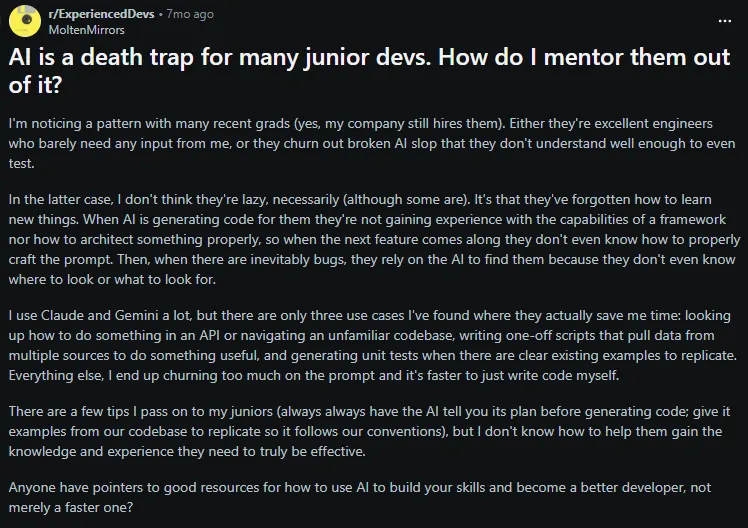
Coding expertise is going to collapse from AI reliance
Lars Faye argues that AI coding assistants can weaken the skill formation novice developers need to use those tools safely and effectively. He calls this the “expert novice” problem: developers entering the field alongside large language models are urged to use AI to keep pace, while effective prompting, code review, system design and output verification still require experience developed through repeated problem-solving. Faye says experienced engineers currently gain more from the tools because they can steer and audit their outputs. Faye cites the study “The Widening Gap: The Benefits and Harms of Generative AI for Novice Programmers,” highlighted by JetBrains, which found that participants using heavier AI assistance often skipped planning, developed an “illusion of competence,” and became lost in generated solutions. Participants who limited assistance performed better by rejecting unhelpful suggestions and using AI to accelerate solutions they already understood. He also cites a 2025 University of Pennsylvania study of 1,000 mathematics students, which reported that unrestricted LLM use led to test performance 17% below a textbook-only group, while a tutor-oriented GPT condition improved AI-assisted practice results by 127% but produced test scores similar to the textbook group. Faye recommends using LLMs primarily for interactive documentation, tutorials and Socratic exercises rather than routine code generation when learning. He says developers should verify AI outputs through official documentation, peers and hands-on testing, and distinguish delegating tedious work from delegating judgment.
larsfaye.com
13 min
8/24/2026

What Happens When the Cost of Intelligence Drops 100x
CatalystNeuro founder Ben Dichter analyzed Artificial Analysis benchmark data and found that the cheapest measured cost for a given level of large-language-model capability has fallen sharply. Models scoring at least 40 on the Artificial Analysis Intelligence Index fell from $1.22 per evaluated task in February 2026 to $0.022 as of August 19, a 56-fold decline. The index combines nine evaluations weighted toward agentic tasks, coding, scientific reasoning, and general capability. GPT-5.6 Luna’s effort settings covered much of the lower-cost frontier, while Claude Opus 5 reached the highest cited score, 63.1, at $2.34 per task at maximum effort. The analysis estimates that cost records for capability tiers of 40, 50, and 60 or higher have been halving roughly every four to ten weeks, though historical price cuts and incomplete retired-model data limit the estimates. Dichter predicts that, if the trend holds, models at index 60 could cost under $0.10 per task within a couple of quarters. Lower costs can make large-scale work such as literature reviews, legal discovery, data curation, moderation, and support triage economically viable. Dichter argues that cheaper model calls may increase total AI spending because organizations can run full-corpus, repeated, and consensus-based workflows that were previously too expensive. OpenRouter offers routing based on a minimum capability score to select the cheapest qualifying frontier model.
catalystneuro.com
17 min
8/21/2026

Norway should buy OpenAI
A proposal calls on Norway’s Government Pension Fund Global (GPFG) to buy OpenAI and ultimately place the AI lab under international multilateral governance. The proposal argues that increasingly capable AI could automate most or all jobs, concentrate wealth and power among system owners, and create societal risks that private companies cannot adequately manage. It characterizes large language models as products of collectively created data, publicly funded research, universities, and internet infrastructure. The proposal puts GPFG’s value at more than $2 trillion and OpenAI’s valuation at about $800 billion, arguing that Norway could finance an acquisition by liquidating roughly 40% of the fund’s portfolio, despite violating its mandate. It says OpenAI began as a nonprofit with capped profits and a windfall clause, and alleges that approval from the California attorney general enabled the organization’s conversion to a for-profit corporation and removal of those commitments. The proposal cites Norway’s democratic stability, management of oil wealth, foreign-aid spending, mediation record, and international institutional ties as reasons to trust it with a temporary stewardship role. It acknowledges that the U.S. government would probably block such an intervention and urges broader policy planning for public or democratic ownership of leading AI labs.
onethousandmeans.com
4 min
8/18/2026

What Happens If OpenAI Dies?
Writer Ed Zitron argues that OpenAI faces a severe financing risk because its compute commitments, operating losses and capital requirements greatly exceed its current revenue and available funding sources. He cites reported figures that OpenAI lost $20.9 billion on $13.07 billion of revenue in 2025, generated $5.7 billion in revenue in the first quarter of 2026 while spending $12.1 billion on cost of revenue and training, and is approaching a $40 billion annualized revenue run rate in August 2026. Zitron criticizes annualized revenue as a promotional metric based on a recent four-week period rather than full-year results. Zitron estimates that OpenAI has more than $800 billion in compute-related obligations through 2030, including at least $147 billion expected through the end of 2027 across major cloud and infrastructure providers. He says OpenAI may need to raise $100 billion to $200 billion annually before reaching projected profitability, while its $122 billion March funding round valued it at $852 billion and relied primarily on Amazon, Nvidia and SoftBank. He argues that an Anthropic IPO could make an OpenAI listing more difficult by exposing both companies’ losses and economics to public-market scrutiny. Zitron speculates that a cash shortfall could lead to a rescue fundraising round, a Microsoft acquisition, a merger with Anthropic, or a collapse that disrupts cloud providers and infrastructure companies dependent on OpenAI spending.
wheresyoured.at
44 min
8/18/2026
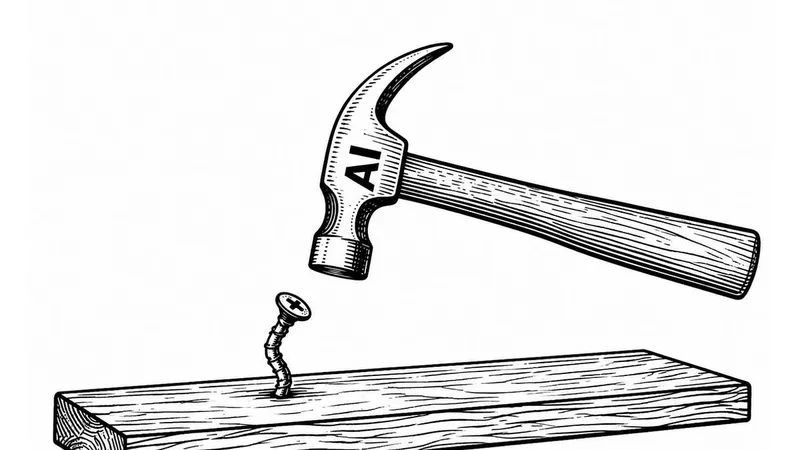

Blog about things you don't understand yet
Each blog post represents at least two lessons learned: the initial topic and insights gained during writing. The author often discovers more than two lessons, as seen in a post about o3 geoguessr, which revealed that newer OpenAI models are more effective than expected.
seangoedecke.com
8 min
8/13/2026
How to Formalize All of Mathematics
A group of mathematicians and formalization researchers argues that AI can help formalize most of mathematics within three years, but only if the resulting Lean libraries are reusable, reviewed, documented, and governed by mathematical communities. They warn that rapidly generated code has limited value when nobody can understand, extend, or trust it. The authors cite an AI-generated formalization of Maryna Viazovska’s sphere-packing work that its original team discarded because cleanup was harder than rebuilding it, and say Anthropic’s 13-million-line, 11-day formal verification of Fermat’s Last Theorem is unlikely to replace a more modern formalization. They support coordinated efforts built around Mathlib, an open-source Lean library with 65 reviewers and 950 contributors that received the 2026 Jean-Pierre Demailly Prize for Open Science in Mathematics. Tau Ceti uses AI-written contributions and AI adversarial review under expert-curated roadmaps; it has grown beyond Mathlib’s 3 million lines of code and includes results such as Riemann–Roch and Chebotarev density. Formal Frontier uses AI-agent systems to turn source texts into interconnected libraries, with 41 released libraries totaling about 200,000 lines. The authors call for open-source interoperability, public review, avoidance of duplicated results, links to literature, sustained compatibility with Lean and Mathlib, and mathematician control over infrastructure and resources.
xenaproject.wordpress.com
12 min
11h ago
The turbulent AI era is here
A Gates Notes post titled “The turbulent AI era is here” was submitted by LVB and received a score of 52 points with 14 comments. The available information does not provide details about the post’s arguments, technologies, people, events, or claims.
gatesnotes.com
1 min
8/26/2026
Coding expertise is going to collapse from AI reliance
Lars Faye argues that AI coding assistants can weaken the skill formation novice developers need to use those tools safely and effectively. He calls this the “expert novice” problem: developers entering the field alongside large language models are urged to use AI to keep pace, while effective prompting, code review, system design and output verification still require experience developed through repeated problem-solving. Faye says experienced engineers currently gain more from the tools because they can steer and audit their outputs. Faye cites the study “The Widening Gap: The Benefits and Harms of Generative AI for Novice Programmers,” highlighted by JetBrains, which found that participants using heavier AI assistance often skipped planning, developed an “illusion of competence,” and became lost in generated solutions. Participants who limited assistance performed better by rejecting unhelpful suggestions and using AI to accelerate solutions they already understood. He also cites a 2025 University of Pennsylvania study of 1,000 mathematics students, which reported that unrestricted LLM use led to test performance 17% below a textbook-only group, while a tutor-oriented GPT condition improved AI-assisted practice results by 127% but produced test scores similar to the textbook group. Faye recommends using LLMs primarily for interactive documentation, tutorials and Socratic exercises rather than routine code generation when learning. He says developers should verify AI outputs through official documentation, peers and hands-on testing, and distinguish delegating tedious work from delegating judgment.
larsfaye.com
13 min
8/24/2026
Norway should buy OpenAI
A proposal calls on Norway’s Government Pension Fund Global (GPFG) to buy OpenAI and ultimately place the AI lab under international multilateral governance. The proposal argues that increasingly capable AI could automate most or all jobs, concentrate wealth and power among system owners, and create societal risks that private companies cannot adequately manage. It characterizes large language models as products of collectively created data, publicly funded research, universities, and internet infrastructure. The proposal puts GPFG’s value at more than $2 trillion and OpenAI’s valuation at about $800 billion, arguing that Norway could finance an acquisition by liquidating roughly 40% of the fund’s portfolio, despite violating its mandate. It says OpenAI began as a nonprofit with capped profits and a windfall clause, and alleges that approval from the California attorney general enabled the organization’s conversion to a for-profit corporation and removal of those commitments. The proposal cites Norway’s democratic stability, management of oil wealth, foreign-aid spending, mediation record, and international institutional ties as reasons to trust it with a temporary stewardship role. It acknowledges that the U.S. government would probably block such an intervention and urges broader policy planning for public or democratic ownership of leading AI labs.
onethousandmeans.com
4 min
8/18/2026
Artificial intelligence is capitalism's final destination
Arundhati Roy’s 15 October 2026 essay argues that artificial intelligence is concentrating economic and political power while damaging human creativity, work, language and social trust. She says generative AI has unsettled education and publishing by making authorship harder to verify, and she describes Anthropic’s use of her books without permission to train large language models; she received a proposed class-action settlement offering several thousand dollars per title. Roy contrasts AI-industry warnings of existential risk with whistleblowers’ concerns about military uses, environmental costs, labour exploitation and algorithmic bias. She cites Meredith Whittaker’s 2019 resignation from Google over machine-vision work for US drones and Timnit Gebru’s 2020 firing after research on large language models’ environmental and social harms. Roy argues that major AI companies’ calls for regulation could entrench dominant firms by tying them more closely to state security systems and limiting smaller competitors. Roy also warns that data centres require large amounts of land, water and energy, citing planned facilities in Visakhapatnam, India, including a $15 billion Google hub. She says low-paid workers provide data and perform work that can train systems intended to automate their jobs. Her essay calls AI-driven extraction of cultural works, human data and natural resources a new form of colonisation and urges resistance rather than relying only on regulation.
equator.org
25 min
13h ago
Bill Gates: The turbulent AI era is here
Bill Gates has characterized the current period as a turbulent AI era requiring critical choices. His remarks appeared in a Gates Notes post titled “A turbulent AI era and critical choices to make,” within a series focused on making AI work for everyone. The post was submitted to a discussion site by user ilamont, where it received 135 points and 202 comments. The available source text provides no further details about Gates’s proposed choices, AI policies, technical claims, or recommendations.
gatesnotes.com
1 min
8/26/2026
What Happens When the Cost of Intelligence Drops 100x
CatalystNeuro founder Ben Dichter analyzed Artificial Analysis benchmark data and found that the cheapest measured cost for a given level of large-language-model capability has fallen sharply. Models scoring at least 40 on the Artificial Analysis Intelligence Index fell from $1.22 per evaluated task in February 2026 to $0.022 as of August 19, a 56-fold decline. The index combines nine evaluations weighted toward agentic tasks, coding, scientific reasoning, and general capability. GPT-5.6 Luna’s effort settings covered much of the lower-cost frontier, while Claude Opus 5 reached the highest cited score, 63.1, at $2.34 per task at maximum effort. The analysis estimates that cost records for capability tiers of 40, 50, and 60 or higher have been halving roughly every four to ten weeks, though historical price cuts and incomplete retired-model data limit the estimates. Dichter predicts that, if the trend holds, models at index 60 could cost under $0.10 per task within a couple of quarters. Lower costs can make large-scale work such as literature reviews, legal discovery, data curation, moderation, and support triage economically viable. Dichter argues that cheaper model calls may increase total AI spending because organizations can run full-corpus, repeated, and consensus-based workflows that were previously too expensive. OpenRouter offers routing based on a minimum capability score to select the cheapest qualifying frontier model.
catalystneuro.com
17 min
8/21/2026
What Happens If OpenAI Dies?
Writer Ed Zitron argues that OpenAI faces a severe financing risk because its compute commitments, operating losses and capital requirements greatly exceed its current revenue and available funding sources. He cites reported figures that OpenAI lost $20.9 billion on $13.07 billion of revenue in 2025, generated $5.7 billion in revenue in the first quarter of 2026 while spending $12.1 billion on cost of revenue and training, and is approaching a $40 billion annualized revenue run rate in August 2026. Zitron criticizes annualized revenue as a promotional metric based on a recent four-week period rather than full-year results. Zitron estimates that OpenAI has more than $800 billion in compute-related obligations through 2030, including at least $147 billion expected through the end of 2027 across major cloud and infrastructure providers. He says OpenAI may need to raise $100 billion to $200 billion annually before reaching projected profitability, while its $122 billion March funding round valued it at $852 billion and relied primarily on Amazon, Nvidia and SoftBank. He argues that an Anthropic IPO could make an OpenAI listing more difficult by exposing both companies’ losses and economics to public-market scrutiny. Zitron speculates that a cash shortfall could lead to a rescue fundraising round, a Microsoft acquisition, a merger with Anthropic, or a collapse that disrupts cloud providers and infrastructure companies dependent on OpenAI spending.
wheresyoured.at
44 min
8/18/2026
Blog about things you don't understand yet
Each blog post represents at least two lessons learned: the initial topic and insights gained during writing. The author often discovers more than two lessons, as seen in a post about o3 geoguessr, which revealed that newer OpenAI models are more effective than expected.
seangoedecke.com
8 min
8/13/2026
How to Formalize All of Mathematics
A group of mathematicians and formalization researchers argues that AI can help formalize most of mathematics within three years, but only if the resulting Lean libraries are reusable, reviewed, documented, and governed by mathematical communities. They warn that rapidly generated code has limited value when nobody can understand, extend, or trust it. The authors cite an AI-generated formalization of Maryna Viazovska’s sphere-packing work that its original team discarded because cleanup was harder than rebuilding it, and say Anthropic’s 13-million-line, 11-day formal verification of Fermat’s Last Theorem is unlikely to replace a more modern formalization. They support coordinated efforts built around Mathlib, an open-source Lean library with 65 reviewers and 950 contributors that received the 2026 Jean-Pierre Demailly Prize for Open Science in Mathematics. Tau Ceti uses AI-written contributions and AI adversarial review under expert-curated roadmaps; it has grown beyond Mathlib’s 3 million lines of code and includes results such as Riemann–Roch and Chebotarev density. Formal Frontier uses AI-agent systems to turn source texts into interconnected libraries, with 41 released libraries totaling about 200,000 lines. The authors call for open-source interoperability, public review, avoidance of duplicated results, links to literature, sustained compatibility with Lean and Mathlib, and mathematician control over infrastructure and resources.
xenaproject.wordpress.com
12 min
11h ago
Bill Gates: The turbulent AI era is here
Bill Gates has characterized the current period as a turbulent AI era requiring critical choices. His remarks appeared in a Gates Notes post titled “A turbulent AI era and critical choices to make,” within a series focused on making AI work for everyone. The post was submitted to a discussion site by user ilamont, where it received 135 points and 202 comments. The available source text provides no further details about Gates’s proposed choices, AI policies, technical claims, or recommendations.
gatesnotes.com
1 min
8/26/2026
Norway should buy OpenAI
A proposal calls on Norway’s Government Pension Fund Global (GPFG) to buy OpenAI and ultimately place the AI lab under international multilateral governance. The proposal argues that increasingly capable AI could automate most or all jobs, concentrate wealth and power among system owners, and create societal risks that private companies cannot adequately manage. It characterizes large language models as products of collectively created data, publicly funded research, universities, and internet infrastructure. The proposal puts GPFG’s value at more than $2 trillion and OpenAI’s valuation at about $800 billion, arguing that Norway could finance an acquisition by liquidating roughly 40% of the fund’s portfolio, despite violating its mandate. It says OpenAI began as a nonprofit with capped profits and a windfall clause, and alleges that approval from the California attorney general enabled the organization’s conversion to a for-profit corporation and removal of those commitments. The proposal cites Norway’s democratic stability, management of oil wealth, foreign-aid spending, mediation record, and international institutional ties as reasons to trust it with a temporary stewardship role. It acknowledges that the U.S. government would probably block such an intervention and urges broader policy planning for public or democratic ownership of leading AI labs.
onethousandmeans.com
4 min
8/18/2026
Blog about things you don't understand yet
Each blog post represents at least two lessons learned: the initial topic and insights gained during writing. The author often discovers more than two lessons, as seen in a post about o3 geoguessr, which revealed that newer OpenAI models are more effective than expected.
seangoedecke.com
8 min
8/13/2026
Artificial intelligence is capitalism's final destination
Arundhati Roy’s 15 October 2026 essay argues that artificial intelligence is concentrating economic and political power while damaging human creativity, work, language and social trust. She says generative AI has unsettled education and publishing by making authorship harder to verify, and she describes Anthropic’s use of her books without permission to train large language models; she received a proposed class-action settlement offering several thousand dollars per title. Roy contrasts AI-industry warnings of existential risk with whistleblowers’ concerns about military uses, environmental costs, labour exploitation and algorithmic bias. She cites Meredith Whittaker’s 2019 resignation from Google over machine-vision work for US drones and Timnit Gebru’s 2020 firing after research on large language models’ environmental and social harms. Roy argues that major AI companies’ calls for regulation could entrench dominant firms by tying them more closely to state security systems and limiting smaller competitors. Roy also warns that data centres require large amounts of land, water and energy, citing planned facilities in Visakhapatnam, India, including a $15 billion Google hub. She says low-paid workers provide data and perform work that can train systems intended to automate their jobs. Her essay calls AI-driven extraction of cultural works, human data and natural resources a new form of colonisation and urges resistance rather than relying only on regulation.
equator.org
25 min
13h ago
Coding expertise is going to collapse from AI reliance
Lars Faye argues that AI coding assistants can weaken the skill formation novice developers need to use those tools safely and effectively. He calls this the “expert novice” problem: developers entering the field alongside large language models are urged to use AI to keep pace, while effective prompting, code review, system design and output verification still require experience developed through repeated problem-solving. Faye says experienced engineers currently gain more from the tools because they can steer and audit their outputs. Faye cites the study “The Widening Gap: The Benefits and Harms of Generative AI for Novice Programmers,” highlighted by JetBrains, which found that participants using heavier AI assistance often skipped planning, developed an “illusion of competence,” and became lost in generated solutions. Participants who limited assistance performed better by rejecting unhelpful suggestions and using AI to accelerate solutions they already understood. He also cites a 2025 University of Pennsylvania study of 1,000 mathematics students, which reported that unrestricted LLM use led to test performance 17% below a textbook-only group, while a tutor-oriented GPT condition improved AI-assisted practice results by 127% but produced test scores similar to the textbook group. Faye recommends using LLMs primarily for interactive documentation, tutorials and Socratic exercises rather than routine code generation when learning. He says developers should verify AI outputs through official documentation, peers and hands-on testing, and distinguish delegating tedious work from delegating judgment.
larsfaye.com
13 min
8/24/2026
What Happens If OpenAI Dies?
Writer Ed Zitron argues that OpenAI faces a severe financing risk because its compute commitments, operating losses and capital requirements greatly exceed its current revenue and available funding sources. He cites reported figures that OpenAI lost $20.9 billion on $13.07 billion of revenue in 2025, generated $5.7 billion in revenue in the first quarter of 2026 while spending $12.1 billion on cost of revenue and training, and is approaching a $40 billion annualized revenue run rate in August 2026. Zitron criticizes annualized revenue as a promotional metric based on a recent four-week period rather than full-year results. Zitron estimates that OpenAI has more than $800 billion in compute-related obligations through 2030, including at least $147 billion expected through the end of 2027 across major cloud and infrastructure providers. He says OpenAI may need to raise $100 billion to $200 billion annually before reaching projected profitability, while its $122 billion March funding round valued it at $852 billion and relied primarily on Amazon, Nvidia and SoftBank. He argues that an Anthropic IPO could make an OpenAI listing more difficult by exposing both companies’ losses and economics to public-market scrutiny. Zitron speculates that a cash shortfall could lead to a rescue fundraising round, a Microsoft acquisition, a merger with Anthropic, or a collapse that disrupts cloud providers and infrastructure companies dependent on OpenAI spending.
wheresyoured.at
44 min
8/18/2026
The turbulent AI era is here
A Gates Notes post titled “The turbulent AI era is here” was submitted by LVB and received a score of 52 points with 14 comments. The available information does not provide details about the post’s arguments, technologies, people, events, or claims.
gatesnotes.com
1 min
8/26/2026
What Happens When the Cost of Intelligence Drops 100x
CatalystNeuro founder Ben Dichter analyzed Artificial Analysis benchmark data and found that the cheapest measured cost for a given level of large-language-model capability has fallen sharply. Models scoring at least 40 on the Artificial Analysis Intelligence Index fell from $1.22 per evaluated task in February 2026 to $0.022 as of August 19, a 56-fold decline. The index combines nine evaluations weighted toward agentic tasks, coding, scientific reasoning, and general capability. GPT-5.6 Luna’s effort settings covered much of the lower-cost frontier, while Claude Opus 5 reached the highest cited score, 63.1, at $2.34 per task at maximum effort. The analysis estimates that cost records for capability tiers of 40, 50, and 60 or higher have been halving roughly every four to ten weeks, though historical price cuts and incomplete retired-model data limit the estimates. Dichter predicts that, if the trend holds, models at index 60 could cost under $0.10 per task within a couple of quarters. Lower costs can make large-scale work such as literature reviews, legal discovery, data curation, moderation, and support triage economically viable. Dichter argues that cheaper model calls may increase total AI spending because organizations can run full-corpus, repeated, and consensus-based workflows that were previously too expensive. OpenRouter offers routing based on a minimum capability score to select the cheapest qualifying frontier model.
catalystneuro.com
17 min
8/21/2026