What Happens If OpenAI Dies?

wheresyoured.at
August 18, 2026
44 min read
50/100
Summary
Writer Ed Zitron argues that OpenAI faces a severe financing risk because its compute commitments, operating losses and capital requirements greatly exceed its current revenue and available funding sources. He cites reported figures that OpenAI lost $20.9 billion on $13.07 billion of revenue in 2025, generated $5.7 billion in revenue in the first quarter of 2026 while spending $12.1 billion on cost of revenue and training, and is approaching a $40 billion annualized revenue run rate in August 2026. Zitron criticizes annualized revenue as a promotional metric based on a recent four-week period rather than full-year results. Zitron estimates that OpenAI has more than $800 billion in compute-related obligations through 2030, including at least $147 billion expected through the end of 2027 across major cloud and infrastructure providers. He says OpenAI may need to raise $100 billion to $200 billion annually before reaching projected profitability, while its $122 billion March funding round valued it at $852 billion and relied primarily on Amazon, Nvidia and SoftBank. He argues that an Anthropic IPO could make an OpenAI listing more difficult by exposing both companies’ losses and economics to public-market scrutiny. Zitron speculates that a cash shortfall could lead to a rescue fundraising round, a Microsoft acquisition, a merger with Anthropic, or a collapse that disrupts cloud providers and infrastructure companies dependent on OpenAI spending.
Key Takeaways
- Ed Zitron estimates that OpenAI has more than $800 billion in compute-related obligations due by the end of 2030 and at least $147 billion in expected compute commitments through the end of 2027.
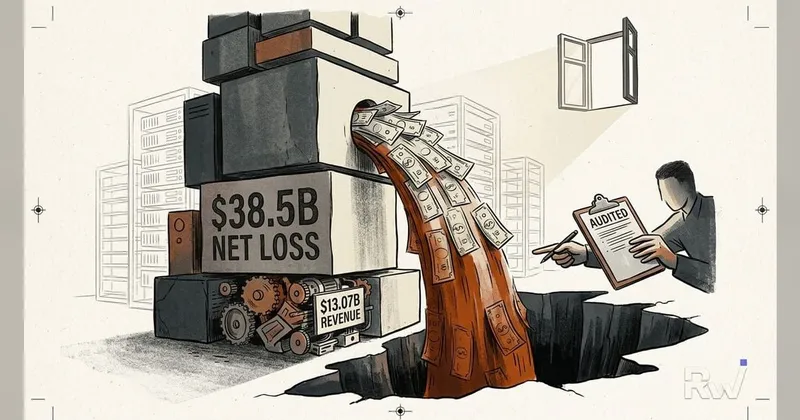
- The source cites reported figures that OpenAI lost $20.9 billion on $13.07 billion in revenue during 2025 and had $5.7 billion in first-quarter 2026 revenue against $12.1 billion in cost of revenue and training.
- OpenAI reportedly calculates annualized revenue by multiplying revenue from its most recent four-week period by 12; Zitron argues that method can overstate sustainable revenue growth.
- OpenAI’s $122 billion funding round was reported to value the company at $852 billion, with Amazon, Nvidia and SoftBank contributing $110 billion of the total.
- Zitron argues that OpenAI’s continued operation depends on repeated large capital raises and speculates that a funding failure could result in acquisition, merger, restructuring or collapse.
What the discussion said
The thread spent less time on the literal disappearance of ChatGPT than on whether OpenAI has become the load-bearing customer for an overheated AI economy. Several commenters treated a failure as increasingly plausible and saw its GPU, memory, server, and datacenter commitments as a potential shock to chip vendors, builders, carriers, and AI investors. Executive churn was read by some as another possible clue that revenue targets or internal goals are not being met. A few took the argument all the way to a broader market crash, while others pushed back that a single buyer disappearing would not instantly erase constrained hardware demand or permanently wreck valuations. There was also substantial skepticism of the article's messenger. Critics saw the author as packaging maximal pessimism for attention and repeating familiar bubble rhetoric, whereas supporters valued the public record of extravagant AI claims and believed harsh scrutiny is overdue. Even many pessimists did not equate OpenAI failing with AI itself ending: liquidation could distribute models, infrastructure, and talent across incumbents and startups, while local models could reduce reliance on one hosted provider. The ugliest practical fear was that a distressed company might monetize user data, underscoring how platform dependence turns corporate failure into a privacy risk.
Where opinion split
The sharpest divide is whether OpenAI's collapse would expose an AI investment bubble or merely reshuffle a durable technology market. Bears argue that its enormous hardware spending, missed revenue goals, and investor dependence could trigger cascading losses; the opposing view is that capacity, assets, talent, and demand would survive and move to competitors or new startups.
Community Sentiment
Positives
- OpenAI disappearing would not kill generative AI: its assets, trained talent, and customer demand could be absorbed by rivals and a wave of new companies.
- More capable local models could fill service gaps after a platform failure, giving users practical alternatives to dependence on a single cloud AI vendor.
- Reduced OpenAI demand could eventually loosen scarce compute and memory supply, easing a hardware bottleneck that has distorted the wider technology economy.
Concerns
- OpenAI's outsized purchases of accelerators, memory, servers, and datacenter capacity could turn one company's failure into a supply-chain and AI-investment shock.
- Senior leadership departures may reflect failed revenue or execution targets, reinforcing fears that blockbuster AI valuations rest on demand that will not materialize.
- A distressed AI platform could treat user information as an asset for sale, making dependence on a centralized chatbot a privacy liability.
- The most bearish readers see AI spending as a bubble large enough to drag public markets down when capital stops subsidizing loss-making model development.