
DiffusionGemma Technical Report
DiffusionGemma is an experimental open-weight language model that generates text through discrete diffusion, refining 256-token blocks in parallel rather than producing tokens sequentially. The design is intended to avoid the decoding bottleneck of autoregressive language models. The model was created by fine-tuning the mixture-of-experts Gemma 4 model, which has 3.8 billion activated parameters and 25.2 billion total parameters. Its two-stage training process used fewer than 10% of the original autoregressive model’s total training-token budget. Supervised fine-tuning first taught bidirectional denoising; a second phase combined reinforcement learning and sampler distillation to improve generation quality and inference efficiency. Across its evaluation suite, DiffusionGemma generated about 20 tokens per forward pass and about 1,500 output tokens per second on a single Nvidia H100 GPU. The researchers say these results establish a new speed-capability trade-off frontier and exceed autoregressive models, including those using speculative decoding. DiffusionGemma retains Gemma 4’s thinking mode, multimodal-input, and long-context support. It can also still generate text autoregressively with minor performance degradation, suggesting potential hybrid diffusion-autoregressive decoding systems.
arxiv.org
2 min
8/20/2026
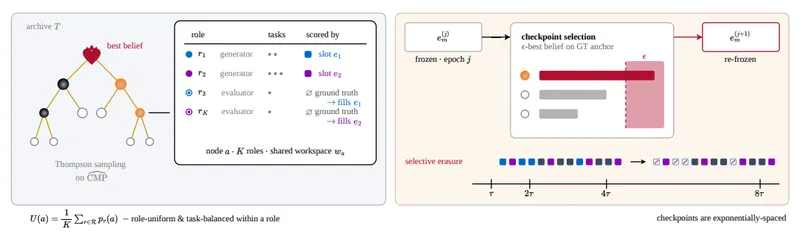
Red queen hypothesis – A new way forward for self-improving AI
Researchers from NVIDIA and Flower Labs have developed a method for recursive self-improving AI agents that allows them to enhance their own code without reaching an evaluation ceiling. This advancement addresses a significant challenge in the development of self-improving AI.
cst.cam.ac.uk
5 min
8/16/2026

Semaglutide linked to 26% lower 5-year predicted dementia risk
Semaglutide is associated with a 26% reduction in the predicted risk of developing dementia over five years. This finding suggests potential cognitive benefits of the drug beyond its use for weight management and diabetes.
alz-journals.onlinelibrary.wiley.com
1 min
8/15/2026

Could a computer scientist build a brain?
A program is proposed to enable a single cell to build itself into a brain using only genomic information. The program must be compact enough to fit within a genome and efficient enough to complete development in a timely manner.
stankerstjens.github.io
36 min
8/15/2026

Launch HN: Discovered Materials (YC P26) – AI agents to discover new materials
The Material Discovery Bench evaluates models on their ability to propose novel, BEOL-compatible crystalline materials that meet specific targets for thermal conductivity ($kappa), static dielectric constant ($epsilon), Young's modulus, and shear modulus. The benchmark utilizes a harness, tools, and graders to measure model performance based on these criteria.
discoveredmaterials.com
8 min
8/12/2026
Emergent Introspective Awareness in Large Language Models
Research investigates the ability of large language models to introspect on their internal states. The study employs injected representations of known concepts into model activations to differentiate genuine introspection from confabulations.
arxiv.org
2 min
8/11/2026

Claude moves bound of the Riemann Hypothesis from 41.6% to 67.2%
8 days ago, while jogging, I asked Claude to solve the Riemann Hypothesis It didn’t. 1.5 days later, it proved >= 67% of the zeros are on the line (prev: 41.6%) Still not sure what that means, but some analytic number theorists seem excited - I’d tried once before in a single session and it went nowhere. Eight days ago, when I tried again, this was the opening message:The heavy lifting was recent ...
twitter.com
1 min
8/10/2026

Learning more about Claude's mathematical capabilities
Claude attempted to address the Riemann hypothesis, a famous unsolved problem in mathematics dating back to 1859. The challenge reflects the ongoing exploration of Claude's mathematical capabilities and its potential contributions to scientific discovery.
anthropic.com
6 min
8/10/2026
When AI Benchmarks Plateau: A Systematic Study of Benchmark Saturation
AI benchmarks are essential for assessing model performance and informing deployment choices. However, they often reach saturation, reducing their effectiveness in distinguishing between models and limiting their long-term utility.
arxiv.org
2 min
8/4/2026

DiffusionGemma Technical Report
DiffusionGemma is an experimental open-weight language model that generates text through discrete diffusion, refining 256-token blocks in parallel rather than producing tokens sequentially. The design is intended to avoid the decoding bottleneck of autoregressive language models. The model was created by fine-tuning the mixture-of-experts Gemma 4 model, which has 3.8 billion activated parameters and 25.2 billion total parameters. Its two-stage training process used fewer than 10% of the original autoregressive model’s total training-token budget. Supervised fine-tuning first taught bidirectional denoising; a second phase combined reinforcement learning and sampler distillation to improve generation quality and inference efficiency. Across its evaluation suite, DiffusionGemma generated about 20 tokens per forward pass and about 1,500 output tokens per second on a single Nvidia H100 GPU. The researchers say these results establish a new speed-capability trade-off frontier and exceed autoregressive models, including those using speculative decoding. DiffusionGemma retains Gemma 4’s thinking mode, multimodal-input, and long-context support. It can also still generate text autoregressively with minor performance degradation, suggesting potential hybrid diffusion-autoregressive decoding systems.
arxiv.org
2 min
8/20/2026
Semaglutide linked to 26% lower 5-year predicted dementia risk
Semaglutide is associated with a 26% reduction in the predicted risk of developing dementia over five years. This finding suggests potential cognitive benefits of the drug beyond its use for weight management and diabetes.
alz-journals.onlinelibrary.wiley.com
1 min
8/15/2026
Launch HN: Discovered Materials (YC P26) – AI agents to discover new materials
The Material Discovery Bench evaluates models on their ability to propose novel, BEOL-compatible crystalline materials that meet specific targets for thermal conductivity ($kappa), static dielectric constant ($epsilon), Young's modulus, and shear modulus. The benchmark utilizes a harness, tools, and graders to measure model performance based on these criteria.
discoveredmaterials.com
8 min
8/12/2026
Claude moves bound of the Riemann Hypothesis from 41.6% to 67.2%
8 days ago, while jogging, I asked Claude to solve the Riemann Hypothesis It didn’t. 1.5 days later, it proved >= 67% of the zeros are on the line (prev: 41.6%) Still not sure what that means, but some analytic number theorists seem excited - I’d tried once before in a single session and it went nowhere. Eight days ago, when I tried again, this was the opening message:The heavy lifting was recent ...
twitter.com
1 min
8/10/2026
When AI Benchmarks Plateau: A Systematic Study of Benchmark Saturation
AI benchmarks are essential for assessing model performance and informing deployment choices. However, they often reach saturation, reducing their effectiveness in distinguishing between models and limiting their long-term utility.
arxiv.org
2 min
8/4/2026
Red queen hypothesis – A new way forward for self-improving AI
Researchers from NVIDIA and Flower Labs have developed a method for recursive self-improving AI agents that allows them to enhance their own code without reaching an evaluation ceiling. This advancement addresses a significant challenge in the development of self-improving AI.
cst.cam.ac.uk
5 min
8/16/2026
Could a computer scientist build a brain?
A program is proposed to enable a single cell to build itself into a brain using only genomic information. The program must be compact enough to fit within a genome and efficient enough to complete development in a timely manner.
stankerstjens.github.io
36 min
8/15/2026
Emergent Introspective Awareness in Large Language Models
Research investigates the ability of large language models to introspect on their internal states. The study employs injected representations of known concepts into model activations to differentiate genuine introspection from confabulations.
arxiv.org
2 min
8/11/2026
Learning more about Claude's mathematical capabilities
Claude attempted to address the Riemann hypothesis, a famous unsolved problem in mathematics dating back to 1859. The challenge reflects the ongoing exploration of Claude's mathematical capabilities and its potential contributions to scientific discovery.
anthropic.com
6 min
8/10/2026
DiffusionGemma Technical Report
DiffusionGemma is an experimental open-weight language model that generates text through discrete diffusion, refining 256-token blocks in parallel rather than producing tokens sequentially. The design is intended to avoid the decoding bottleneck of autoregressive language models. The model was created by fine-tuning the mixture-of-experts Gemma 4 model, which has 3.8 billion activated parameters and 25.2 billion total parameters. Its two-stage training process used fewer than 10% of the original autoregressive model’s total training-token budget. Supervised fine-tuning first taught bidirectional denoising; a second phase combined reinforcement learning and sampler distillation to improve generation quality and inference efficiency. Across its evaluation suite, DiffusionGemma generated about 20 tokens per forward pass and about 1,500 output tokens per second on a single Nvidia H100 GPU. The researchers say these results establish a new speed-capability trade-off frontier and exceed autoregressive models, including those using speculative decoding. DiffusionGemma retains Gemma 4’s thinking mode, multimodal-input, and long-context support. It can also still generate text autoregressively with minor performance degradation, suggesting potential hybrid diffusion-autoregressive decoding systems.
arxiv.org
2 min
8/20/2026
Could a computer scientist build a brain?
A program is proposed to enable a single cell to build itself into a brain using only genomic information. The program must be compact enough to fit within a genome and efficient enough to complete development in a timely manner.
stankerstjens.github.io
36 min
8/15/2026
Claude moves bound of the Riemann Hypothesis from 41.6% to 67.2%
8 days ago, while jogging, I asked Claude to solve the Riemann Hypothesis It didn’t. 1.5 days later, it proved >= 67% of the zeros are on the line (prev: 41.6%) Still not sure what that means, but some analytic number theorists seem excited - I’d tried once before in a single session and it went nowhere. Eight days ago, when I tried again, this was the opening message:The heavy lifting was recent ...
twitter.com
1 min
8/10/2026
Red queen hypothesis – A new way forward for self-improving AI
Researchers from NVIDIA and Flower Labs have developed a method for recursive self-improving AI agents that allows them to enhance their own code without reaching an evaluation ceiling. This advancement addresses a significant challenge in the development of self-improving AI.
cst.cam.ac.uk
5 min
8/16/2026
Launch HN: Discovered Materials (YC P26) – AI agents to discover new materials
The Material Discovery Bench evaluates models on their ability to propose novel, BEOL-compatible crystalline materials that meet specific targets for thermal conductivity ($kappa), static dielectric constant ($epsilon), Young's modulus, and shear modulus. The benchmark utilizes a harness, tools, and graders to measure model performance based on these criteria.
discoveredmaterials.com
8 min
8/12/2026
Learning more about Claude's mathematical capabilities
Claude attempted to address the Riemann hypothesis, a famous unsolved problem in mathematics dating back to 1859. The challenge reflects the ongoing exploration of Claude's mathematical capabilities and its potential contributions to scientific discovery.
anthropic.com
6 min
8/10/2026
Semaglutide linked to 26% lower 5-year predicted dementia risk
Semaglutide is associated with a 26% reduction in the predicted risk of developing dementia over five years. This finding suggests potential cognitive benefits of the drug beyond its use for weight management and diabetes.
alz-journals.onlinelibrary.wiley.com
1 min
8/15/2026
Emergent Introspective Awareness in Large Language Models
Research investigates the ability of large language models to introspect on their internal states. The study employs injected representations of known concepts into model activations to differentiate genuine introspection from confabulations.
arxiv.org
2 min
8/11/2026
When AI Benchmarks Plateau: A Systematic Study of Benchmark Saturation
AI benchmarks are essential for assessing model performance and informing deployment choices. However, they often reach saturation, reducing their effectiveness in distinguishing between models and limiting their long-term utility.
arxiv.org
2 min
8/4/2026