Red queen hypothesis – A new way forward for self-improving AI
cst.cam.ac.uk
August 16, 2026
5 min read
🔥🔥🔥🔥🔥
50/100
Summary
Researchers from NVIDIA and Flower Labs have developed a method for recursive self-improving AI agents that allows them to enhance their own code without reaching an evaluation ceiling. This advancement addresses a significant challenge in the development of self-improving AI.
Key Takeaways
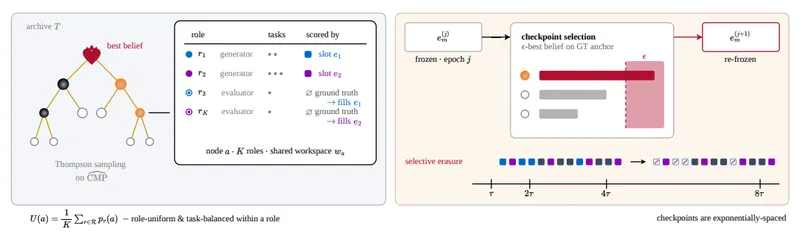
- Researchers developed a method for recursive self-improving AI agents that allows both the agents and their evaluators to evolve together, preventing stagnation in improvement.
- The new framework, called the Red Queen Gödel Machine, demonstrated improved performance in tasks such as scientific paper writing and grading, achieving higher acceptance rates and accuracy compared to previous methods.
- The approach addresses the limitation of fixed evaluators by ensuring that as AI agents improve, the evaluation criteria also become more challenging, creating a continuous self-improvement loop.
- The research team includes collaborators from NVIDIA and Flower Labs, and the findings have been shared in a pre-print paper on arXiv.
Community Sentiment
Positives
- The concept of co-evolving agents and evaluators is a fresh take that could enhance self-improvement in AI, echoing GAN principles from a decade ago.
- This approach allows for dynamic evaluation, which could lead to more robust AI systems that adapt better to changing conditions.
- The paper taps into evolutionary principles that have been effective in various domains, bringing a solid theoretical foundation to the discussion.
Concerns
- Critics argue that this method is limited to problems already defined by humans, raising concerns about its utility for novel challenges without existing ground-truth examples.
- Some commenters point out that while the idea is intriguing, it feels like a rehash of concepts from the 90s, lacking true innovation.
- There’s skepticism about whether the AI can generate reliable ground-truth examples for unsolved problems, which could hinder its self-improvement capabilities.