
OpenAI Jalapeño: Better than Nvidia Blackwell
OpenAI has disclosed Jalapeño, a custom AI inference accelerator developed with Broadcom and presented at Hot Chips. The company began designing the chip in mid-2024 and taped out its CoWoS package design in November 2025. Engineering samples use the A0 stepping, while a B0 revision in fabrication is projected by OpenAI to improve performance per watt by about 25%. Production is scheduled to ramp gradually during 2027. SemiAnalysis said it observed OpenAI engineers run parts of its InferenceX benchmark in OpenAI’s lab, but said the reported results were supplied by OpenAI and that it did not run the complete benchmark suite or AgentX’s longer-context, multi-turn tests. SemiAnalysis reported that Jalapeño exceeded Nvidia Blackwell and, in output-token throughput per megawatt, Nvidia Vera Rubin’s published multi-token-prediction results while Jalapeño used single-token prediction. The comparison remains limited by differing models, software maturity, and benchmark configurations. Jalapeño uses HBM4 memory with 15.4 TB/s of package bandwidth, a 700 W TDP, and a TSMC N3P compute die. Each rack contains 128 accelerators, and a scale-up network can link 16 racks, or 2,048 chips. OpenAI designed the chip for a unified inference pool rather than separate prefill and decode pools, and uses its Gluon programming language and Codex-assisted kernel development.
newsletter.semianalysis.com
24 min
8/25/2026

OpenAI: GPT 5.6 Sol price reduction (until at least Nov 21)
OpenAI lists API pricing for GPT-5.6 Sol, Terra, and Luna across short- and long-context requests, with separate rates for input, cached input, cache writes, and output. GPT-5.6 Sol is listed at $4 input and $20 output for short context, rising to $8 input and $30 output for long context; Luna is listed at $0.20 input and $1.20 output for short context. Sol promotional pricing is available at least through November 21, 2026. OpenAI renamed Priority processing to Fast mode on July 30, 2026, while continuing to accept both the "priority" and "fast" service-tier values. The pricing page also covers realtime, image, video, transcription, search, container, file-search, and specialized coding services. Sora 2 video generation is listed at $0.10 per second for 720p, while Sora 2 Pro ranges from $0.30 per second at 720p to $0.70 at 1080p. GPT-Transcribe has an estimated cost of $0.0045 per minute, and web search costs $10 per 1,000 calls plus search-content tokens at model rates. OpenAI is winding down its fine-tuning platform: new users cannot access it, while existing users can create training jobs for the coming months. Fine-tuned models remain available for inference until their base models are deprecated.
developers.openai.com
6 min
8/24/2026
GPT 5.6 Sol 20% price reduction
OpenAI’s GPT-5.6 Sol is a frontier model for complex professional work and the top tier of the GPT-5.6 family. The gpt-5.6 alias routes requests to GPT-5.6 Sol, which roughly corresponds to the unsuffixed model tier in earlier GPT-5 families. It accepts text and image inputs and produces text output, with a 1,050,000-token context window, a maximum output of 128,000 tokens, and a February 16, 2026 knowledge cutoff. The model supports reasoning-effort settings of none, low, medium, high, xhigh, and max; medium is the default. It supports streaming, function calling, structured outputs, and a range of Responses API tools, including web search, file search, image generation, code interpreter, hosted shell, computer use, MCP, and tool search. Fine-tuning is not supported. GPT-5.6 Sol costs $4 per million input tokens, $0.40 per million cached-input tokens, and $20 per million output tokens. OpenAI says these rates represent 20% lower input pricing and 33% lower output pricing, with promotional pricing available at least through November 21, 2026. Requests containing more than 272,000 input tokens are billed at twice the input rate and 1.5 times the output rate for the entire request.
developers.openai.com
2 min
8/22/2026
DeepSeek-v4-flash-vision-exp
DeepSeek’s experimental deepseek-v4-flash-vision-exp model accepts image and text inputs for tasks including image description, screenshot text reading, and chart analysis. It supports JPEG, PNG, GIF, and WebP files, detecting formats from file contents rather than filenames or declared MIME types. Developers can provide images as inline base64 data URLs, public HTTP(S) URLs, or Files API uploads referenced by file_id. The model is available through OpenAI-compatible Chat Completions and Responses APIs, as well as DeepSeek’s Anthropic-compatible Messages endpoint. Inline image data counts toward a 48 MiB request-body limit. External image URLs may contain up to 8,192 characters, must download within 60 seconds, and are limited to 32 MiB per image. Files API references support images up to 64 MiB and allow uploaded images to be reused. Requests can contain up to 600 images, with total image limits of 64 MiB without file_id images and up to 200 MiB when file_id images are included. DeepSeek resizes images before inference and caps usage at 384 image tokens each. Images below about 384×384 pixels are enlarged, while larger images are reduced to roughly 800×800 pixels. A low-detail option downsizes image_url inputs to 512×512 for faster, cheaper processing. Images are accepted only in user messages for Chat Completions, and only the vision model supports them.
api-docs.deepseek.com
6 min
8/21/2026
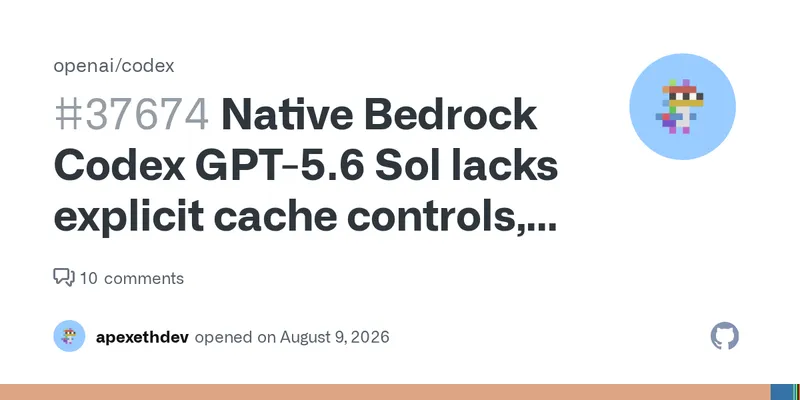
Codex on AWS bedrock bug causing 10x charges
A GitHub issue reports that Codex CLI 0.147.0 using its native Amazon Bedrock provider cannot enable explicit prompt caching for the openai.gpt-5.6-sol model through the Bedrock Mantle Responses API in us-east-1. The reporter says Codex emits a session-scoped prompt_cache_key, but its HTTP and WebSocket Responses request types do not support prompt_cache_options or prompt_cache_breakpoint fields. The built-in Bedrock provider configuration supports transport and authentication settings rather than request-body transformations, preventing configuration through config.toml. For completed days from August 5 through August 8, 2026, the reporter estimated 3,656 requests generated 171.94 million cache-write tokens, costing $1,182.09 of an estimated $1,386.46 total model spend. Cache writes represented about 85% of the estimate, which was derived from AWS Cost Explorer quantities and Bedrock rate-card pricing rather than finalized invoice amounts. A local session recorded 76 Sol requests, 6.709 million cache-write input tokens, no cached input tokens, and roughly 88,000 cache-write tokens per request; corresponding CloudWatch metrics showed no client errors. The requested changes include support for prompt_cache_options, typed prompt_cache_breakpoint input fields, provider and model capability checks, placement after stable instruction and tool prefixes, and per-turn cache-read and cache-write telemetry.
github.com
2 min
8/21/2026
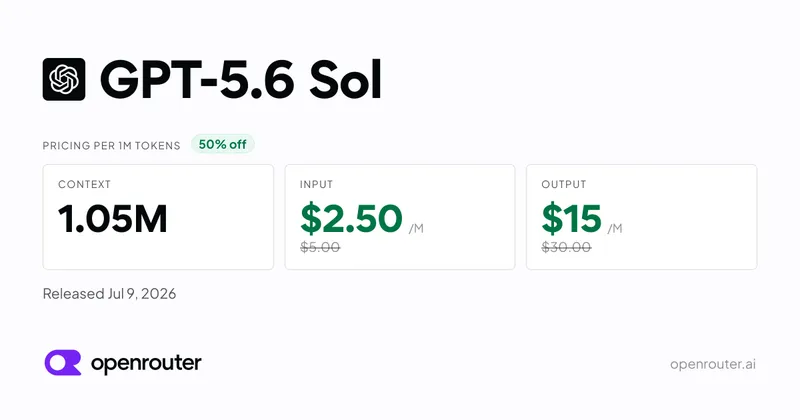
GPT-5.6 Sol Pricing Cut by 50%
GPT-5.6 Sol is OpenAI’s flagship model in the GPT-5.6 series, released on July 9, 2026. It is positioned for complex reasoning, coding, agentic workflows, command-line work, multi-step coding tasks, and long-horizon problem solving. The model has a 1 million-token context window and a February 2026 knowledge cutoff. OpenRouter lists pricing of $2.50 per million input tokens and $15 per million output tokens, reflecting a 50% discount from listed rates of $5 and $30. Provider listings shown on the platform include input prices from $5 to $5.50 per million tokens, output prices from $30 to $33, and cache pricing from $0.50 to $0.55. OpenRouter says actual customer prices can be lower because of caching and discounts. OpenRouter can route requests for GPT-5.6 Sol among multiple hosting providers through Balanced, Nitro, or Exacto modes, which prioritize price and speed, fastest response, or tool-calling accuracy, respectively. The platform reports a best-provider median latency of 3.07 seconds and a best-across-providers median throughput of 46 tokens per second. It reports 100.00% uptime over the prior three days and 99.76% availability, and says it can reroute requests after upstream-provider errors when request filters permit it. OpenRouter’s OpenAI-compatible API allows many SDKs to use the model by changing the base URL and model slug.
openrouter.ai
2 min
8/17/2026
DeepSeek peak/off-peak pricing update
DeepSeek-V4-Pro has been launched with major agent upgrades that enhance production performance. It features flexible reasoning capabilities for various task complexities and offers native support for the OpenAI Responses API, optimized for Codex with one-click setup.
api-docs.deepseek.com
1 min
8/14/2026
Accelerating GPT-5.6 Sol Ultrafast
Cerebras and OpenAI have introduced Ultrafast Mode, a new service tier in the OpenAI API that accelerates GPT-5.6 Sol. This mode delivers up to 750 output tokens per second without compromising quality, targeting time-sensitive and mission-critical tasks.
cerebras.ai
4 min
8/13/2026

ChatGPT Desktop (Codex Desktop) for Linux
Codex in ChatGPT enables AI coding agents to perform tasks such as building features, complex refactors, and migrations using OpenAI's advanced coding models. It supports multi-agent workflows with built-in worktrees and cloud environments, allowing agents to work in parallel across projects.
openai.com
2 min
8/13/2026

OpenChamber: An Agentic Development Environment
OpenChamber is an agentic development environment for AI coding that allows users to set session goals for continuous task execution. It supports multi-run tasks across multiple models, provides a changes walkthrough feature for understanding modifications, and enables previewing elements in a running app by sending relevant information to the agent.
openchamber.dev
3 min
8/9/2026
OpenAI Jalapeño: Better than Nvidia Blackwell
OpenAI has disclosed Jalapeño, a custom AI inference accelerator developed with Broadcom and presented at Hot Chips. The company began designing the chip in mid-2024 and taped out its CoWoS package design in November 2025. Engineering samples use the A0 stepping, while a B0 revision in fabrication is projected by OpenAI to improve performance per watt by about 25%. Production is scheduled to ramp gradually during 2027. SemiAnalysis said it observed OpenAI engineers run parts of its InferenceX benchmark in OpenAI’s lab, but said the reported results were supplied by OpenAI and that it did not run the complete benchmark suite or AgentX’s longer-context, multi-turn tests. SemiAnalysis reported that Jalapeño exceeded Nvidia Blackwell and, in output-token throughput per megawatt, Nvidia Vera Rubin’s published multi-token-prediction results while Jalapeño used single-token prediction. The comparison remains limited by differing models, software maturity, and benchmark configurations. Jalapeño uses HBM4 memory with 15.4 TB/s of package bandwidth, a 700 W TDP, and a TSMC N3P compute die. Each rack contains 128 accelerators, and a scale-up network can link 16 racks, or 2,048 chips. OpenAI designed the chip for a unified inference pool rather than separate prefill and decode pools, and uses its Gluon programming language and Codex-assisted kernel development.
newsletter.semianalysis.com
24 min
8/25/2026
GPT 5.6 Sol 20% price reduction
OpenAI’s GPT-5.6 Sol is a frontier model for complex professional work and the top tier of the GPT-5.6 family. The gpt-5.6 alias routes requests to GPT-5.6 Sol, which roughly corresponds to the unsuffixed model tier in earlier GPT-5 families. It accepts text and image inputs and produces text output, with a 1,050,000-token context window, a maximum output of 128,000 tokens, and a February 16, 2026 knowledge cutoff. The model supports reasoning-effort settings of none, low, medium, high, xhigh, and max; medium is the default. It supports streaming, function calling, structured outputs, and a range of Responses API tools, including web search, file search, image generation, code interpreter, hosted shell, computer use, MCP, and tool search. Fine-tuning is not supported. GPT-5.6 Sol costs $4 per million input tokens, $0.40 per million cached-input tokens, and $20 per million output tokens. OpenAI says these rates represent 20% lower input pricing and 33% lower output pricing, with promotional pricing available at least through November 21, 2026. Requests containing more than 272,000 input tokens are billed at twice the input rate and 1.5 times the output rate for the entire request.
developers.openai.com
2 min
8/22/2026
Codex on AWS bedrock bug causing 10x charges
A GitHub issue reports that Codex CLI 0.147.0 using its native Amazon Bedrock provider cannot enable explicit prompt caching for the openai.gpt-5.6-sol model through the Bedrock Mantle Responses API in us-east-1. The reporter says Codex emits a session-scoped prompt_cache_key, but its HTTP and WebSocket Responses request types do not support prompt_cache_options or prompt_cache_breakpoint fields. The built-in Bedrock provider configuration supports transport and authentication settings rather than request-body transformations, preventing configuration through config.toml. For completed days from August 5 through August 8, 2026, the reporter estimated 3,656 requests generated 171.94 million cache-write tokens, costing $1,182.09 of an estimated $1,386.46 total model spend. Cache writes represented about 85% of the estimate, which was derived from AWS Cost Explorer quantities and Bedrock rate-card pricing rather than finalized invoice amounts. A local session recorded 76 Sol requests, 6.709 million cache-write input tokens, no cached input tokens, and roughly 88,000 cache-write tokens per request; corresponding CloudWatch metrics showed no client errors. The requested changes include support for prompt_cache_options, typed prompt_cache_breakpoint input fields, provider and model capability checks, placement after stable instruction and tool prefixes, and per-turn cache-read and cache-write telemetry.
github.com
2 min
8/21/2026
DeepSeek peak/off-peak pricing update
DeepSeek-V4-Pro has been launched with major agent upgrades that enhance production performance. It features flexible reasoning capabilities for various task complexities and offers native support for the OpenAI Responses API, optimized for Codex with one-click setup.
api-docs.deepseek.com
1 min
8/14/2026
ChatGPT Desktop (Codex Desktop) for Linux
Codex in ChatGPT enables AI coding agents to perform tasks such as building features, complex refactors, and migrations using OpenAI's advanced coding models. It supports multi-agent workflows with built-in worktrees and cloud environments, allowing agents to work in parallel across projects.
openai.com
2 min
8/13/2026
OpenAI: GPT 5.6 Sol price reduction (until at least Nov 21)
OpenAI lists API pricing for GPT-5.6 Sol, Terra, and Luna across short- and long-context requests, with separate rates for input, cached input, cache writes, and output. GPT-5.6 Sol is listed at $4 input and $20 output for short context, rising to $8 input and $30 output for long context; Luna is listed at $0.20 input and $1.20 output for short context. Sol promotional pricing is available at least through November 21, 2026. OpenAI renamed Priority processing to Fast mode on July 30, 2026, while continuing to accept both the "priority" and "fast" service-tier values. The pricing page also covers realtime, image, video, transcription, search, container, file-search, and specialized coding services. Sora 2 video generation is listed at $0.10 per second for 720p, while Sora 2 Pro ranges from $0.30 per second at 720p to $0.70 at 1080p. GPT-Transcribe has an estimated cost of $0.0045 per minute, and web search costs $10 per 1,000 calls plus search-content tokens at model rates. OpenAI is winding down its fine-tuning platform: new users cannot access it, while existing users can create training jobs for the coming months. Fine-tuned models remain available for inference until their base models are deprecated.
developers.openai.com
6 min
8/24/2026
DeepSeek-v4-flash-vision-exp
DeepSeek’s experimental deepseek-v4-flash-vision-exp model accepts image and text inputs for tasks including image description, screenshot text reading, and chart analysis. It supports JPEG, PNG, GIF, and WebP files, detecting formats from file contents rather than filenames or declared MIME types. Developers can provide images as inline base64 data URLs, public HTTP(S) URLs, or Files API uploads referenced by file_id. The model is available through OpenAI-compatible Chat Completions and Responses APIs, as well as DeepSeek’s Anthropic-compatible Messages endpoint. Inline image data counts toward a 48 MiB request-body limit. External image URLs may contain up to 8,192 characters, must download within 60 seconds, and are limited to 32 MiB per image. Files API references support images up to 64 MiB and allow uploaded images to be reused. Requests can contain up to 600 images, with total image limits of 64 MiB without file_id images and up to 200 MiB when file_id images are included. DeepSeek resizes images before inference and caps usage at 384 image tokens each. Images below about 384×384 pixels are enlarged, while larger images are reduced to roughly 800×800 pixels. A low-detail option downsizes image_url inputs to 512×512 for faster, cheaper processing. Images are accepted only in user messages for Chat Completions, and only the vision model supports them.
api-docs.deepseek.com
6 min
8/21/2026
GPT-5.6 Sol Pricing Cut by 50%
GPT-5.6 Sol is OpenAI’s flagship model in the GPT-5.6 series, released on July 9, 2026. It is positioned for complex reasoning, coding, agentic workflows, command-line work, multi-step coding tasks, and long-horizon problem solving. The model has a 1 million-token context window and a February 2026 knowledge cutoff. OpenRouter lists pricing of $2.50 per million input tokens and $15 per million output tokens, reflecting a 50% discount from listed rates of $5 and $30. Provider listings shown on the platform include input prices from $5 to $5.50 per million tokens, output prices from $30 to $33, and cache pricing from $0.50 to $0.55. OpenRouter says actual customer prices can be lower because of caching and discounts. OpenRouter can route requests for GPT-5.6 Sol among multiple hosting providers through Balanced, Nitro, or Exacto modes, which prioritize price and speed, fastest response, or tool-calling accuracy, respectively. The platform reports a best-provider median latency of 3.07 seconds and a best-across-providers median throughput of 46 tokens per second. It reports 100.00% uptime over the prior three days and 99.76% availability, and says it can reroute requests after upstream-provider errors when request filters permit it. OpenRouter’s OpenAI-compatible API allows many SDKs to use the model by changing the base URL and model slug.
openrouter.ai
2 min
8/17/2026
Accelerating GPT-5.6 Sol Ultrafast
Cerebras and OpenAI have introduced Ultrafast Mode, a new service tier in the OpenAI API that accelerates GPT-5.6 Sol. This mode delivers up to 750 output tokens per second without compromising quality, targeting time-sensitive and mission-critical tasks.
cerebras.ai
4 min
8/13/2026
OpenChamber: An Agentic Development Environment
OpenChamber is an agentic development environment for AI coding that allows users to set session goals for continuous task execution. It supports multi-run tasks across multiple models, provides a changes walkthrough feature for understanding modifications, and enables previewing elements in a running app by sending relevant information to the agent.
openchamber.dev
3 min
8/9/2026
OpenAI Jalapeño: Better than Nvidia Blackwell
OpenAI has disclosed Jalapeño, a custom AI inference accelerator developed with Broadcom and presented at Hot Chips. The company began designing the chip in mid-2024 and taped out its CoWoS package design in November 2025. Engineering samples use the A0 stepping, while a B0 revision in fabrication is projected by OpenAI to improve performance per watt by about 25%. Production is scheduled to ramp gradually during 2027. SemiAnalysis said it observed OpenAI engineers run parts of its InferenceX benchmark in OpenAI’s lab, but said the reported results were supplied by OpenAI and that it did not run the complete benchmark suite or AgentX’s longer-context, multi-turn tests. SemiAnalysis reported that Jalapeño exceeded Nvidia Blackwell and, in output-token throughput per megawatt, Nvidia Vera Rubin’s published multi-token-prediction results while Jalapeño used single-token prediction. The comparison remains limited by differing models, software maturity, and benchmark configurations. Jalapeño uses HBM4 memory with 15.4 TB/s of package bandwidth, a 700 W TDP, and a TSMC N3P compute die. Each rack contains 128 accelerators, and a scale-up network can link 16 racks, or 2,048 chips. OpenAI designed the chip for a unified inference pool rather than separate prefill and decode pools, and uses its Gluon programming language and Codex-assisted kernel development.
newsletter.semianalysis.com
24 min
8/25/2026
DeepSeek-v4-flash-vision-exp
DeepSeek’s experimental deepseek-v4-flash-vision-exp model accepts image and text inputs for tasks including image description, screenshot text reading, and chart analysis. It supports JPEG, PNG, GIF, and WebP files, detecting formats from file contents rather than filenames or declared MIME types. Developers can provide images as inline base64 data URLs, public HTTP(S) URLs, or Files API uploads referenced by file_id. The model is available through OpenAI-compatible Chat Completions and Responses APIs, as well as DeepSeek’s Anthropic-compatible Messages endpoint. Inline image data counts toward a 48 MiB request-body limit. External image URLs may contain up to 8,192 characters, must download within 60 seconds, and are limited to 32 MiB per image. Files API references support images up to 64 MiB and allow uploaded images to be reused. Requests can contain up to 600 images, with total image limits of 64 MiB without file_id images and up to 200 MiB when file_id images are included. DeepSeek resizes images before inference and caps usage at 384 image tokens each. Images below about 384×384 pixels are enlarged, while larger images are reduced to roughly 800×800 pixels. A low-detail option downsizes image_url inputs to 512×512 for faster, cheaper processing. Images are accepted only in user messages for Chat Completions, and only the vision model supports them.
api-docs.deepseek.com
6 min
8/21/2026
DeepSeek peak/off-peak pricing update
DeepSeek-V4-Pro has been launched with major agent upgrades that enhance production performance. It features flexible reasoning capabilities for various task complexities and offers native support for the OpenAI Responses API, optimized for Codex with one-click setup.
api-docs.deepseek.com
1 min
8/14/2026
OpenChamber: An Agentic Development Environment
OpenChamber is an agentic development environment for AI coding that allows users to set session goals for continuous task execution. It supports multi-run tasks across multiple models, provides a changes walkthrough feature for understanding modifications, and enables previewing elements in a running app by sending relevant information to the agent.
openchamber.dev
3 min
8/9/2026
OpenAI: GPT 5.6 Sol price reduction (until at least Nov 21)
OpenAI lists API pricing for GPT-5.6 Sol, Terra, and Luna across short- and long-context requests, with separate rates for input, cached input, cache writes, and output. GPT-5.6 Sol is listed at $4 input and $20 output for short context, rising to $8 input and $30 output for long context; Luna is listed at $0.20 input and $1.20 output for short context. Sol promotional pricing is available at least through November 21, 2026. OpenAI renamed Priority processing to Fast mode on July 30, 2026, while continuing to accept both the "priority" and "fast" service-tier values. The pricing page also covers realtime, image, video, transcription, search, container, file-search, and specialized coding services. Sora 2 video generation is listed at $0.10 per second for 720p, while Sora 2 Pro ranges from $0.30 per second at 720p to $0.70 at 1080p. GPT-Transcribe has an estimated cost of $0.0045 per minute, and web search costs $10 per 1,000 calls plus search-content tokens at model rates. OpenAI is winding down its fine-tuning platform: new users cannot access it, while existing users can create training jobs for the coming months. Fine-tuned models remain available for inference until their base models are deprecated.
developers.openai.com
6 min
8/24/2026
Codex on AWS bedrock bug causing 10x charges
A GitHub issue reports that Codex CLI 0.147.0 using its native Amazon Bedrock provider cannot enable explicit prompt caching for the openai.gpt-5.6-sol model through the Bedrock Mantle Responses API in us-east-1. The reporter says Codex emits a session-scoped prompt_cache_key, but its HTTP and WebSocket Responses request types do not support prompt_cache_options or prompt_cache_breakpoint fields. The built-in Bedrock provider configuration supports transport and authentication settings rather than request-body transformations, preventing configuration through config.toml. For completed days from August 5 through August 8, 2026, the reporter estimated 3,656 requests generated 171.94 million cache-write tokens, costing $1,182.09 of an estimated $1,386.46 total model spend. Cache writes represented about 85% of the estimate, which was derived from AWS Cost Explorer quantities and Bedrock rate-card pricing rather than finalized invoice amounts. A local session recorded 76 Sol requests, 6.709 million cache-write input tokens, no cached input tokens, and roughly 88,000 cache-write tokens per request; corresponding CloudWatch metrics showed no client errors. The requested changes include support for prompt_cache_options, typed prompt_cache_breakpoint input fields, provider and model capability checks, placement after stable instruction and tool prefixes, and per-turn cache-read and cache-write telemetry.
github.com
2 min
8/21/2026
Accelerating GPT-5.6 Sol Ultrafast
Cerebras and OpenAI have introduced Ultrafast Mode, a new service tier in the OpenAI API that accelerates GPT-5.6 Sol. This mode delivers up to 750 output tokens per second without compromising quality, targeting time-sensitive and mission-critical tasks.
cerebras.ai
4 min
8/13/2026
GPT 5.6 Sol 20% price reduction
OpenAI’s GPT-5.6 Sol is a frontier model for complex professional work and the top tier of the GPT-5.6 family. The gpt-5.6 alias routes requests to GPT-5.6 Sol, which roughly corresponds to the unsuffixed model tier in earlier GPT-5 families. It accepts text and image inputs and produces text output, with a 1,050,000-token context window, a maximum output of 128,000 tokens, and a February 16, 2026 knowledge cutoff. The model supports reasoning-effort settings of none, low, medium, high, xhigh, and max; medium is the default. It supports streaming, function calling, structured outputs, and a range of Responses API tools, including web search, file search, image generation, code interpreter, hosted shell, computer use, MCP, and tool search. Fine-tuning is not supported. GPT-5.6 Sol costs $4 per million input tokens, $0.40 per million cached-input tokens, and $20 per million output tokens. OpenAI says these rates represent 20% lower input pricing and 33% lower output pricing, with promotional pricing available at least through November 21, 2026. Requests containing more than 272,000 input tokens are billed at twice the input rate and 1.5 times the output rate for the entire request.
developers.openai.com
2 min
8/22/2026
GPT-5.6 Sol Pricing Cut by 50%
GPT-5.6 Sol is OpenAI’s flagship model in the GPT-5.6 series, released on July 9, 2026. It is positioned for complex reasoning, coding, agentic workflows, command-line work, multi-step coding tasks, and long-horizon problem solving. The model has a 1 million-token context window and a February 2026 knowledge cutoff. OpenRouter lists pricing of $2.50 per million input tokens and $15 per million output tokens, reflecting a 50% discount from listed rates of $5 and $30. Provider listings shown on the platform include input prices from $5 to $5.50 per million tokens, output prices from $30 to $33, and cache pricing from $0.50 to $0.55. OpenRouter says actual customer prices can be lower because of caching and discounts. OpenRouter can route requests for GPT-5.6 Sol among multiple hosting providers through Balanced, Nitro, or Exacto modes, which prioritize price and speed, fastest response, or tool-calling accuracy, respectively. The platform reports a best-provider median latency of 3.07 seconds and a best-across-providers median throughput of 46 tokens per second. It reports 100.00% uptime over the prior three days and 99.76% availability, and says it can reroute requests after upstream-provider errors when request filters permit it. OpenRouter’s OpenAI-compatible API allows many SDKs to use the model by changing the base URL and model slug.
openrouter.ai
2 min
8/17/2026
ChatGPT Desktop (Codex Desktop) for Linux
Codex in ChatGPT enables AI coding agents to perform tasks such as building features, complex refactors, and migrations using OpenAI's advanced coding models. It supports multi-agent workflows with built-in worktrees and cloud environments, allowing agents to work in parallel across projects.
openai.com
2 min
8/13/2026