GPT-5.6 Sol Pricing Cut by 50%
openrouter.ai
August 17, 2026
2 min read
70/100
Summary
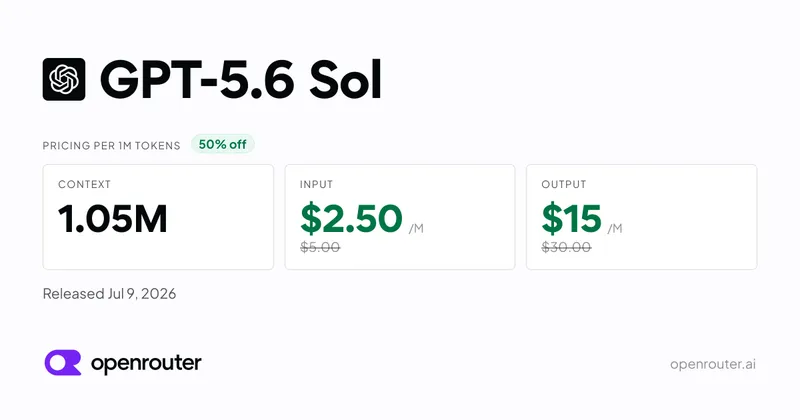
GPT-5.6 Sol is OpenAI’s flagship model in the GPT-5.6 series, released on July 9, 2026. It is positioned for complex reasoning, coding, agentic workflows, command-line work, multi-step coding tasks, and long-horizon problem solving. The model has a 1 million-token context window and a February 2026 knowledge cutoff. OpenRouter lists pricing of $2.50 per million input tokens and $15 per million output tokens, reflecting a 50% discount from listed rates of $5 and $30. Provider listings shown on the platform include input prices from $5 to $5.50 per million tokens, output prices from $30 to $33, and cache pricing from $0.50 to $0.55. OpenRouter says actual customer prices can be lower because of caching and discounts. OpenRouter can route requests for GPT-5.6 Sol among multiple hosting providers through Balanced, Nitro, or Exacto modes, which prioritize price and speed, fastest response, or tool-calling accuracy, respectively. The platform reports a best-provider median latency of 3.07 seconds and a best-across-providers median throughput of 46 tokens per second. It reports 100.00% uptime over the prior three days and 99.76% availability, and says it can reroute requests after upstream-provider errors when request filters permit it. OpenRouter’s OpenAI-compatible API allows many SDKs to use the model by changing the base URL and model slug.
Key Takeaways
- GPT-5.6 Sol is OpenAI’s flagship GPT-5.6 model, released July 9, 2026, with a 1 million-token context window and a February 2026 knowledge cutoff.
- OpenRouter lists discounted pricing of $2.50 per million input tokens and $15 per million output tokens for GPT-5.6 Sol.
- OpenRouter reports 3.07-second median latency at the best provider and 46 tokens per second median throughput across its providers.
- OpenRouter routes GPT-5.6 Sol requests among providers using modes tuned for price and speed, fastest response, or tool-calling accuracy.
What the discussion said
The thread quickly moved beyond the advertised price cut into a practical comparison of Sol 5.6 against Claude/Fable and other coding models. Several heavy users call Sol startlingly capable on difficult technical work: debugging narrow failures, analyzing obfuscated code, reverse engineering, hardware-driver work, and performance-sensitive paths. They value its lower apparent reasoning overhead and see it as a credible reason to leave subscriptions made frustrating by recurring safety restrictions and refusals. A few describe a deliberate division of labor: use Fable for broad problem-solving or project framing, then hand Sol the targeted diagnosis, cleanup, or verification work. But the praise is anything but universal. A substantial group finds Sol worse on ordinary requests, prone to fixating on incidental details and inflating a simple checklist or code change into a large, brittle solution. For them, the model’s persistence reads as poor judgment rather than intelligence, and prompt patterns that work with Claude do not transfer cleanly. Readers also challenged the headline: the reduction appears to be a temporary OpenRouter promotion rather than a native API cut, so its effect on real API budgets is limited. Even so, many welcome aggressive model price competition, while questioning whether discounts reflect sustainable economics, market-share buying, or data-collection incentives.
Where opinion split
The sharpest split is whether Sol 5.6 is a frontier-grade replacement for Claude/Fable or a regression that needs constant babysitting. Supporters point to unusually strong debugging, reverse engineering, and low-level systems work with fewer reasoning tokens; detractors say it turns routine requests into sprawling designs, makes unjustified assumptions, and produces code that takes several corrective turns to tame.
Community Sentiment
Positives
- Sol 5.6 is winning converts with demanding systems work, handling obfuscated code, undocumented drivers, Vulkan experimentation, and targeted debugging that users consider unusually advanced.
- Its shorter apparent reasoning path is seen as a real productivity gain: users report getting capable answers without the token-heavy deliberation they associate with competing models.
- For specific debugging, cleanup, and optimization passes, Sol pairs well with another model’s planning, giving developers a useful specialist rather than a one-model workflow.
- The discount intensifies a welcome price war, pushing high-end AI capability closer to users who previously treated frontier-model access as a premium-only expense.
Concerns
- Sol 5.6 often mistakes diligence for judgment, ballooning simple tasks into elaborate implementations that users must repeatedly steer back toward maintainable code.
- Instruction sets that work smoothly with Claude/Fable can trigger strange assumptions and unwanted actions in Sol, making model switching costly for established AI-assisted workflows.
- The supposed 50% reduction is a short-lived OpenRouter offer rather than a native API price change, so developers should not mistake it for broadly cheaper Sol access.
- High-volume users still describe API consumption as punishingly expensive once subscription limits are exhausted, despite the promotional pricing rhetoric.