Top stories
Story · 1 report
AI isn't replacing SREs, it's deskilling them
AI is automating an increasing share of site reliability engineering work, including alert grouping, runbook execution, log-pattern detection, anomaly flagging, root-cause suggestions, and remediation of known failures such as restarting crashed pods or scaling overloaded services. PagerDuty describes a tiered model in which known incidents are fully automated, partially understood incidents receive AI recommendations subject to human validation, and novel or cascading failures remain human-led. SigNoz argues that this division of work could deskill SREs by removing the repeated hands-on practice that builds incident-response intuition. The argument draws on Lisanne Bainbridge’s 1983 paper, “Ironies of Automation,” which found that automation can leave operators responsible for rare, high-stakes failures while reducing their ability to handle them. The source cites a study in which AI-assisted endoscopists’ unassisted polyp-detection rates fell from 28% to 22%, and says aviation research has linked heavy autopilot use with reduced situational awareness and manual flying ability. The risk extends to junior SREs who may never acquire foundational troubleshooting skills if AI handles routine incidents. SigNoz recommends deliberate human practice on some automatable incidents and systems that keep operators actively engaged alongside AI. It plans to begin with an assistant that keeps humans in control and later add autonomy within guardrails.
newsletter.signoz.io
🔥🔥🔥🔥🔥2 min summary
10/30/2026
Story · 1 report
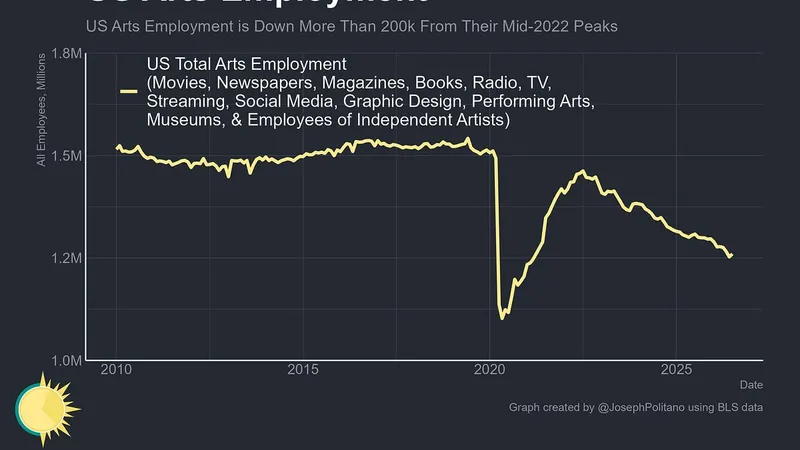
America has lost 200k of jobs in media, film and the arts. How much is AI?
Apricitas links a four-year decline of more than 200,000 U.S. jobs in creative industries, including roughly 50,000 lost in the most recent year, to mounting pressure on digital-media business models as generative AI spreads. The publication says movie and sound recording lost more than 100,000 jobs, nearly one-third of its workforce, while written publishing lost more than 70,000 jobs. It says in-person entertainment continues to grow, contrasting with declines across digital creative sectors, but acknowledges that AI’s role is difficult to separate from consolidation, offshoring, streaming and competition from social platforms. The analysis compares generative AI’s potential effects with the internet’s disruption of music, video and publishing. It argues that piracy and streaming reduced recorded-music revenue and shifted musicians toward concerts and merchandise, while newspapers lost advertising and readership as information moved online. It says Hollywood faces falling ticket and cable revenue alongside competition from free user-generated and AI-generated content, without a live-performance equivalent to offset losses. About 32% of arts, entertainment and recreation workers use generative AI to some extent, according to the publication. Apricitas also notes that book sales rose 70% over the past six years amid BookTok’s influence, underscoring that technology can create unpredictable demand. It argues creative-sector losses could foreshadow broader disruption in tech and other creative-adjacent work.
apricitas.io
🔥🔥🔥🔥🔥2 min summary
10/24/2026
Story · 1 report
AI didn't cause the tech jobs bust, but it explains why there's no recovery
US tech employment has declined even as the wider economy added jobs, with information-sector payrolls falling to 2.739 million in September 2026, 12% below their November 2022 peak. Indeed’s US software-development postings peaked in February 2022, before ChatGPT’s November launch, and had already fallen 36% by then. The data attributes the initial contraction to higher interest rates and the unwinding of pandemic-era hiring. The recovery in hiring has favored senior workers and AI-specific roles rather than restoring broad tech employment. US software-development postings rose 16% from January 2025 to October 2026 while information-sector employment fell 5%. CompTIA counted 349,821 US tech postings requiring AI skills in September 2026, or 56% of active tech postings; Indeed found senior positions accounted for 71% of the rebound in software-development postings from May 2025 to May 2026. AI-skilled roles carried an estimated 56% wage premium. Job losses have increasingly occurred through attrition rather than mass layoffs. The US layoffs rate was 1.0% in August 2026, while the hires rate was 3.3%. Similar shifts toward AI and experienced hires appear in India and China. Youth unemployment was 14.5% for US workers aged 16–19, 19.0% for urban Indians aged 15–29, and 18.9% for urban Chinese workers aged 16–24 excluding students.
vithushansylvester.com
🔥🔥🔥🔥🔥2 min summary
10/25/2026
Story · 1 report
Product Managers aren't safe either
A programmer who worked on data-marketing products and later joined Cloudflare through its acquisition of YC company Zaraz argues that generative AI threatens a far broader range of jobs than software development. He says routine “code spitter” work is especially vulnerable as highly capable developers use AI to produce software faster, while AI agents and eventually coordinated agent systems could further displace developers. He distinguishes software architecture from routine implementation, arguing that architecture still requires private organizational data, interpersonal work, and trade-offs among security, compliance, technical capability, and budgets. He compares generative AI’s effect on developers with smartphone photography’s effect on professional photographers: in his view, it erodes the advantage held by most practitioners while increasing the value of a smaller group with difficult-to-copy expertise. He also argues that product managers face similar pressure because developers can use LLMs to prototype or build features and spend more time understanding customer problems, company context, assumptions, and design trade-offs. He expects technical and product roles to increasingly merge into one function, and says product managers should develop durable technical skills, particularly architecture and practical programming, such as text-file analysis in concise code.
lucaskostka.com
🔥🔥🔥🔥🔥1 min summary
10/30/2026


No more articles to load