
The End of Programming
Bun 1.4 includes a rewrite of Bun from Zig to Rust, adding more than 1 million lines of Rust code. Bun creator Jarred Sumner reportedly used a pre-release model called Fable 5, an agent framework that could work in parallel, and an effectively unlimited token budget to complete the initial translation in 11 days. The effort generated 6,778 commits and would have cost about $165,000 at API pricing, according to the account. Agents then continued refining the code for months before the supported release, which Paul Dix says is running on millions of developer machines. Dix argues that AI agents will increasingly write, test and improve software while people specify requirements, build verification systems and assess end results rather than review every line of code. He reports using Fable to build unshipped InfluxDB prototypes: an Iceberg integration in 14 hours and an edge-data replication system in 28 hours, followed by testing and bug fixes. Dix says neither project is production-ready or supported, but both reached end-to-end working implementations. Dix predicts that cheaper, faster frontier models and larger token budgets could make this workflow widely accessible by the end of the following year. He expects organizational inertia to preserve manual programming and code review at many companies, while more productive teams rely on AI-directed software factories and automated verification.
pauldix.com
10 min
8/26/2026
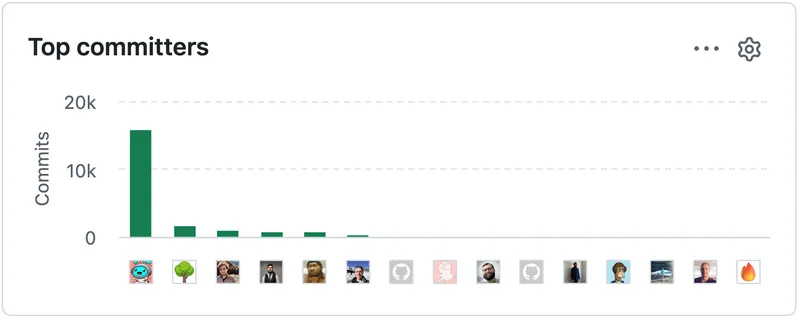
Bun 1.4 Rust rewrite is not looking good
Bun’s planned 1.4 release, which includes a rewrite from Zig to Rust, remained unreleased three months after the prior stable version, its longest release gap since Bun launched in 2022. Public posts from Bun creator Jarred Sumner set and then missed several expected release dates, including July 7, a Tuesday, Monday, and “tomorrow.” Sumner said on August 15 that Bun 1.4 was compiling and on August 17 that it was delayed until Monday. The rewrite has generated substantial AI-assisted development activity. Over the preceding month, the source text reports 15,800 commits from robobun, 1,600 from autofix-ci[bot], and 790 from Sumner. Bun also had more than 5,000 open pull requests, compared with 2,200 for OpenClaw and 441 for React; GitHub recommends keeping fewer than 1,000 open pull requests against a single branch to avoid mergeability-check timeouts. The source text characterizes Bun 1.4 as a test of AI agents maintaining a production codebase under human direction. Zig creator Andrew Kelley said he and others were “increasingly horrified” by programming practices in Bun’s codebase, citing hacks, assertions, and code quality concerns. The source text argues that numerous Rust unsafe blocks call into question whether the rewrite achieved its stated memory-safety rationale, while framing the project as a prominent demonstration of Anthropic’s Claude coding capabilities.
tipiirai.com
4 min
8/19/2026
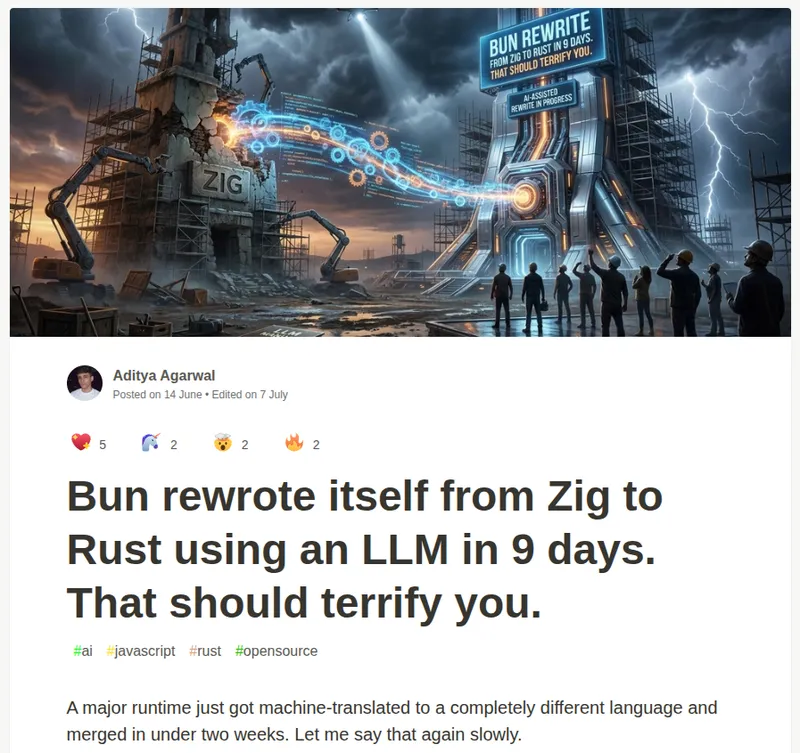

Bun has been converted to rust. Now what?
Bun has transitioned to Rust with over a million lines of code and 6,755 commits, primarily generated by Claude Code agents in nine days. The previous Zig implementation has been removed following Anthropic's acquisition of Bun in December.
bytecode.news
8 min
6/3/2026


The End of Programming
Bun 1.4 includes a rewrite of Bun from Zig to Rust, adding more than 1 million lines of Rust code. Bun creator Jarred Sumner reportedly used a pre-release model called Fable 5, an agent framework that could work in parallel, and an effectively unlimited token budget to complete the initial translation in 11 days. The effort generated 6,778 commits and would have cost about $165,000 at API pricing, according to the account. Agents then continued refining the code for months before the supported release, which Paul Dix says is running on millions of developer machines. Dix argues that AI agents will increasingly write, test and improve software while people specify requirements, build verification systems and assess end results rather than review every line of code. He reports using Fable to build unshipped InfluxDB prototypes: an Iceberg integration in 14 hours and an edge-data replication system in 28 hours, followed by testing and bug fixes. Dix says neither project is production-ready or supported, but both reached end-to-end working implementations. Dix predicts that cheaper, faster frontier models and larger token budgets could make this workflow widely accessible by the end of the following year. He expects organizational inertia to preserve manual programming and code review at many companies, while more productive teams rely on AI-directed software factories and automated verification.
pauldix.com
10 min
8/26/2026
How is the Bun Rewrite in Rust going?
Bun is undergoing a rewrite in Rust, which aims to leverage AI capabilities for the work typically done by open-source maintainers. Anthropic's AI tools, including a C compiler, are contributing to this rewrite process.
lockwood.dev
5 min
7/27/2026
Bun has been converted to rust. Now what?
Bun has transitioned to Rust with over a million lines of code and 6,755 commits, primarily generated by Claude Code agents in nine days. The previous Zig implementation has been removed following Anthropic's acquisition of Bun in December.
bytecode.news
8 min
6/3/2026
Bun 1.4 Rust rewrite is not looking good
Bun’s planned 1.4 release, which includes a rewrite from Zig to Rust, remained unreleased three months after the prior stable version, its longest release gap since Bun launched in 2022. Public posts from Bun creator Jarred Sumner set and then missed several expected release dates, including July 7, a Tuesday, Monday, and “tomorrow.” Sumner said on August 15 that Bun 1.4 was compiling and on August 17 that it was delayed until Monday. The rewrite has generated substantial AI-assisted development activity. Over the preceding month, the source text reports 15,800 commits from robobun, 1,600 from autofix-ci[bot], and 790 from Sumner. Bun also had more than 5,000 open pull requests, compared with 2,200 for OpenClaw and 441 for React; GitHub recommends keeping fewer than 1,000 open pull requests against a single branch to avoid mergeability-check timeouts. The source text characterizes Bun 1.4 as a test of AI agents maintaining a production codebase under human direction. Zig creator Andrew Kelley said he and others were “increasingly horrified” by programming practices in Bun’s codebase, citing hacks, assertions, and code quality concerns. The source text argues that numerous Rust unsafe blocks call into question whether the rewrite achieved its stated memory-safety rationale, while framing the project as a prominent demonstration of Anthropic’s Claude coding capabilities.
tipiirai.com
4 min
8/19/2026
My thoughts on the Bun Rust rewrite
Bun is being rewritten in Rust to improve performance and maintainability. Jarred's early involvement in the Zig community showcased his experimental approach to problem-solving, contributing to his growth as an engineer.
andrewkelley.me
8 min
7/9/2026
The End of Programming
Bun 1.4 includes a rewrite of Bun from Zig to Rust, adding more than 1 million lines of Rust code. Bun creator Jarred Sumner reportedly used a pre-release model called Fable 5, an agent framework that could work in parallel, and an effectively unlimited token budget to complete the initial translation in 11 days. The effort generated 6,778 commits and would have cost about $165,000 at API pricing, according to the account. Agents then continued refining the code for months before the supported release, which Paul Dix says is running on millions of developer machines. Dix argues that AI agents will increasingly write, test and improve software while people specify requirements, build verification systems and assess end results rather than review every line of code. He reports using Fable to build unshipped InfluxDB prototypes: an Iceberg integration in 14 hours and an edge-data replication system in 28 hours, followed by testing and bug fixes. Dix says neither project is production-ready or supported, but both reached end-to-end working implementations. Dix predicts that cheaper, faster frontier models and larger token budgets could make this workflow widely accessible by the end of the following year. He expects organizational inertia to preserve manual programming and code review at many companies, while more productive teams rely on AI-directed software factories and automated verification.
pauldix.com
10 min
8/26/2026
My thoughts on the Bun Rust rewrite
Bun is being rewritten in Rust to improve performance and maintainability. Jarred's early involvement in the Zig community showcased his experimental approach to problem-solving, contributing to his growth as an engineer.
andrewkelley.me
8 min
7/9/2026
Bun 1.4 Rust rewrite is not looking good
Bun’s planned 1.4 release, which includes a rewrite from Zig to Rust, remained unreleased three months after the prior stable version, its longest release gap since Bun launched in 2022. Public posts from Bun creator Jarred Sumner set and then missed several expected release dates, including July 7, a Tuesday, Monday, and “tomorrow.” Sumner said on August 15 that Bun 1.4 was compiling and on August 17 that it was delayed until Monday. The rewrite has generated substantial AI-assisted development activity. Over the preceding month, the source text reports 15,800 commits from robobun, 1,600 from autofix-ci[bot], and 790 from Sumner. Bun also had more than 5,000 open pull requests, compared with 2,200 for OpenClaw and 441 for React; GitHub recommends keeping fewer than 1,000 open pull requests against a single branch to avoid mergeability-check timeouts. The source text characterizes Bun 1.4 as a test of AI agents maintaining a production codebase under human direction. Zig creator Andrew Kelley said he and others were “increasingly horrified” by programming practices in Bun’s codebase, citing hacks, assertions, and code quality concerns. The source text argues that numerous Rust unsafe blocks call into question whether the rewrite achieved its stated memory-safety rationale, while framing the project as a prominent demonstration of Anthropic’s Claude coding capabilities.
tipiirai.com
4 min
8/19/2026
Bun has been converted to rust. Now what?
Bun has transitioned to Rust with over a million lines of code and 6,755 commits, primarily generated by Claude Code agents in nine days. The previous Zig implementation has been removed following Anthropic's acquisition of Bun in December.
bytecode.news
8 min
6/3/2026
How is the Bun Rewrite in Rust going?
Bun is undergoing a rewrite in Rust, which aims to leverage AI capabilities for the work typically done by open-source maintainers. Anthropic's AI tools, including a C compiler, are contributing to this rewrite process.
lockwood.dev
5 min
7/27/2026
No more articles to load