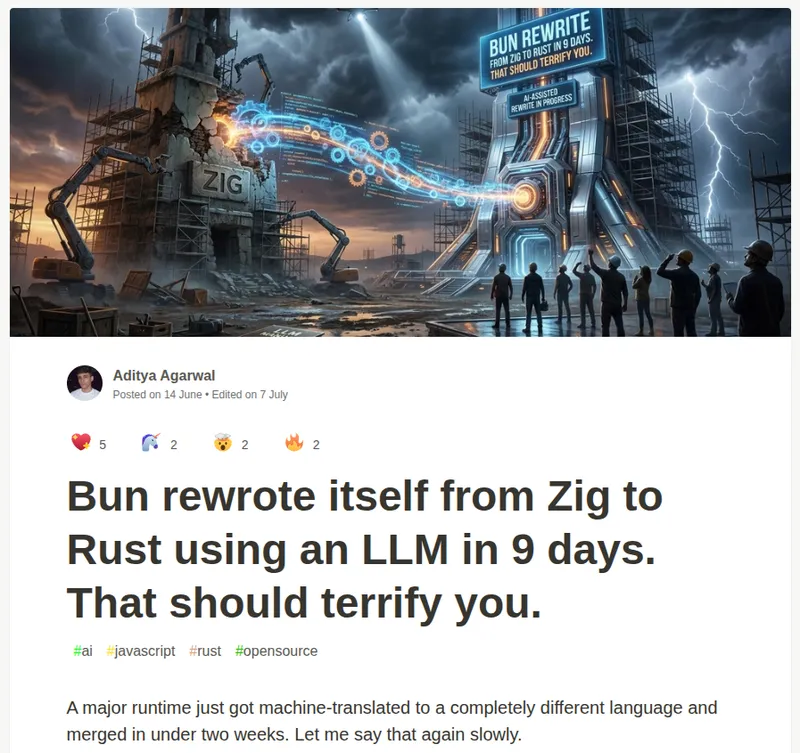
Bun 1.4 Rust rewrite is not looking good
tipiirai.com
August 19, 2026
4 min read
56/100
Summary
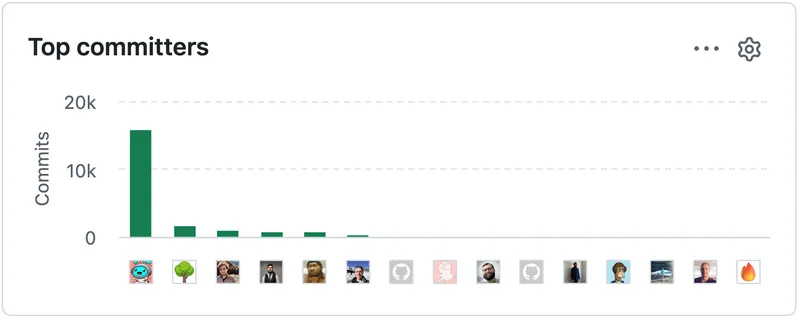
Bun’s planned 1.4 release, which includes a rewrite from Zig to Rust, remained unreleased three months after the prior stable version, its longest release gap since Bun launched in 2022. Public posts from Bun creator Jarred Sumner set and then missed several expected release dates, including July 7, a Tuesday, Monday, and “tomorrow.” Sumner said on August 15 that Bun 1.4 was compiling and on August 17 that it was delayed until Monday. The rewrite has generated substantial AI-assisted development activity. Over the preceding month, the source text reports 15,800 commits from robobun, 1,600 from autofix-ci[bot], and 790 from Sumner. Bun also had more than 5,000 open pull requests, compared with 2,200 for OpenClaw and 441 for React; GitHub recommends keeping fewer than 1,000 open pull requests against a single branch to avoid mergeability-check timeouts. The source text characterizes Bun 1.4 as a test of AI agents maintaining a production codebase under human direction. Zig creator Andrew Kelley said he and others were “increasingly horrified” by programming practices in Bun’s codebase, citing hacks, assertions, and code quality concerns. The source text argues that numerous Rust unsafe blocks call into question whether the rewrite achieved its stated memory-safety rationale, while framing the project as a prominent demonstration of Anthropic’s Claude coding capabilities.
Key Takeaways
- Bun 1.4’s Rust rewrite remained unreleased three months after Bun’s previous stable release despite multiple public release-date estimates from creator Jarred Sumner.
- The source text reports that robobun made 15,800 commits in the prior month, compared with 1,600 from autofix-ci[bot] and 790 from Jarred Sumner.
- Bun had more than 5,000 open pull requests; GitHub recommends remaining below 1,000 open pull requests against a single branch to prevent mergeability checks from timing out.
- Zig creator Andrew Kelley criticized Bun’s codebase practices, while the source text argues that Rust unsafe blocks weaken the claimed memory-safety case for the rewrite.
What the discussion said
The thread’s AI-relevant argument is not really about whether Rust beats Zig; it is about whether an AI-assisted rewrite can be trusted when the project has gone quiet before the promised release. Several commenters refuse to infer failure from missed dates, open pull requests, or rhetoric about generated code alone. They want a clean comparison between the existing release and 1.4: reproducible regressions, performance changes, correctness failures, or evidence that the generated code resists maintenance. One commenter points to an external deployment report where the rewrite performed better than the prior stable version under a real workload, suggesting the code may already deliver concrete operational value. Skeptics focus on the longer-term bill. Frontier models can produce plausible code quickly, but commenters doubt they reliably preserve modularity, readable intent, curated tests, and the architectural discipline needed after the initial migration. The concern is not merely that AI code could contain bugs today; it is that repeated model-driven patches could compound into an opaque system whose fixes trigger endless regressions. Others say current frontier-model output is generally usable with human review, but the discussion treats that as a cautious practice rather than proof that this rewrite is healthy. Some also want token spending disclosed, since AI-driven development shifts part of the engineering cost into continuing inference expense.
Where opinion split
Can AI-assisted code generation sustain a major runtime rewrite, rather than just make its first version compile? Optimists argue that human-reviewed frontier-model code is already dependable enough and point to a real deployment that found the rewrite better than its stable predecessor. Skeptics argue that without reproducible 1.4 results, maintainability evidence, and clarity on ongoing token costs, passing tests says little about whether the codebase will remain understandable or repairable.
Community Sentiment
Positives
- A production-oriented evaluation reportedly found the Rust rewrite more reliable than the stable release it replaced, suggesting the migration may already produce real workload-level gains.
- Several readers see frontier-model code as broadly trustworthy when humans review it, making AI a practical accelerator rather than an unsupervised author.
- Bun’s native image tooling has already removed costly native-package rebuilds for some users, showing why preserving its developer-facing capabilities matters through the rewrite.
Concerns
- The missing release and lack of reproducible 1.3-versus-1.4 evidence leave commenters unable to tell whether AI-assisted changes improved the runtime or merely expanded uncertainty.
- Commenters fear model-generated patches will accumulate into opaque spaghetti: tests may pass now while future feature work becomes a regression-heavy whack-a-mole exercise.
- The rewrite’s token budget and recurring AI costs remain unaccounted for, obscuring whether its apparent engineering speed is economically sustainable.