Report · vithushansylvester.com
AI didn't cause the tech jobs bust, but it explains why there's no recovery
vithushansylvester.com
Source published October 25, 2026
Summary: 2 min read
49/100
Summary
US tech employment has declined even as the wider economy added jobs, with information-sector payrolls falling to 2.739 million in September 2026, 12% below their November 2022 peak. Indeed’s US software-development postings peaked in February 2022, before ChatGPT’s November launch, and had already fallen 36% by then. The data attributes the initial contraction to higher interest rates and the unwinding of pandemic-era hiring. The recovery in hiring has favored senior workers and AI-specific roles rather than restoring broad tech employment. US software-development postings rose 16% from January 2025 to October 2026 while information-sector employment fell 5%. CompTIA counted 349,821 US tech postings requiring AI skills in September 2026, or 56% of active tech postings; Indeed found senior positions accounted for 71% of the rebound in software-development postings from May 2025 to May 2026. AI-skilled roles carried an estimated 56% wage premium. Job losses have increasingly occurred through attrition rather than mass layoffs. The US layoffs rate was 1.0% in August 2026, while the hires rate was 3.3%. Similar shifts toward AI and experienced hires appear in India and China. Youth unemployment was 14.5% for US workers aged 16–19, 19.0% for urban Indians aged 15–29, and 18.9% for urban Chinese workers aged 16–24 excluding students.
Key Takeaways
- US software-development job postings peaked in February 2022, and the Federal Reserve first raised rates in that cycle on 16 March 2022; postings had fallen 36% by ChatGPT’s November 2022 launch.
- US information-sector employment reached 2.739 million in September 2026, 12% below its November 2022 peak, while the overall economy added about 4.8 million jobs over four years.
- CompTIA counted 349,821 US tech postings requiring AI skills in September 2026, representing 56% of all active tech postings.
- Indeed found that senior roles accounted for 71% of the increase in US software-development postings between May 2025 and May 2026, while roles requiring AI skills accounted for 37% of the increase.
- US tech employment losses have increasingly occurred through attrition: the layoffs rate was 1.0% in August 2026, and announced tech layoffs through 10 September were about half the 2023 total.
- Youth unemployment was three to four times the overall rate in the United States, India and China in 2026, alongside stronger demand for senior AI workers than entry-level workers.
What the discussion said
The thread mostly pushed back on a clean story in which AI alone explains a frozen tech labor market. Several commenters noted that software postings are recovering, even if the rebound remains too weak to replace the jobs lost, and argued that the familiar COVID hiring surge followed by overcorrection fits the data at least as well. Apple’s comparatively restrained pandemic hiring was offered as a pointed example: it avoided the layoff cycle precisely because it did not inflate payroll first. The sharper AI argument was not that coding roles have already been wholesale automated away, but that AI has redirected corporate budgets. Cash-rich firms can spend billions on GPUs and datacenters instead of expanding engineering teams, making AI infrastructure a competitor for hiring even before models directly replace workers. Others challenged the evidence for assigning layoffs to AI, since corporate layoff explanations are self-serving and higher interest rates or management failures can produce the same headcount cuts. Freelance data added another wrinkle: AI appears in many job descriptions, yet only a small fraction of projects are genuinely AI-centered, suggesting buzzword pressure rather than broad displacement. A few readers also found the article’s prose conspicuously AI-like, undermining confidence in its presentation. Overall, commenters treated AI as an important capital-allocation force, but not a proven single-cause explanation for the jobs slump.
Where opinion split
The central dispute is whether AI is genuinely sustaining tech layoffs or merely serving as a convenient explanation for a post-pandemic correction. The AI case is that companies are diverting money from engineers to GPU fleets and can therefore operate with leaner staffs; the opposing case is that overhiring, rates, and poor executive decisions explain the contraction, while AI rhetoric makes those choices easier to sell.
Coverage & discussions
Hacker News · vithushansylvester.com
Community discussions
Community Sentiment
Positives
- Software-job postings are climbing again, and the existence of substantial non-AI contract demand weakens the claim that coding work has simply vanished.
- AI may be transforming tech investment into datacenters and compute capacity, a concrete industrial shift rather than a vague claim that every engineer has already been automated away.
- Only a small slice of AI-labeled freelance listings are actually AI projects, suggesting ordinary development work still has meaningful market demand beneath the buzzword layer.
Concerns
- Companies may be pouring capital into GPUs and datacenters instead of hiring engineers, leaving workers squeezed even when tech revenues recover.
- Attributing layoffs to AI rests heavily on corporate narratives that may conceal pandemic overhiring, high-rate pressure, and executive mismanagement.
- The article’s AI-sounding prose drew skepticism, with readers seeing synthetic-style writing as a credibility and communication problem.
Related Articles

AI has torched the market for junior programmers
Jul 4, 2026

Tech jobs are getting demolished in ways not seen since 2008
Mar 7, 2026

2026 tech layoffs reach 45,000 in March
Mar 14, 2026

The Philippines' big offshoring industry is growing despite AI
Aug 10, 2026
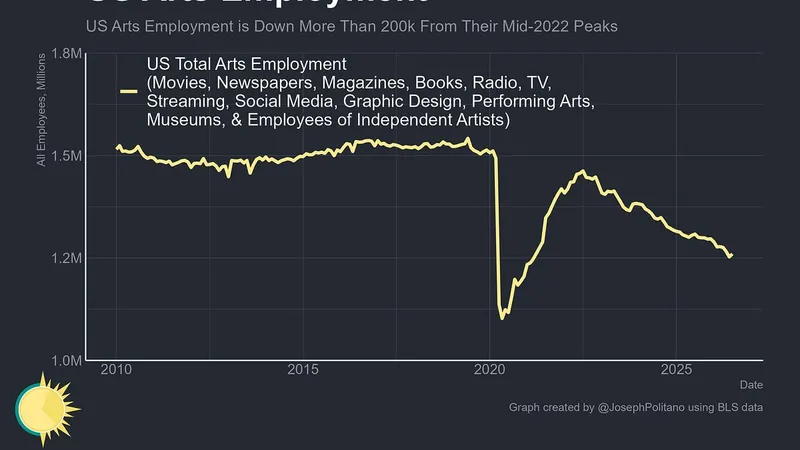
America has lost 200k of jobs in media, film and the arts. How much is AI?
Oct 24, 2026