Report · dailycal.org
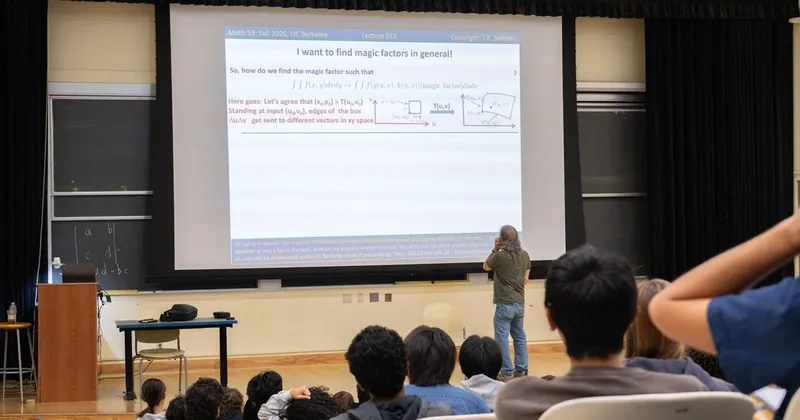
AI use leads UC Berkeley math professor to see 'no point' in grading homework
dailycal.org
Source published October 25, 2026
Summary: 2 min read
59/100
Summary
UC Berkeley mathematics professor and Fields Medalist Richard Borcherds has stopped grading homework for correctness after seeing students use AI to consistently earn top scores. He now gives credit for completion when students submit assignments, calling the arrangement “not a very good system” but saying he has no alternative while AI use is unavoidable. Borcherds said there was no point in paying readers to assess homework correctness under those conditions. In an interview following OpenAI’s announcement that AI agents had apparently solved the Navier-Stokes existence and smoothness problem, Borcherds said that, if AI improves at its current rate, it could soon outperform human mathematicians in every task. He said he no longer knows whether to encourage students to enter mathematics and that even ChatGPT did not offer him a clear prediction about the profession’s future. He expects academic inertia could leave math departments largely unchanged for several years despite AI advances. UC Berkeley asks faculty to include course expectations for AI use in syllabi, but individual instructors set class policies. The campus has tested AI-detection tools including Turnitin and Rumi, but has concluded they are not reliable enough for campuswide standardization. Berkeley’s AI Hub provides faculty with sample syllabus statements and guidance on AI tools and policies.
Key Takeaways
- Richard Borcherds, a UC Berkeley professor and Fields Medalist, now grades student homework on completion rather than correctness because he considers AI use unavoidable.
- Borcherds said continued AI improvement could leave human mathematicians unable to perform any task better than AI within a few years.
- UC Berkeley leaves classroom AI policies to faculty while asking instructors to state AI expectations in their course syllabi.
- UC Berkeley tested Turnitin and Rumi but determined that AI-detection tools were not adequate for campuswide standardization.
What the discussion said
Commenters mostly treated the professor’s remark as an assessment-design problem, not proof that mathematics education has become pointless. The broad view is that take-home work can no longer carry meaningful credit when a model can generate polished solutions on demand. But many insisted homework still matters because struggling through problems exposes false understanding, builds habits, and gives instructors a chance to correct reasoning before a high-stakes exam. The proposed fix was blunt: make homework low- or zero-stakes, retain feedback and completion requirements, then certify mastery through supervised written or oral exams. Several readers warned that this shift will punish procrastinators who rely on graded assignments to force steady work, while others replied that college students should own that responsibility. There was also optimism that the same systems that make untrusted submissions easy can become unusually capable tutors: an independent learner can get immediate, detailed critique of a proof instead of waiting for scarce human help. That promise came with practical doubts about whether AI can reliably interpret messy handwritten mathematics and assess rigorous proofs. A smaller but sharper thread challenged the article’s larger fatalism: AI solving homework does not establish that studying math, or universities themselves, has lost its purpose.
Where opinion split
The sharp dispute is whether AI makes ordinary homework obsolete or merely forces schools to stop using it as a credential. One side argues generated answers erase the evidence that a student did the work, so supervised exams and vivas must replace graded take-home assignments. The other argues homework remains essential practice and feedback; remove its grade weight, not the learning activity, because students still need repeated contact with the material to succeed.
Coverage & discussions
Hacker News · dailycal.org
Community discussions
Community Sentiment
Positives
- AI could turn math self-study into a far more accessible apprenticeship, offering instant critique of attempted proofs that previously required a postdoc or tutor.
- Separating practice from certification lets AI-assisted homework remain useful for learning while in-person exams verify what a student can actually do.
- Always-available AI feedback could give anxious students enough support to attempt harder mathematics courses rather than avoiding them.
Concerns
- Generative models make a polished take-home solution nearly worthless as evidence of mathematical understanding, collapsing the case for homework points.
- When AI removes the small daily pressure to practice, students prone to postponement may discover too late that they cannot perform under exam conditions.
- The claim that AI can grade rigorous mathematics at expert level is still operationally shaky when student work is handwritten, nonlinear, and full of diagrammatic reasoning.
- Treating AI’s homework competence as evidence that nobody should study math confuses automating answers with replacing human understanding and education.
Related Articles

Failing grades soar with AI usage, dwindling math skills in Berkeley CS classes
Jun 4, 2026

Instead of banning AI, I made a classroom contract with my students
Jul 3, 2026
AI is scoring college essays and conducting interviews, a new layer in admissions stress
Jan 21, 2026

AI boosted homework scores, then exam scores dropped: Study
Aug 21, 2026
Professor's invisible prompt trap catches 32/35 students cheating with AI
Jul 27, 2026