Report · cerebras.ai
Cerebras Deploys Trillion-Parameter AI Models
cerebras.ai
Source published October 25, 2026
Summary: 1 min read
64/100
Summary
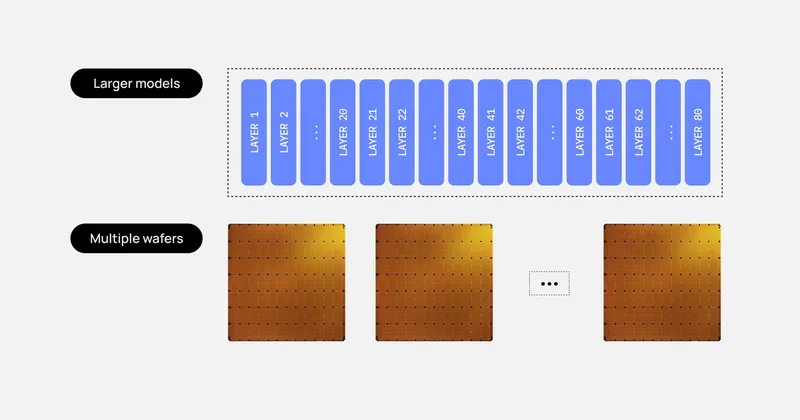
Cerebras says it can deploy multi-trillion-parameter AI models by distributing their layers across WSE-3T wafer-scale chips and connecting the chips as an inference pipeline. Each WSE-3T wafer contains 44 GB of on-chip SRAM, while a trillion-parameter model requires terabytes of weight storage. Cerebras says this layout can run multi-trillion-parameter models at 1,000 to more than 2,000 tokens per second. Using the open-source Kimi K3 model as an example, Cerebras maps its roughly 3 trillion parameters, 69 linear-attention layers, and 24 dense layers across 59 wafers. With 4-bit weight quantization, each layer occupies about 16 GB. Dense layers are assigned one per wafer because the remaining memory is used for the key-value cache; two linear-attention layers fit on a wafer because they use fixed-size per-request state rather than a context-length-dependent KV cache. Activations, rather than model weights, move between wafers through RDMA over Ethernet at roughly two microseconds per hop. Multiple requests remain in flight simultaneously through pipeline stages, and each stage can process a micro-batch. Cerebras says smaller micro-batches reduce individual-request latency, while larger ones raise throughput. Available KV-cache memory on dense-layer wafers limits concurrency for 256,000-token average requests using an 8-bit KV cache.
Key Takeaways
- Cerebras maps Kimi K3, an approximately 3-trillion-parameter model, across 59 WSE-3T wafers under a configuration using 4-bit weights and an 8-bit KV cache.
- Each WSE-3T wafer has 44 GB of on-chip SRAM, allowing Cerebras to keep model layers and their weights on individual wafers in most cases.
- Dense attention layers require KV-cache space and occupy one wafer each, while two linear-attention layers can fit on a wafer because their request state is fixed in size.
- Cerebras pipelines requests across wafers, passing activations through RDMA over Ethernet while different stages process different requests concurrently.
- Cerebras says its multi-wafer deployment can run multi-trillion-parameter models at 1,000 to more than 2,000 tokens per second.
What the discussion said
The thread mostly bypassed the headline’s trillion-parameter bravado and dug into what Cerebras’s wafer-scale design actually buys. Commenters described a spatially mapped inference pipeline: weights stay put across a two-dimensional mesh while activations move between neighboring processing elements. That structure can split tensors along different dimensions, carry out reductions and broadcasts locally, and avoid making requests wait together in a conventional batch. Several readers saw the result as potentially consequential: if capable models can reason, call tools, and iterate at radically lower latency, the experience could cross a practical threshold even without becoming anything mystical. The discussion was not uncritical. Readers questioned whether 44 GB of on-wafer SRAM is small for such a physically large device, then clarified that this is cache-like memory whose density is fundamentally expensive; substantially larger SRAM capacities remain difficult. Energy use also drew a cautious assessment: roughly 4.1 joules per token for the quoted configuration seems respectable at this model scale, but it still implies a megawatt-class installation. The sharpest unresolved concern was operational resilience. Unlike a distributed GPU cluster that can tolerate and replace a failed node, a long wafer pipeline may make each wafer a rack-wide dependency, complicating failure handling and rolling upgrades.
Where opinion split
The core dispute is whether Cerebras’s pipeline is a qualitatively distinct inference advantage or principally a specialized way to realize parallelism. Supporters argue that physically placing model layers across the wafer keeps weights stationary and lets independent requests stream continuously, avoiding GPU-style batch waiting. Skeptics concede a centrally organized GPU could emulate parts of it, but question whether the latency benefit survives the operational cost of a tightly coupled, failure-sensitive 59-wafer pipeline.
Coverage & discussions
Hacker News · cerebras.ai
Community discussions
Community Sentiment
Positives
- The spatial wafer pipeline keeps weights resident while activations flow locally, making continuous multi-request inference feel less like a queue of GPU batches and more like an assembly line.
- Splitting tensor dimensions across a two-dimensional mesh gives each core simple neighbor-to-neighbor work, a topology well suited to the broadcasts and reductions transformer inference repeatedly needs.
- Extreme inference speed could turn already useful language models into much more capable agentic systems, because long chains of reasoning and tool use stop being dominated by waiting.
- Around 4.1 joules per token was viewed as a respectable efficiency figure for serving a trillion-parameter-scale model, despite the system’s enormous absolute power draw.
Concerns
- Forty-four gigabytes of on-wafer SRAM looks unexpectedly tight beside a wafer-sized processor, underscoring how costly dense fast memory remains for giant-model inference.
- A roughly 1.18-megawatt deployment is efficient only in relative terms; frontier-scale serving still demands power infrastructure on the order of many GPU racks.
- A model spread across a 59-wafer live pipeline may have a harsher failure domain than a GPU fleet: one bad wafer could interrupt the whole model rather than merely reduce capacity.
- The claims invite skepticism because GPU systems can in principle simulate deep pipeline behavior, leaving open whether Cerebras’s advantage is architectural magic or an expensive specialization.
Related Articles
Smaller, faster, safer: running Kimi and GLM at scale
Aug 3, 2026
Running a One Trillion-Parameter LLM Locally on AMD Ryzen AI Max+ Cluster
Mar 1, 2026

Cerebras CS-4
Aug 19, 2026
Real-time LLM Inference on Standard GPUs: 3k tokens/s per request
May 29, 2026
Self-hosting Kimi K3: 20% more hardware cost, 20% better task resolution
Jul 29, 2026